
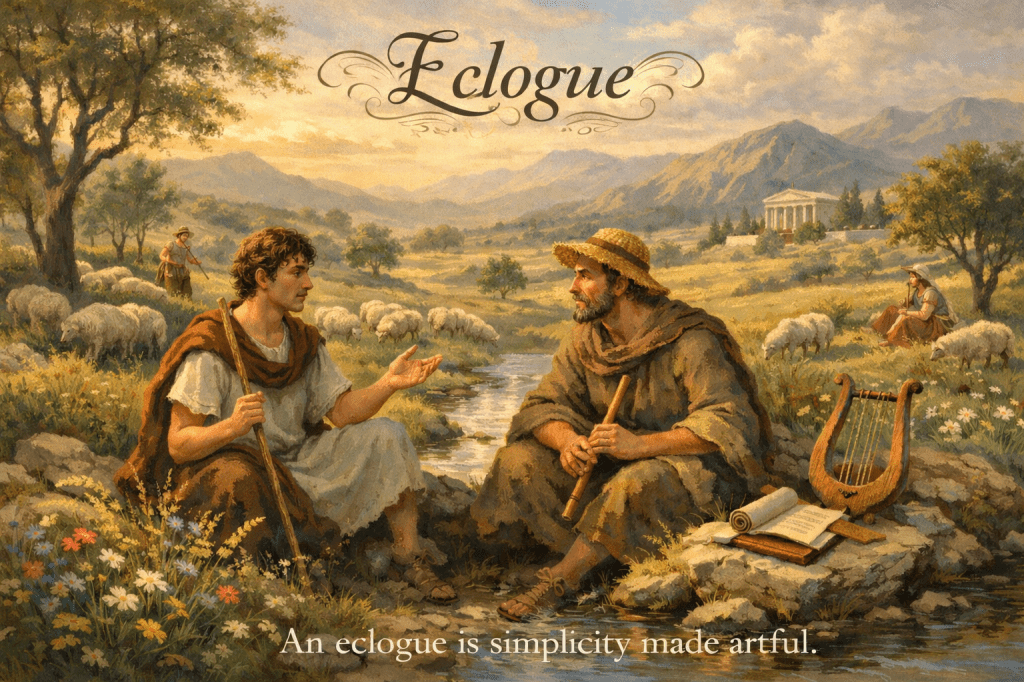
Eclogue
IPA Pronunciation: /ˈɛk.lɒɡ/ (British) • /ˈɛk.loʊɡ/ (American)
Part of Speech: Noun
Origin
Eclogue belongs to the vocabularies of poetry, pastoral literature, and classical studies. It refers to a short pastoral poem, often written as a dialogue, depicting rural life, shepherds, landscapes, and reflections on nature, love, or song.
The form is most closely associated with the ancient Greek poet Theocritus and later perfected in Latin by Virgil, whose pastoral poems established the genre as a literary ideal of stylized simplicity and reflective nature.
An eclogue is simplicity made artful.
Etymology
From Greek: eklogē — selection, chosen piece
From ek- — out + legein — to gather, choose
Originally meaning a “selected poem,” the word evolved to denote a specific poetic form associated with pastoral themes.
Core Definitions
Pastoral Poem
A short poem depicting rural life or shepherd scenes.
“He composed an eclogue about spring.”
Dialogic Verse
A poetic exchange between rustic speakers.
“The eclogue unfolds as a conversation.”
Literary Form
A stylized poetic mode idealizing nature.
“The collection contains twelve eclogues.”
Explanation & Nuance
An eclogue does not simply describe rural life; it reimagines it. The countryside in an eclogue is often:
Harmonious
Idealized
Musical
Timeless
Reflective
Rather than realism, the genre emphasizes mood and tone. Shepherds speak like philosophers, landscapes echo emotion, and nature becomes a stage for thought.
An eclogue is rural life translated into lyric form.
Formal Characteristics
Typical features include:
Pastoral setting — fields, groves, hills
Rustic speakers — shepherds or herdsmen
Dialogue — conversational structure
Song contests — poetic rivalry
Themes — love, loss, politics, art, nature
Though simple in surface imagery, eclogues often contain sophisticated allegory or political commentary.
Literary Significance
Eclogues shaped the pastoral tradition that influenced centuries of poetry.
They established:
Nature as poetic ideal
Rural life as philosophical space
Song as symbolic expression
Landscape as emotional mirror
Many later poets used the form to comment indirectly on contemporary events, disguising critique within pastoral calm.
Examples in Context
Literary:
“The poet’s first book is a series of eclogues.”
Descriptive:
“The scene reads like an eclogue.”
Academic:
“The eclogue tradition spans millennia.”
Creative:
“He framed the dialogue as an eclogue.”
Metaphorical:
“The valley became an eclogue at sunset.”
Symbolic Dimensions
Pasture — harmony between human and land
Flute Song — art arising from simplicity
Dialogue — thought shared aloud
Green World — refuge from conflict
Stillness — time slowed into reflection
Eclogue symbolizes peace imagined through language.
Synonyms & Near-Relations
Pastoral — broader genre
Idyll — idealized rustic scene
Georgic — agricultural poem
Lyric — short expressive poem
Bucolic — rural-themed work
(Only eclogue specifically denotes a short pastoral poem, often dialogic.)
Conceptual Relations
Idealization — shaping reality into harmony
Nature — setting as meaning
Allegory — hidden significance
Tradition — inherited literary form
Voice — poetry as speech
Cultural & Intellectual Resonance
Classical Literature
A foundational form linking Greek and Roman poetic traditions.
Renaissance Poetry
Revived as a model of classical imitation.
Literary Theory
Studied as an example of genre shaping perception of nature.
Philosophy of Art
Illustrates how simplicity can be deliberately constructed.
Takeaway
Eclogue names the poem that turns pasture into philosophy —
a chosen scene where nature speaks in human voice.
It reminds us that landscapes can be composed,
that simplicity can be stylized,
and that quiet places often hold the deepest songs.
An eclogue is not merely a rural poem.
It is a clearing in language,
where thought sits beside a stream
and speaks softly enough
for the world to listen.
Where pasture becomes philosophy and simplicity becomes song.
 Word of the Day - The English Nook
Leave a comment