
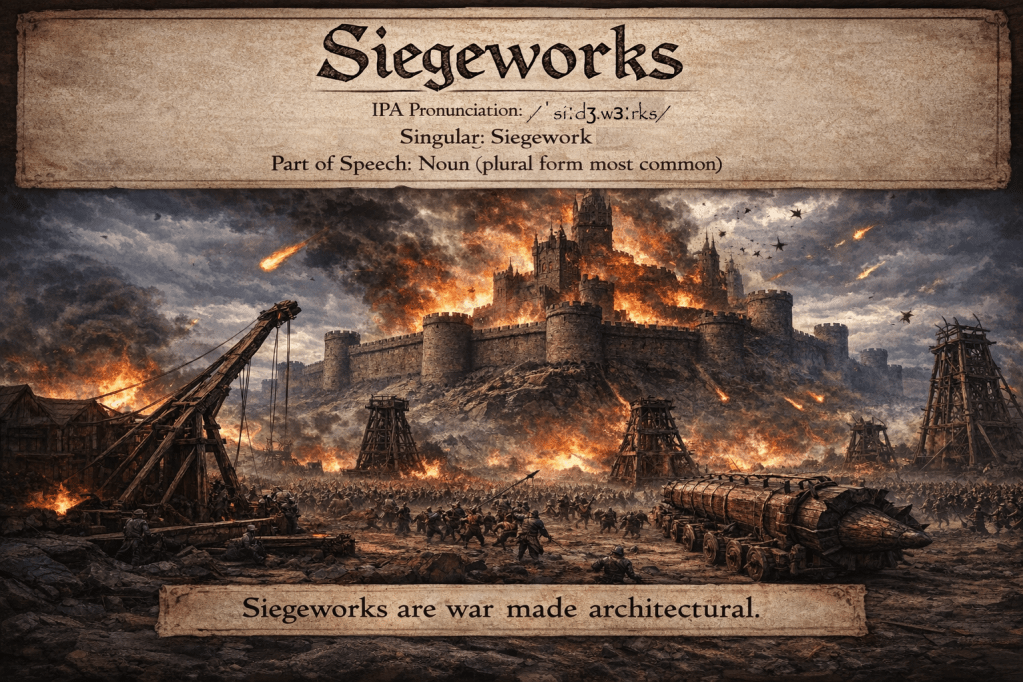
Siegeworks
IPA Pronunciation: /ˈsiːdʒ.wɜːrks/
Singular: Siegework /ˈsiːdʒ.wɜːrk/
Part of Speech: Noun (plural form most common)
Origin
Siegeworks belongs to the vocabularies of military history, fortification engineering, and medieval warfare. It refers to the structures, earthworks, and mechanical constructions built by an attacking force to besiege and capture a fortified place.
Armies laying siege to cities or castles often surrounded them with siegeworks — temporary landscapes of trenches, ramps, towers, and barriers designed to breach defenses or prevent escape.
Siegeworks are war made architectural.
Etymology
From Middle English: sege — siege, attack
- werkes — works, constructions
Literally: works of a siege.
The word preserves the sense of warfare as construction rather than destruction.
Core Definitions
Military Engineering Structures
Temporary fortifications built by attackers during a siege.
“The army completed its siegeworks.”
Encircling Earthworks
Trenches, ramparts, and embankments surrounding a target.
“The siegeworks cut off all exits.”
Assault Infrastructure
Devices and platforms used to approach and breach defenses.
“The siegeworks advanced toward the walls.”
Explanation & Nuance
Siegeworks transform open terrain into engineered battlefield geometry. They are not random constructions but calculated systems designed to:
Approach safely
Neutralize defenses
Control movement
Apply pressure
Common elements include:
Trenches — protected approach paths
Ramparts — defensive embankments
Siege towers — mobile height platforms
Mantlets — movable shields
Mining tunnels — underground breach routes
Siegeworks are landscapes shaped by strategy.
Structural Characteristics
They tend to be:
Temporary
Functional
Layered
Incremental
Directional
Unlike permanent fortifications, siegeworks are built quickly, often from earth, timber, and debris, optimized for speed rather than durability.
They represent engineering under urgency.
Historical Significance
In pre-modern warfare, siegeworks often determined victory more than direct combat.
They allowed armies to:
Avoid heavy casualties
Starve defenders
Control supply routes
Outmaneuver walls
Apply psychological pressure
Many famous sieges were decided not by battle but by construction.
Tactical Role
Siegeworks serve both offensive and defensive purposes for attackers.
They can:
Protect soldiers from arrows and artillery
Create elevated firing positions
Block reinforcements
Prevent sorties
Gradually close distance
They turn patience into weaponry.
Examples in Context
Historical:
“The siegeworks advanced closer each night.”
Descriptive:
“The plain was scarred with siegeworks.”
Strategic:
“The general ordered new siegeworks on the northern flank.”
Narrative:
“They watched the enemy raise siegeworks beyond the moat.”
Metaphorical:
“He built siegeworks around her defenses.”
Symbolic Dimensions
Encirclement — pressure through persistence
Construction — effort directed toward conquest
Patience — slow advance of force
Geometry — order imposed on conflict
Pressure Ring — inevitability tightening
Siegeworks symbolize power applied gradually rather than explosively.
Synonyms & Near-Relations
Earthworks — general term
Siege Lines — encircling fortifications
Approach Trenches — protected paths
Batteries — artillery positions
Fieldworks — temporary defenses
(Only siegeworks specifically denotes the combined system built during a siege.)
Conceptual Relations
Attrition — victory through exhaustion
Encirclement — strategic isolation
Engineering — applied structure
Logistics — sustained pressure
Time — weaponized duration
Cultural & Intellectual Resonance
Military History
Illustrates the importance of engineering over brute force.
Strategy Theory
Demonstrates indirect approaches to victory.
Architecture of War
Shows how conflict reshapes terrain.
Literature
Often used metaphorically for psychological or emotional pressure.
Takeaway
Siegeworks name the structures raised to conquer walls —
forms built not to defend, but to close in.
They remind us that domination is often constructed slowly,
that pressure can be engineered,
and that victory sometimes arrives
not with a charge,
but with a trench.
Siegeworks are the geometry of persistence,
drawn on the earth by intention and time.
Not all victories storm the walls—some are built toward them.
Curious about what happened today in history? Want to learn a new word every day?
You’ll find it all—first and in one place—at The-English-Nook.com!
If you love languages, this is your space.
Enjoy bilingual short stories, fun readings, useful vocabulary, and so much more in both English and Spanish.
Come explore!
 Word of the Day - The English Nook
Leave a comment