
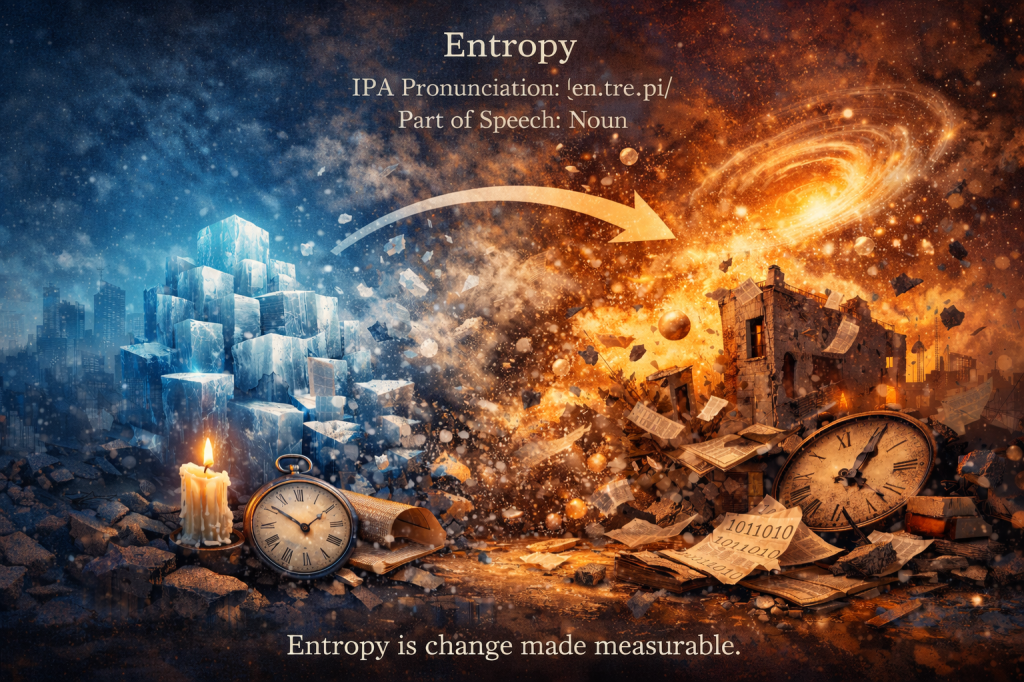
Entropy
IPA Pronunciation: /ˈɛn.trə.pi/
Part of Speech: Noun
Origin
Entropy belongs to the vocabularies of thermodynamics, physics, information theory, and philosophy. It refers to a measurable quantity representing disorder, randomness, or the number of microscopic configurations consistent with a system’s state.
Physicists describe entropy as a directional arrow hidden inside matter — a tendency for organized systems to disperse, equilibrate, and spread energy. It governs why heat flows, why structures decay, and why time appears to move forward.
Entropy is change made measurable.
Etymology
From Greek: en- — within
trope — transformation, turning
Coined in the 19th century to parallel the word energy, preserving the sense of internal transformation.
Core Definitions
Thermodynamic Quantity
A measure of energy dispersal or microscopic disorder.
“The entropy of the closed system increased.”
Direction of Natural Processes
Indicator of irreversibility in physical change.
“Melting ice raises entropy.”
Information Measure
In information theory, a measure of uncertainty or unpredictability.
“The message had high entropy.”
Explanation & Nuance
Entropy describes how many ways a system can be arranged internally without changing its outward appearance.
Low entropy systems are:
Ordered
Structured
Concentrated
Predictable
High entropy systems are:
Dispersed
Random
Diffuse
Statistically probable
A crystal has low entropy.
A gas filling a room has high entropy.
Entropy does not mean chaos alone — it means multiplicity of possible states.
Scientific Significance
In physics, entropy is central to the Second Law of Thermodynamics, which states that in an isolated system:
Entropy tends to increase.
This principle governs:
Heat flow
Chemical reactions
Phase transitions
Cosmic evolution
It explains why:
Hot objects cool
Stars burn out
Structures decay
Time seems directional
Without entropy, physical processes would be reversible and time would lack distinction between past and future.
Mathematical Perspective
Entropy can be expressed quantitatively.
Thermodynamic form relates entropy to heat and temperature.
Statistical mechanics defines it through the number of microscopic arrangements compatible with a system’s macrostate.
Information theory defines it as:
Average uncertainty per symbol.
Thus, entropy links:
Physics
Probability
Information
Time
Everyday Analogies
Ink dispersing in water
A shuffled deck of cards
A messy room
Perfume diffusing through air
All illustrate systems moving from fewer arrangements to more.
Examples in Context
Scientific:
“Entropy increases in irreversible processes.”
Everyday:
“Leaving things alone invites entropy.”
Computational:
“The algorithm reduces entropy in the data.”
Philosophical:
“Civilizations struggle against entropy.”
Metaphorical:
“His plans dissolved into entropy.”
Symbolic Dimensions
Drift — tendency toward dispersion
Fading — loss of structure
Probability — dominance of the most likely state
Time’s Arrow — direction embedded in matter
Dissolution — order relaxing into possibility
Entropy symbolizes inevitability without intention.
Synonyms & Near-Relations
Disorder — general condition
Randomness — unpredictability
Dissipation — spreading of energy
Equilibrium — final state
Decay — structural breakdown
(Only entropy unifies all these under a single measurable principle.)
Conceptual Relations
Irreversibility — one-way processes
Time — directional flow
Probability — statistical likelihood
Energy — transformation capacity
Complexity — structure versus distribution
Cultural & Intellectual Resonance
Physics
Defines the limits of engines, computation, and physical processes.
Philosophy
Used to discuss impermanence and the fate of systems.
Information Science
Measures uncertainty and data compression limits.
Literature & Art
Symbolizes decline, dissolution, or the passage of time.
Takeaway
Entropy names the quiet law governing change —
the tendency of all things to spread, soften, and rearrange.
It reminds us that order is local,
effort is temporary,
and equilibrium is patient.
Entropy is not destruction,
but redistribution.
It is the mathematics of becoming,
the statistic behind time,
the whisper that all structures,
however intricate,
lean gently toward possibility.
Entropy is time’s quiet signature written into matter.
Curious about what happened today in history? Want to learn a new word every day?
You’ll find it all—first and in one place—at The-English-Nook.com!
If you love languages, this is your space.
Enjoy bilingual short stories, fun readings, useful vocabulary, and so much more in both English and Spanish.
Come explore!
 Word of the Day - The English Nook
Leave a comment