
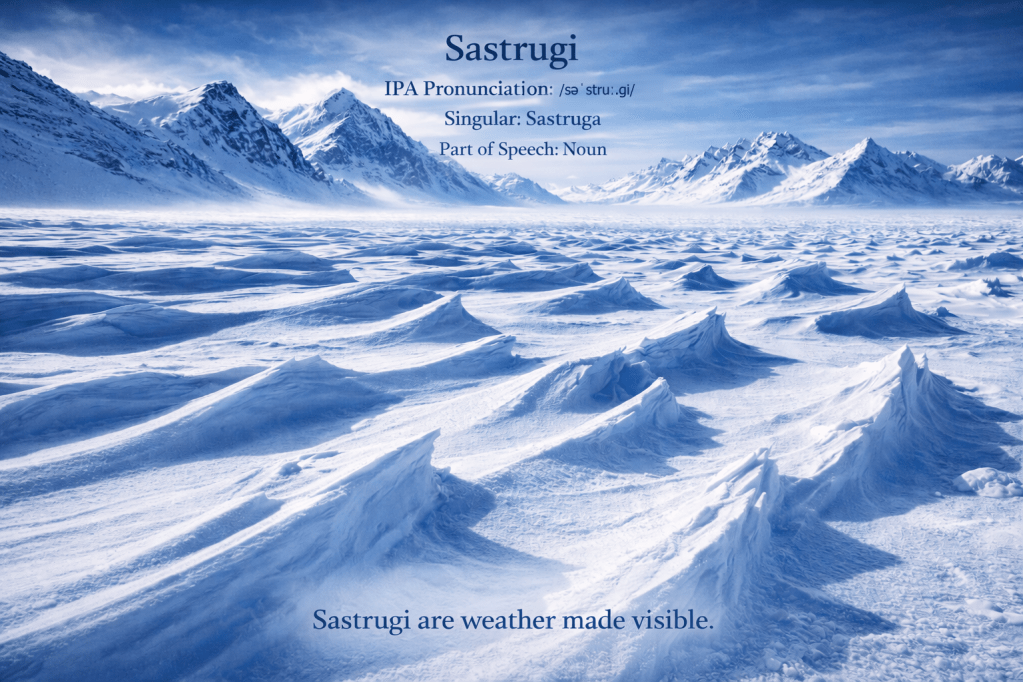
Sastrugi
IPA Pronunciation: /ˈsæs.trʊ.ɡaɪ/ or /səˈstruː.ɡi/
Singular: Sastruga /ˈsæs.trʊ.ɡə/
Part of Speech: Noun (plural form most common)
Origin
Sastrugi belongs to the vocabulary of polar exploration, meteorology, and cryospheric science. It refers to wind-sculpted ridges or grooves formed on snow or ice surfaces, especially in polar and alpine environments.
Explorers crossing Antarctica or Arctic plateaus often encounter sastrugi as natural barriers — frozen waves shaped by persistent winds. These formations can be sharp, hardened, and irregular, making travel difficult and revealing the invisible architecture of air currents.
Sastrugi are weather made visible.
Etymology
From Russian: zastrugi — grooves, ridges cut by wind
Related verb root meaning to plane, shave, or carve
The word preserves the sense of wind as a sculptor.
Core Definitions
Wind-Carved Snow Ridges
Hard, wave-like formations created by strong, steady winds.
“The sled jolted over the sastrugi.”
Frozen Surface Texture
Irregular patterns etched into snowfields.
“The plain was marked by sastrugi.”
Indicator of Wind Direction
Natural formations that record prevailing air currents.
“The sastrugi pointed east.”
Explanation & Nuance
Sastrugi form when wind erodes loose snow and deposits it in aligned ridges. Over time, these ridges harden into crusted formations that may resemble:
- Waves
- Scales
- Knives
- Corrugations
Their characteristics include:
- Sharp edges
- Parallel alignment
- Hardened surfaces
- Directional orientation
They function as a meteorological archive, recording wind behavior in frozen form.
Scientific Significance
In polar science, sastrugi provide valuable data about:
- Prevailing wind patterns
- Snow transport processes
- Surface roughness affecting climate models
- Ice-sheet dynamics
They influence:
- Heat absorption
- Surface reflectivity (albedo)
- Snow accumulation rates
Thus, sastrugi affect both local travel and global climate calculations.
Exploration Context
For polar explorers, sastrugi are both obstacle and guide.
They can:
- Slow sled travel
- Damage equipment
- Indicate wind direction when visibility is low
- Reveal storm history
Many expedition journals describe them as one of the most physically exhausting terrain features.
Examples in Context
Scientific:
“Sastrugi formed after sustained winds.”
Exploratory:
“They dragged the sled across sastrugi.”
Descriptive:
“The ice field glittered with sastrugi.”
Meteorological:
“The sastrugi aligned with prevailing winds.”
Metaphorical:
“His thoughts formed sastrugi.”
Symbolic Dimensions
- Frozen Waves — motion captured in stillness
- Carved Surface — invisible forces made visible
- Ridges — persistence of pressure
- Alignment — order imposed by environment
- Scar — trace of passage
Sastrugi symbolize forces that shape without being seen.
Synonyms & Near-Relations
- Snowdrift — accumulation
- Dune (snow) — shaped mound
- Cornice — overhanging snow formation
- Ripple Mark — patterned surface
- Wind Carving — process description
(Only sastrugi specifically denotes hardened, wind-cut ridges in snowfields.)
Conceptual Relations
- Erosion — shaping by removal
- Ephemerality — forms subject to change
- Landscape Memory — terrain as record
- Half-light — subtle visibility of structure
- Natural Selection — survival under environment
Cultural & Intellectual Resonance
Exploration Literature
Evokes isolation and endurance.
Environmental Science
Evidence of atmospheric interaction with terrain.
Poetics
Used metaphorically for mental or emotional patterning.
Philosophy of Nature
Illustrates unseen forces shaping visible form.
Takeaway
Sastrugi names the patterns carved into snow by wind —
forms that record motion long after the air has passed.
They remind us that forces need not be visible to be powerful,
and that landscapes, like memory, are written by pressures we cannot see.
Sastrugi are the script of the wind,
etched into the earth in a language of ridges and light.
Sastrugi: where the wind signs its name in ice.
Curious about what happened today in history? Want to learn a new word every day?
You’ll find it all—first and in one place—at The-English-Nook.com!
If you love languages, this is your space.
Enjoy bilingual short stories, fun readings, useful vocabulary, and so much more in both English and Spanish.
Come explore!
 Word of the Day - The English Nook
Leave a comment