
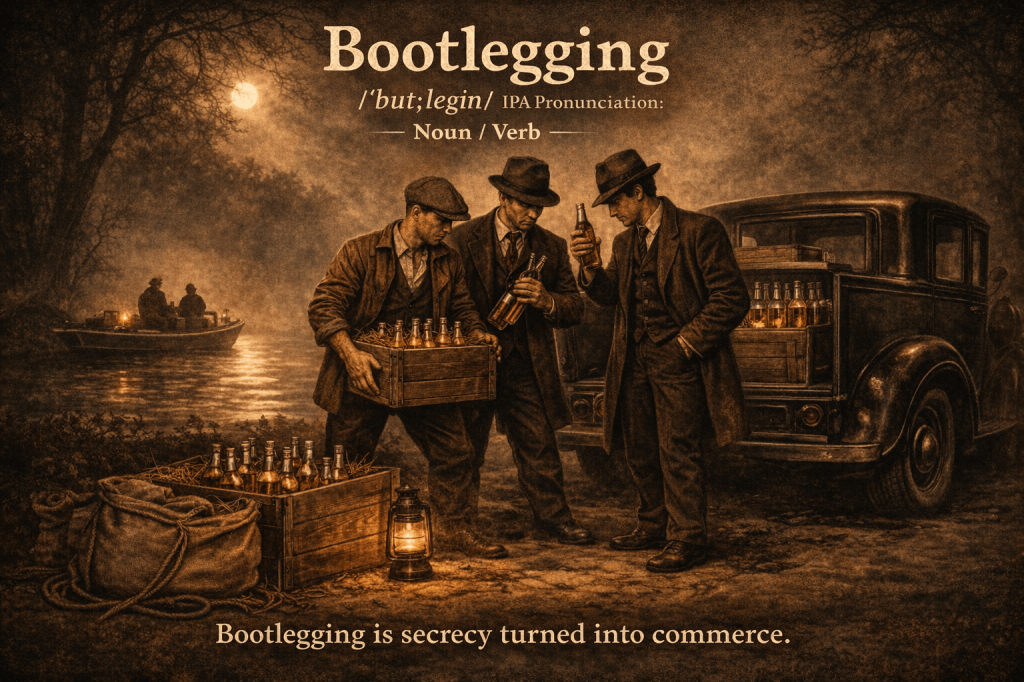
Bootlegging
IPA Pronunciation: /ˈbuːtˌlɛɡɪŋ/
Part of Speech: Noun / Verb (present participle of bootleg)
Origin
Bootlegging originally referred to the illicit smuggling of goods hidden in the legs of tall boots. The term gained widespread prominence in the early 20th century, especially during American alcohol prohibition, when illegal liquor distribution became a vast underground enterprise.
What began as literal concealment evolved into a broader concept: any unauthorized production, transport, or sale of restricted goods.
Bootlegging is secrecy turned into commerce.
Etymology
English: boot + leg
The word evokes concealment in plain sight — contraband carried on the body, hidden yet mobile.
Core Definitions
Illegal Production or Distribution
The unauthorized making or selling of prohibited goods.
“Bootlegging flourished during prohibition.”
Smuggling Activity
Transporting goods secretly to evade law enforcement or taxation.
“He was arrested for bootlegging.”
Unauthorized Reproduction
The illicit copying or distribution of recordings or media.
“Collectors traded bootlegging tapes.”
Explanation & Nuance
Bootlegging differs from ordinary smuggling in tone and cultural resonance.
Its defining qualities include:
- Improvisation
- Evasion
- Informal networks
- Entrepreneurial opportunism
- Defiance of authority
Bootlegging often arises where law conflicts with demand.
When prohibition exists without consensus, bootlegging becomes a parallel economy.
Historical Context
Bootlegging is most strongly associated with the Prohibition era in the United States (1920–1933), when alcohol production and sale were outlawed nationwide.
During this period:
- Illegal distilleries proliferated
- Organized crime syndicates expanded
- Speakeasies operated covertly
- Corruption spread through institutions
Figures such as Al Capone built vast criminal enterprises through bootlegging networks centered in cities like Chicago.
Bootlegging transformed crime into industry.
Economic Dimensions
Bootlegging economies typically share structural traits:
| Feature | Function |
|---|---|
| Scarcity | Creates profit |
| Risk | Raises prices |
| Illegality | Requires secrecy |
| Demand | Sustains networks |
| Violence | Enforces territory |
Illicit markets follow recognizable economic logic — law alters supply chains but rarely eliminates demand.
Cultural & Media Usage
The term expanded beyond alcohol to include:
- Unauthorized concert recordings
- Pirated films
- Counterfeit merchandise
- Illegal digital downloads
Thus, bootlegging now refers broadly to unlicensed reproduction and distribution, even when physical smuggling is absent.
Examples in Context
Historical:
“Bootlegging dominated urban crime.”
Legal:
“He faced charges for bootlegging.”
Cultural:
“Fans collected bootlegging recordings.”
Economic:
“Bootlegging thrived under prohibition.”
Metaphorical:
“The idea spread like bootlegging.”
Symbolic Dimensions
- Hidden Bottle — secrecy and defiance
- Back Door — alternate systems
- Night Delivery — commerce in shadow
- False Label — disguise
- Whisper Network — underground circulation
Bootlegging symbolizes ingenuity under constraint.
Synonyms & Near-Relations
- Smuggling — covert transport
- Trafficking — illicit trade
- Piracy — unauthorized copying
- Black Market — illegal commerce sphere
- Counterfeiting — imitation production
(Only bootlegging carries the historical aura of prohibition-era defiance and improvisation.)
Conceptual Relations
- Outlaw Economy — informal markets
- Vendetta — territorial criminal conflict
- Sovereignty — limits of state control
- Subculture — alternative systems
- Razmatazz — spectacle masking illegality
Cultural & Intellectual Resonance
History
Illustrates unintended consequences of prohibition policies.
Economics
Demonstrates persistence of supply under restriction.
Sociology
Shows how informal systems arise when formal ones fail.
Law
Tests boundaries between authority and compliance.
Narrative
Provides archetypal imagery for crime fiction and film.
Takeaway
Bootlegging names the enterprise that emerges when desire outpaces permission —
a commerce born in secrecy,
sustained by demand,
and shaped by resistance.
It reveals a persistent truth of human systems:
when something is forbidden but wanted,
a hidden marketplace will appear to provide it.
When the law said no, bootlegging said business.
Curious about what happened today in history? Want to learn a new word every day?
You’ll find it all—first and in one place—at The-English-Nook.com!
If you love languages, this is your space.
Enjoy bilingual short stories, fun readings, useful vocabulary, and so much more in both English and Spanish.
Come explore!
 Word of the Day - The English Nook
Leave a comment