
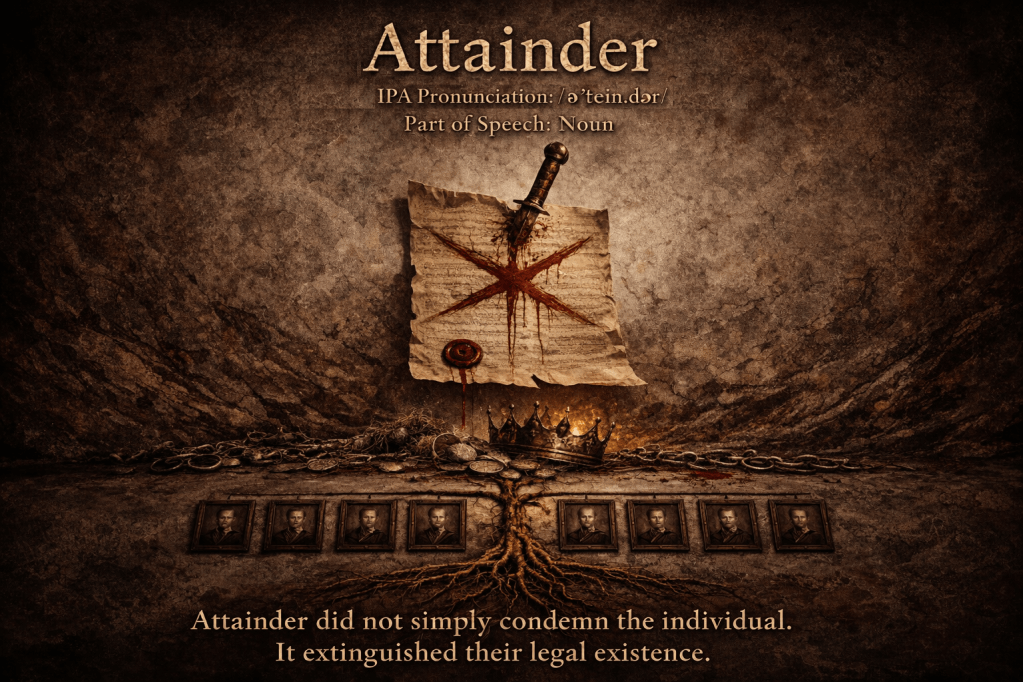
Attainder
IPA Pronunciation: /əˈteɪn.dər/
Plural: Attainders
Part of Speech: Noun
Origin
Attainder belongs to the legal and constitutional vocabulary of medieval and early modern England. It referred to the legal consequences of a conviction for treason or felony, especially the loss of civil rights, property, and hereditary privileges.
Under attainder, a convicted person was considered “civilly dead.” Their bloodline was said to be “corrupted,” meaning heirs could not inherit titles or estates. Thus, attainder functioned not merely as punishment but as a total legal erasure of status and lineage.
Attainder did not simply condemn the individual.
It extinguished their legal existence.
Etymology
From Old French: ataindre — to convict, stain, reach
From Latin: attingere — to touch upon, affect
Root sense: to be struck or tainted by judgment.
Core Definitions
Legal Extinction of Civil Rights
The loss of property, rank, and legal protections following conviction.
“The nobleman suffered attainder.”
Corruption of Blood
A doctrine preventing inheritance from or through the convicted person.
“His family was ruined by attainder.”
Legislative Condemnation
A formal act declaring guilt without judicial trial (historically known as a bill of attainder).
“The monarch issued an attainder.”
Explanation & Nuance
Attainder is not merely punishment; it is legal annihilation.
Its defining elements include:
- Confiscation of property
- Loss of civil status
- Disinheritance of heirs
- Public disgrace
- Erasure from legal continuity
Where ordinary punishment ends with the offender, attainder extends its effects into the future.
Historical Context
Attainders were most prominent in:
- Medieval England
- Tudor political struggles
- Dynastic conflicts
They were often used as instruments of political control, allowing rulers to eliminate rivals without traditional judicial safeguards.
Because of their potential for abuse, later constitutional systems restricted or prohibited them.
Legal Legacy
The phrase “bill of attainder” survives in constitutional law, referring to legislation that punishes a person or group without trial.
Modern democratic legal systems generally prohibit such acts because they violate principles of:
- Due process
- Separation of powers
- Judicial independence
Thus, attainder now serves as a historical example of law used as a tool of domination rather than justice.
Examples in Context
Historical:
“He was executed and placed under attainder.”
Legal:
“The constitution forbids bills of attainder.”
Political:
“The decree resembled attainder.”
Literary:
“The sentence carried the weight of attainder.”
Symbolic:
“His disgrace felt like attainder.”
Symbolic Dimensions
- Stain — judgment as contamination
- Erasure — removal from civic life
- Broken Lineage — severed inheritance
- Seal — authority’s irreversible mark
- Shadow — punishment extending beyond death
Attainder symbolizes power that reaches beyond the individual into time itself.
Synonyms & Near-Relations
- Forfeiture — loss of property
- Disgrace — social condemnation
- Excommunication — spiritual exclusion
- Outlawry — legal exclusion
- Condemnation — formal judgment
(Only attainder combines punishment with hereditary extinction.)
Conceptual Relations
- Sovereignty — ultimate legal authority
- Vendetta — punishment beyond proportion
- State of Exception — suspension of normal law
- Justice — contested ideal
- Legitimacy — authority questioned
Cultural & Intellectual Resonance
Legal History
Illustrates evolution from punitive sovereignty to constitutional restraint.
Political Theory
Demonstrates dangers of concentrated power.
Literature
Used symbolically for total disgrace or erasure.
Ethics
Raises questions about collective punishment.
Historical Memory
Represents the tension between justice and authority.
Takeaway
Attainder names a form of judgment that reaches beyond the crime and beyond the criminal —
a punishment that erases not only a person’s rights, but their continuity.
It reminds us that law can protect or obliterate,
and that when authority claims the power to stain a lineage,
justice risks becoming indistinguishable from domination.
Attainder is the legal form of absolute condemnation —
a verdict that attempts to end not just a life, but its future.
Attainder was not a sentence—it was a legal extinction.
Curious about what happened today in history? Want to learn a new word every day?
You’ll find it all—first and in one place—at The-English-Nook.com!
If you love languages, this is your space.
Enjoy bilingual short stories, fun readings, useful vocabulary, and so much more in both English and Spanish.
Come explore!
 Word of the Day - The English Nook
Leave a comment