
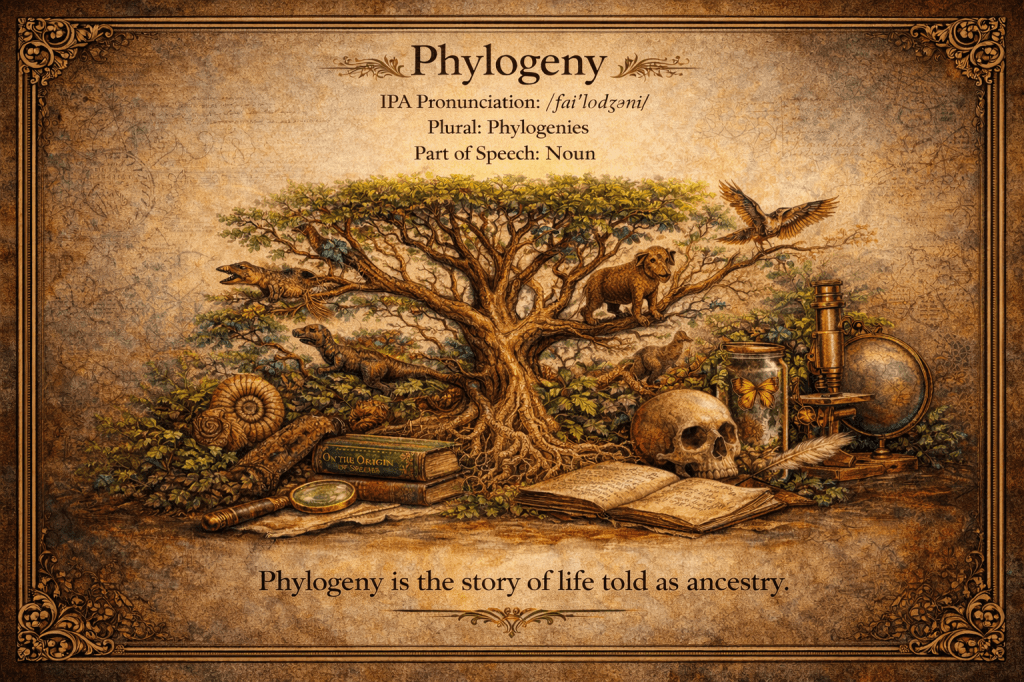
Phylogeny
IPA Pronunciation: /faɪˈlɒdʒəni/
Plural: Phylogenies
Part of Speech: Noun
Origin
Phylogeny belongs to the scientific vocabulary of evolutionary biology and systematics. It refers to the evolutionary history and lineage relationships among organisms, tracing how species diverge from common ancestors across deep time.
The concept arose in the 19th century as scientists began reconstructing life’s branching history using fossils, comparative anatomy, and later genetics. Today, phylogeny is visualized through evolutionary trees, diagrams that map descent and divergence.
Phylogeny is the story of life told as ancestry.
Etymology
From Greek:
- phylon — tribe, race, lineage
- genesis — origin, creation
Literally: “origin of a lineage.”
Core Definitions
Evolutionary Lineage
The historical sequence of descent connecting organisms.
“The phylogeny of whales reveals their land-dwelling ancestors.”
Branching Tree of Life
A diagrammatic model showing evolutionary relationships.
“The phylogeny clarifies species divergence.”
Genetic Relationship Framework
A structure inferred from molecular or morphological data.
“DNA sequencing reshaped primate phylogeny.”
Explanation & Nuance
Phylogeny differs from taxonomy.
- Taxonomy classifies organisms.
- Phylogeny explains their ancestry.
Classification organizes.
Phylogeny narrates.
Modern phylogeny integrates:
- Fossil evidence
- Comparative anatomy
- Embryology
- Molecular genetics
- Bioinformatics
It is not static knowledge but a revisable hypothesis continually refined by new data.
Scientific Significance
Phylogeny is foundational to:
- Evolutionary biology
- Medicine (tracking pathogens)
- Conservation biology
- Linguistics (language family trees)
- Anthropology
Understanding phylogeny reveals:
- Common ancestry
- Adaptive radiation
- Extinction patterns
- Convergent evolution
It answers not just what exists, but how it came to be.
Conceptual Dimensions
Phylogeny operates on multiple scales:
| Scale | Example |
|---|---|
| Gene | Evolution of hemoglobin |
| Species | Relationship among cats |
| Clade | Mammalian ancestry |
| Life | Universal common ancestor |
Each level tells the same story differently:
descent with modification.
Philosophical Resonance
Phylogeny reshaped humanity’s self-understanding.
Before evolutionary theory, species were viewed as fixed.
Phylogeny instead portrays life as:
- Dynamic
- Interconnected
- Historically contingent
It reframes existence as a process rather than a state.
Symbolic Dimensions
Phylogeny often symbolizes:
- Continuity through time
- Interdependence of life
- Hidden ancestry
- Deep history
- Shared origin
The evolutionary tree is a metaphor for both biological and cultural descent.
Examples in Context
Scientific:
“Phylogeny suggests birds evolved from theropod dinosaurs.”
Educational:
“Students reconstructed the phylogeny.”
Comparative:
“The phylogeny clarified relationships.”
Metaphorical:
“The novel traces a family’s phylogeny.”
Related Terms
- Cladistics — method of reconstructing evolutionary relationships
- Clade — group with a common ancestor
- Monophyletic — descended from a single lineage
- Homology — shared ancestry trait
- Phylogenetics — study of evolutionary relationships
Contrasts
- Ontogeny — development of an individual organism
- Genealogy — ancestry of persons
- Typology — classification without historical relation
Intellectual & Cultural Influence
Phylogenetic thinking has influenced:
- Historical linguistics (language trees)
- Cultural anthropology
- Manuscript studies
- Textual criticism
- Comparative mythology
Whenever scholars reconstruct origins through branching descent, they are using phylogenetic logic.
Takeaway
Phylogeny is the architecture of ancestry.
It reveals that life is not a collection of isolated forms but a branching continuum —
every organism a living record of time, mutation, and survival.
To understand phylogeny is to see the present as a moment
in a lineage far older than memory.
Phylogeny doesn’t just classify life—it tells its family story across time.
Curious about what happened today in history? Want to learn a new word every day?
You’ll find it all—first and in one place—at The-English-Nook.com!
If you love languages, this is your space.
Enjoy bilingual short stories, fun readings, useful vocabulary, and so much more in both English and Spanish.
Come explore!
 Word of the Day - The English Nook
Leave a comment