
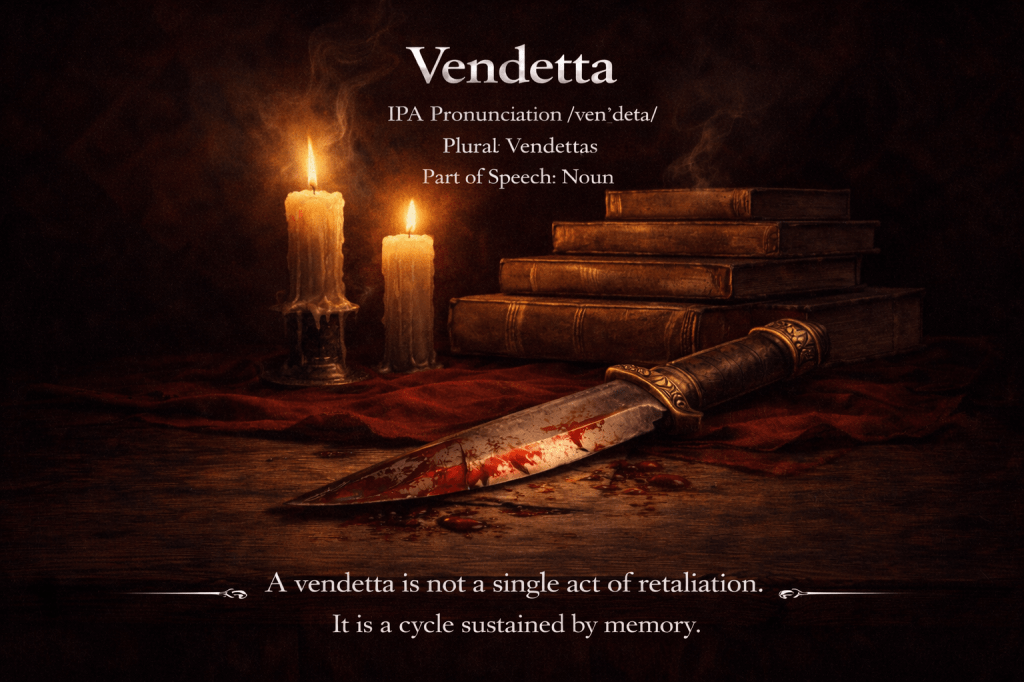
Vendetta
IPA Pronunciation: /vɛnˈdɛtə/
Plural: Vendettas
Part of Speech: Noun
Origin
Vendetta originates in Mediterranean honor cultures, particularly in Corsica and southern Italy, where it referred to a prolonged blood feud between families or clans. These feuds were governed not by formal legal systems but by codes of honor, reciprocity, and obligation.
The term entered English in the 19th century, carrying with it an aura of ritualized retaliation. Over time, its meaning broadened beyond familial blood feuds to signify any sustained campaign of personal revenge.
A vendetta is not a single act of retaliation.
It is a cycle sustained by memory.
Etymology
Italian: vendetta — revenge
From Latin: vindicta — vengeance, claim of justice
The root links vengeance with the assertion of right.
Core Definitions
A Blood Feud
A prolonged retaliatory conflict between families or groups.
“The vendetta lasted generations.”
A Personal Campaign of Revenge
An obsessive pursuit of retribution.
“He pursued a vendetta.”
A Sustained Grievance
An enduring hostility often disproportionate to the initial offense.
“The rivalry turned into a vendetta.”
Explanation & Nuance
Vendetta differs from simple revenge.
Its defining qualities include:
- Duration — extended across time
- Reciprocity — retaliation invites counter-retaliation
- Honor Codes — justice framed as duty
- Inheritance — grievances passed down
- Escalation — conflict expands beyond origin
A vendetta transforms injury into identity.
Historical Context
In traditional Corsican society, vendettas functioned as:
- Informal systems of justice
- Mechanisms of social deterrence
- Reinforcements of family loyalty
However, they also led to cycles of violence that destabilized communities, prompting eventual state intervention.
Vendetta emerges where state law is absent, weak, or distrusted.
Psychological Dimensions
Psychologically, vendetta is sustained by:
- Rumination
- Moral absolutism
- Collective memory
- Shame and pride
- Perceived injustice
It converts grievance into narrative continuity.
In this way, vendetta resembles a moral obsession — an identity organized around retaliation.
Literary & Cultural Resonance
Vendetta appears frequently in:
- Tragedy (family feuds and generational curses)
- Crime fiction
- Political dramas
- Stories of organized crime
- Revenge epics
In literature, vendetta often illustrates the destructive symmetry of retaliation.
Examples in Context
Historical:
“The clan’s vendetta endured.”
Literary:
“The novel centers on a vendetta.”
Political:
“The policy seemed driven by vendetta.”
Personal:
“He carried a private vendetta.”
Critical:
“The feud hardened into vendetta.”
Symbolic Dimensions
- Bloodline — inherited grievance
- Cycle — repetition without closure
- Fire — sustained anger
- Scar — wound that does not heal
- Ledger — wrongs recorded and balanced
Vendetta symbolizes justice unmoderated by mercy.
Synonyms & Near-Relations
- Revenge — singular retaliation
- Feud — ongoing hostility
- Vengeance — moralized retribution
- Grudge — sustained resentment
- Retribution — formal punishment
(Only vendetta carries the weight of generational obligation and cyclical violence.)
Conceptual Relations
- Honor — moral framework
- Outlaw — justice beyond law
- Sovereignty — private enforcement
- Tragedy — inherited conflict
- Moral Reckoning — unresolved justice
Cultural & Intellectual Resonance
Anthropology
Honor cultures and kinship systems.
Literature
The inevitability of retaliation.
Psychology
Obsession and grievance.
Law
Transition from private vengeance to public justice.
Ethics
Justice versus mercy.
Takeaway
Vendetta names revenge extended into structure —
an injury preserved, nurtured, and transmitted.
It reveals how memory can harden into obligation,
and how justice, when privatized and absolutized,
risks perpetuating the harm it seeks to redress.
A vendetta does not merely punish —
it binds the future to the past.
A vendetta doesn’t end a wrong—it recruits the future to avenge the past.
Curious about what happened today in history? Want to learn a new word every day?
You’ll find it all—first and in one place—at The-English-Nook.com!
If you love languages, this is your space.
Enjoy bilingual short stories, fun readings, useful vocabulary, and so much more in both English and Spanish.
Come explore!
 Word of the Day - The English Nook
Leave a comment