
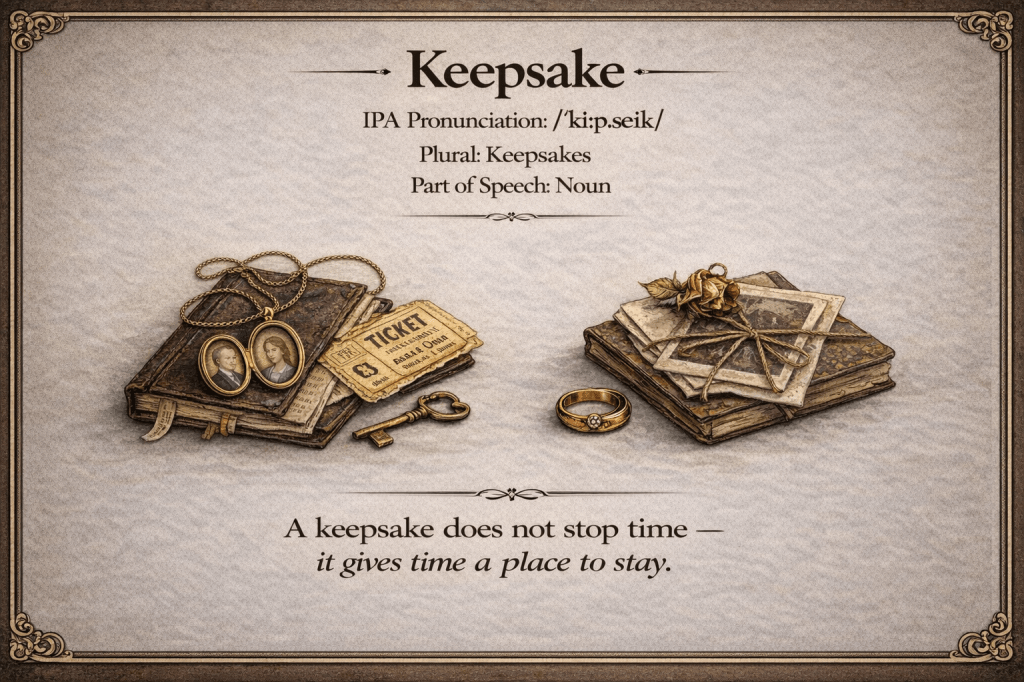
Keepsake
IPA Pronunciation: /ˈkiːp.seɪk/
Plural: Keepsakes
Part of Speech: Noun
Origin
Keepsake arises from domestic and sentimental contexts rather than formal institutions. It names an object kept not for use or value, but for remembrance — a material anchor for memory, affection, or loss.
Unlike heirlooms, which carry lineage and obligation, keepsakes are often modest and private. Their power lies not in rarity or worth, but in association: they hold time, relationship, and emotion within ordinary form.
A keepsake is not important in itself.
It becomes important because someone remembers through it.
Etymology
Middle English: keep — to retain, preserve
Old English: sacan / sake — cause, reason, matter
Literally: something kept for a reason.
Core Definitions
An Object Preserved for Memory
A token retained to recall a person, place, or moment.
“She kept it as a keepsake.”
A Sentimental Memento
An item valued for emotional significance rather than utility.
“The ticket stub became a keepsake.”
A Material Trace of Relationship
A physical reminder of connection or loss.
“The ring was her keepsake.”
Explanation & Nuance
Keepsakes operate at the intersection of materiality and emotion.
Their defining qualities include:
- Attachment — emotional investment
- Durability — survival beyond the moment
- Silence — meaning not publicly declared
- Portability — memory carried in object form
- Fragility — vulnerability to loss or damage
A keepsake does not explain itself; its meaning is stored, not displayed.
Psychological Dimensions
Psychologically, keepsakes function as:
- Memory anchors — stabilizing recollection
- Transitional objects — linking presence and absence
- Grief containers — holding unresolved emotion
- Identity markers — fragments of personal narrative
They allow memory to persist without constant recall.
Cultural & Literary Resonance
In literature and art, keepsakes often signify:
- Love remembered rather than lived
- Loss made tangible
- Time condensed into object
- Private history resisting erasure
Keepsakes frequently appear in moments of parting, death, migration, or return.
Examples in Context
Personal:
“He carried it as a keepsake.”
Literary:
“The keepsake lay untouched in the drawer.”
Psychological:
“The object functioned as a keepsake.”
Cultural:
“Souvenirs become keepsakes over time.”
Symbolic:
“The photograph served as a keepsake.”
Symbolic Dimensions
- Token — presence in absence
- Container — memory held
- Relic — secular remembrance
- Fragment — partial survival
- Trace — what remains
The keepsake symbolizes memory made durable.
Synonyms & Near-Relations
- Memento — reminder emphasis
- Souvenir — place-based memory
- Token — symbolic exchange
- Relic — reverent framing
- Heirloom — inherited continuity
(Only keepsake emphasizes intimacy without obligation.)
Conceptual Relations
- Memory — recollection stabilized
- Elegy — mourning without speech
- Ephemerality — time arrested
- Attachment — emotional bond
- Loss — presence transformed
Cultural & Intellectual Resonance
Psychology
Memory and attachment.
Anthropology
Material culture and remembrance.
Literature
Objects as narrative carriers.
Grief Studies
Continuing bonds.
Everyday Life
Private rituals of keeping.
Takeaway
Keepsake names the quiet practice of holding onto meaning —
not by preservation of the past,
but by allowing memory to reside in matter.
It is a small resistance to erasure,
a way of saying: this mattered,
even when the moment itself has passed.
A keepsake doesn’t hold the past—it gives the past a place to live.
Curious about what happened today in history? Want to learn a new word every day?
You’ll find it all—first and in one place—at The-English-Nook.com!
If you love languages, this is your space.
Enjoy bilingual short stories, fun readings, useful vocabulary, and so much more in both English and Spanish.
Come explore!
 Word of the Day - The English Nook
Leave a comment