
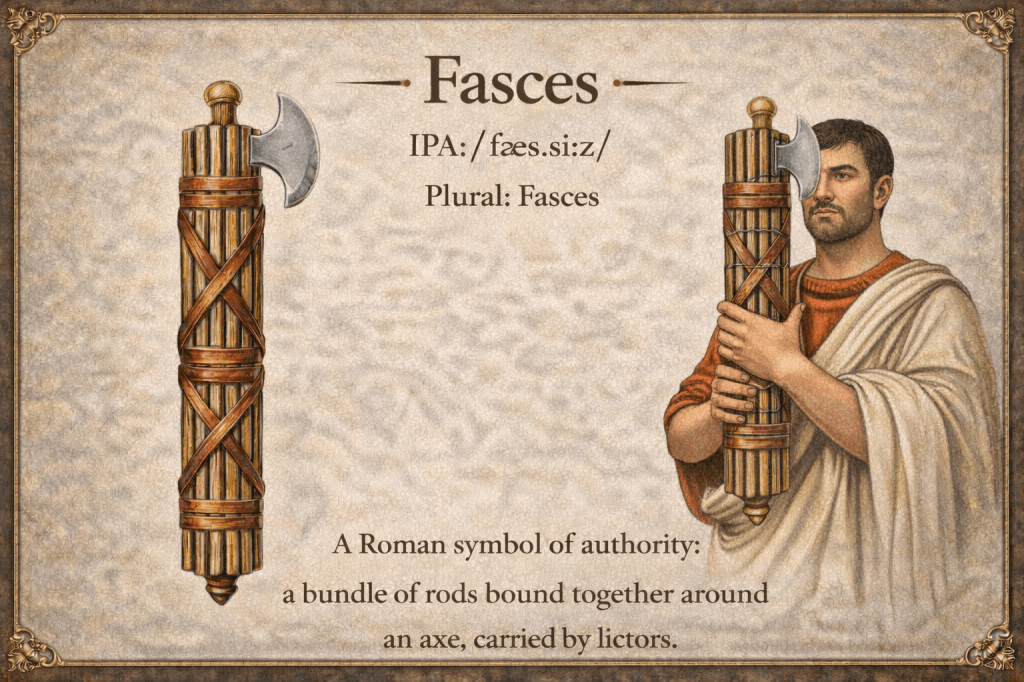
Fasces
IPA Pronunciation: /ˈfæs.siːz/
Plural: Fasces
Part of Speech: Noun (plural form; singular rarely used: fascis)
Origin
Fasces originates in ancient Rome, where it referred to a bundle of wooden rods bound together, often enclosing an axe blade. Carried by lictors who accompanied Roman magistrates, the fasces functioned as a visible emblem of state authority, signaling the magistrate’s power to punish, discipline, and, in extreme cases, execute.
The symbol conveyed a dual message: unity and coercion. The rods represented collective strength — fragile individually, formidable when bound — while the axe signified the ultimate power over life and death.
Fasces did not merely represent power.
They announced its readiness.
Etymology
Latin: fasces — bundle, pack
From fascis — bundle of sticks
The root emphasizes binding as the source of strength.
Core Definitions
A Roman Symbol of Authority
A bundle of rods with an axe, carried by lictors.
“The consul was preceded by fasces.”
An Emblem of Collective Power
Unity enforced through discipline and order.
“The fasces symbolized civic authority.”
A Precursor to Modern Political Symbolism
An ancient image later reappropriated by ideological movements.
“The fasces were revived as political iconography.”
Explanation & Nuance
The fasces expresses power through structure rather than charisma.
Its essential components convey layered meaning:
- Rods — discipline, law, punishment
- Binding Cord — unity through restraint
- Axe Blade — sovereign power over life and death
- Public Display — authority must be seen to function
The fasces embodies authority as visible, collective, and coercive.
Historical Context
Roman Republic & Empire
- Carried by lictors
- Number of fasces indicated rank
- Axe removed within Rome to respect citizens’ rights
This removal underscores the symbol’s sensitivity to jurisdiction and legal limits.
Later Appropriations
Renaissance & Enlightenment
Adopted as a symbol of republican unity and law.
Modern State Iconography
Appears in architecture, seals, and emblems, often stripped of explicit violence.
20th Century Fascism
Reappropriated by Italian Fascism as a central emblem, emphasizing unity, strength, and authoritarian control.
This modern usage profoundly altered the symbol’s connotation, fusing it with totalitarian ideology.
Examples in Context
Historical:
“The magistrate’s lictors bore the fasces.”
Political:
“The symbol evokes centralized authority.”
Architectural:
“Fasces appear carved into the building.”
Critical:
“The image reflects coercive unity.”
Symbolic:
“The fasces binds strength to violence.”
Symbolic Dimensions
- Bundle — unity through binding
- Axe — ultimate sanction
- Visibility — performative power
- Discipline — order enforced
- State Body — collective over individual
The fasces symbolizes order maintained by force.
Synonyms & Near-Relations
- Scepter — royal authority
- Regalia — ceremonial power
- Insignia — official symbol
- Emblem — representational authority
- Standard — collective identity
(Only fasces unites unity, discipline, and sanctioned violence so explicitly.)
Conceptual Relations
- Sovereignty — supreme authority
- State of Exception — power over life
- Law — codified discipline
- Collectivism — unity over individuality
- Authoritarianism — centralized control
Cultural & Intellectual Resonance
Classical Studies
Roman political symbolism.
Political Theory
Visibility of power.
Art History
Authority rendered as object.
Modern History
Symbolic continuity and rupture.
Ethics
Unity versus coercion.
Takeaway
Fasces names an ancient image of power that binds unity to discipline and order to violence.
It reminds us that collective strength is never neutral —
that binding creates force,
and that authority, when made visible, demands obedience.
The fasces endures as a warning as much as a symbol:
unity can empower,
but it can also compel.
Bound together, power looks stronger—and sharper.
Curious about what happened today in history? Want to learn a new word every day?
You’ll find it all—first and in one place—at The-English-Nook.com!
If you love languages, this is your space.
Enjoy bilingual short stories, fun readings, useful vocabulary, and so much more in both English and Spanish.
Come explore!
 Word of the Day - The English Nook
Leave a comment