
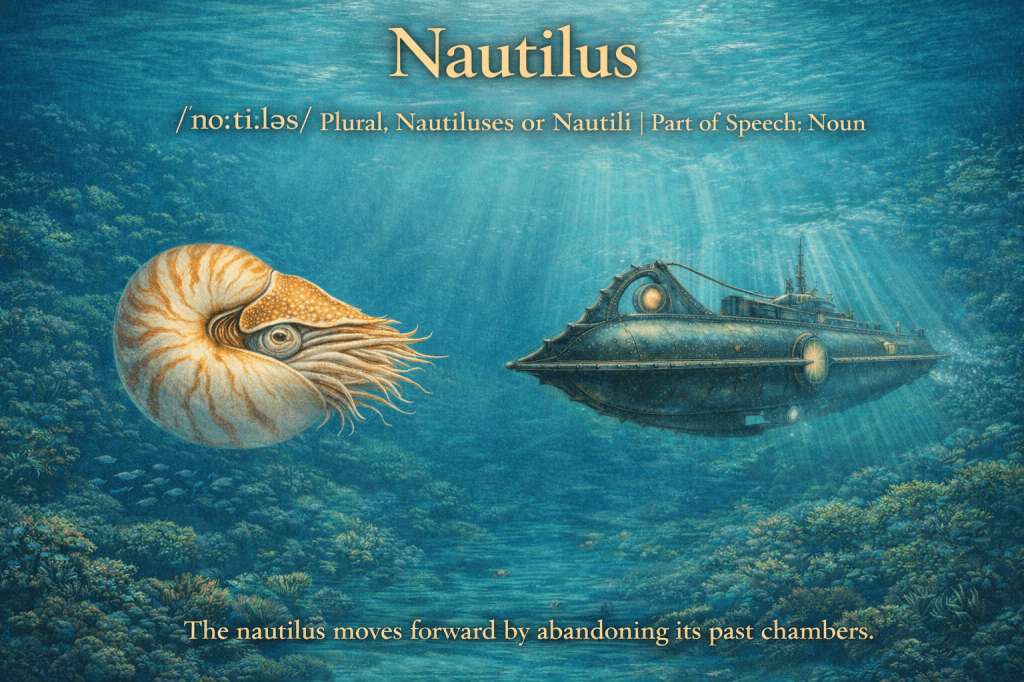
Nautilus
IPA Pronunciation: /ˈnɔː.tɪ.ləs/
Plural: Nautiluses or Nautili
Part of Speech: Noun
Origin
Nautilus names both a living marine organism and a powerful symbol of natural order, recursion, and mystery. Known for its spiral shell divided into chambers, the nautilus has fascinated scientists, artists, and philosophers for centuries as an emblem of growth governed by hidden logic.
Beyond biology, the nautilus entered cultural imagination through poetry, natural philosophy, and fiction — most famously as the name of Captain Nemo’s submarine in Jules Verne’s Twenty Thousand Leagues Under the Sea. In this literary transformation, the nautilus becomes a vessel of isolation, autonomy, and resistance to surface civilization.
The nautilus moves forward by abandoning its past chambers.
Etymology
Greek: nautilos — sailor, mariner
Related to naus — ship
The name imagines the creature as a natural navigator, drifting through depths like a living vessel.
Core Definitions
A Marine Cephalopod
A living fossil with a coiled, chambered shell.
“The nautilus inhabits deep reefs.”
A Spiral Shell Structure
A natural form associated with mathematical proportion and growth.
“The nautilus shell reveals hidden order.”
A Symbol of Evolution and Continuity
An organism unchanged over millions of years.
“The nautilus embodies deep time.”
Explanation & Nuance
The nautilus shell consists of successive chambers, each sealed as the animal grows. The living body occupies only the outermost chamber, regulating buoyancy by adjusting gas and liquid in the previous ones.
This structure gives the nautilus rich metaphorical power:
- Growth through abandonment
- Memory preserved but uninhabited
- Progress without erasure
- Order emerging organically
- Survival through adaptation
The nautilus models a form of becoming that retains structure without clinging.
Scientific & Mathematical Significance
While often mistakenly associated with the “golden ratio,” the nautilus shell nonetheless exemplifies:
- Logarithmic spiral growth
- Recursive natural design
- Efficient spatial expansion
Its form illustrates how complexity can arise from simple, repeated rules.
Literary & Cultural Resonance
Poetry
Oliver Wendell Holmes’s “The Chambered Nautilus” uses the shell as a metaphor for spiritual and intellectual growth.
Fiction
Jules Verne’s Nautilus becomes a self-contained world, embodying technological sovereignty and withdrawal from empire.
Art & Design
The nautilus inspires architecture, ornament, and conceptual design through its balance of function and beauty.
Psychological & Philosophical Dimensions
Symbolically, the nautilus can represent:
- The layered self
- Memory as structure rather than habitation
- Growth through release
- Interior order hidden beneath surface motion
- Solitude without stagnation
It is a figure of self-directed evolution.
Examples in Context
Scientific:
“The nautilus controls buoyancy through its chambers.”
Literary:
“He lived like a nautilus, moving forward through old rooms.”
Philosophical:
“The self expands like a nautilus shell.”
Cultural:
“The submarine was named Nautilus.”
Symbolic:
“The nautilus embodies recursive growth.”
Symbolic Dimensions
- Spiral — continuity without repetition
- Chambers — memory, stages, past selves
- Depth — withdrawal from surface life
- Shell — protection and form
- Navigation — movement without destination
The nautilus symbolizes order discovered, not imposed.
Synonyms & Near-Relations
- Cephalopod — biological category
- Spiral Shell — descriptive
- Living Fossil — evolutionary framing
- Logarithmic Spiral — mathematical analogy
- Submarine (symbolic) — literary extension
(Only nautilus unites biology, mathematics, and metaphor so seamlessly.)
Conceptual Relations
- Deep Time — evolutionary continuity
- Autonomy — self-contained motion
- Utopia — enclosed ideal world
- Interzone — withdrawal from surface order
- Mythopoeia — symbolic elaboration
Cultural & Intellectual Resonance
Natural Philosophy
Nature as ordered growth.
Romanticism
Organic development of the self.
Modern Science
Evolutionary persistence.
Literature
Isolation and resistance.
Design
Form following function.
Takeaway
Nautilus names a form of life and a philosophy of growth —
expansion without rupture,
progress without erasure.
It teaches that development need not destroy its past,
only move beyond it,
carrying memory as structure rather than burden.
The nautilus advances by leaving its chambers intact,
a model of becoming that honors what it outgrows.
It moves forward not by breaking the past—but by outgrowing it.
Curious about what happened today in history? Want to learn a new word every day?
You’ll find it all—first and in one place—at The-English-Nook.com!
If you love languages, this is your space.
Enjoy bilingual short stories, fun readings, useful vocabulary, and so much more in both English and Spanish.
Come explore!
 Word of the Day - The English Nook
Leave a comment