
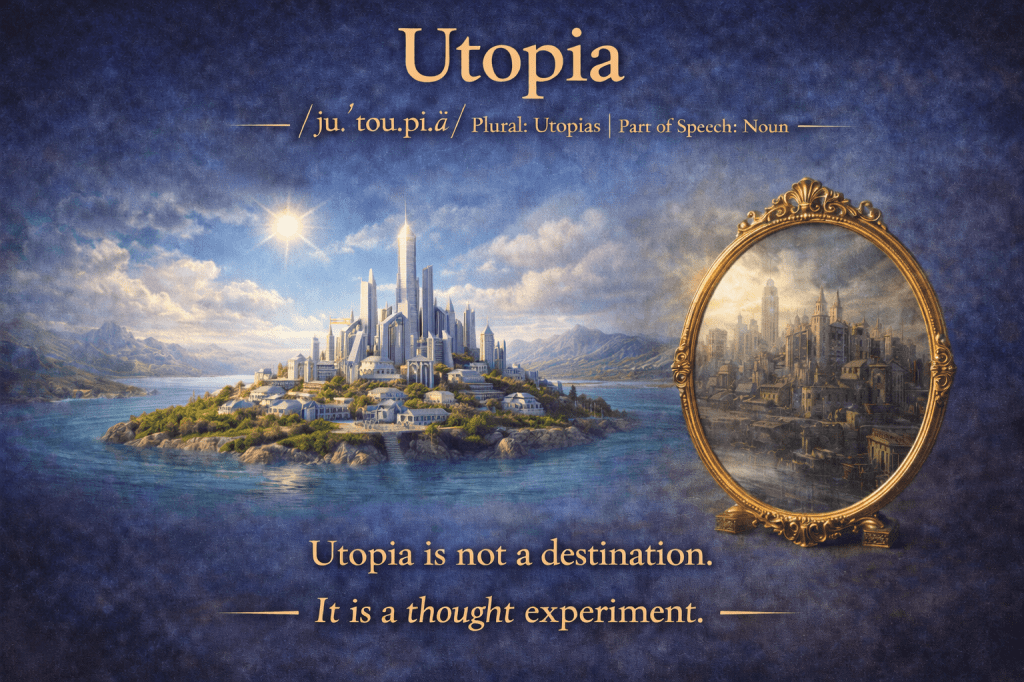
Utopia
IPA Pronunciation: /juːˈtəʊ.pi.ə/
Plural: Utopias
Part of Speech: Noun
Origin
Utopia enters the language through Thomas More’s 1516 work Utopia, a fictional account of an ideal society used to critique the political, religious, and economic conditions of early modern Europe.
From its inception, utopia is deliberately unstable. More constructs the word as a pun: it suggests both ou-topos (“no place”) and eu-topos (“good place”). This doubleness embeds irony at the heart of the concept — utopia is simultaneously desirable and unattainable.
Utopia is not a destination.
It is a thought experiment.
Etymology
Greek:
- ou — not
- topos — place
(Homophonically echoes eu — good)
The word encodes contradiction: the perfect place that does not exist.
Core Definitions
An Ideal or Perfect Society
A vision of social, political, or moral harmony.
“They dreamed of a utopia.”
A Fictional Construct for Critique
An imagined world used to expose flaws in the present.
“The novel presents a utopia.”
An Unrealizable Ideal
A standard that guides aspiration rather than realization.
“It remained a utopia.”
Explanation & Nuance
Utopia functions less as a plan than as a mirror.
Its defining qualities include:
- Idealization — projection of desired values
- Abstraction — simplification of social complexity
- Critique — indirect condemnation of existing systems
- Totality — comprehensive reordering of life
- Risk of Coercion — perfection enforced through control
Utopia reveals as much about the dreamer as about the dreamed world.
Historical & Literary Development
Renaissance
Utopia as rational social design (More).
Enlightenment
Progress and reason as utopian engines.
19th Century
Socialist and communal utopias.
20th Century
Disillusionment and dystopia.
Contemporary Thought
Utopia as horizon rather than blueprint.
Each era reshapes utopia according to its hopes and fears.
Utopia & Power
Utopian visions often require:
- Uniformity
- Surveillance
- Suppression of dissent
- Regulation of desire
Thus, utopia risks becoming dystopia when perfection overrides freedom.
Examples in Context
Literary:
“The novel imagines a fragile utopia.”
Political:
“Revolution promised utopia.”
Cultural:
“The commune pursued utopia.”
Psychological:
“He longed for utopia.”
Critical:
“Utopia exposes social failure.”
Symbolic Dimensions
- The Island — isolation and control
- The Blueprint — total design
- The Garden — cultivated perfection
- The Horizon — unreachable ideal
- The Mirror — critique of the present
Utopia symbolizes desire disciplined by imagination.
Synonyms & Near-Relations
- Ideal Society — descriptive
- Paradise — theological emphasis
- Arcadia — pastoral ideal
- Golden Age — mythic past
- Commonwealth — political framing
(Only utopia preserves the tension between ideal and impossible.)
Conceptual Relations
- Dystopia — inverted utopia
- Pastoral Fantasy — idyllic simplification
- Sovereignty — authority in perfection
- Mythopoeia — world-making
- Teleology — directed history
Cultural & Intellectual Resonance
Political Theory
Ideal governance.
Literature
Speculative critique.
Philosophy
Ethics and perfection.
Religion
Eschatological hope.
Psychology
Projection of desire.
Takeaway
Utopia names the human impulse to imagine a better order —
not to escape reality,
but to judge it.
It is a vision that clarifies values by exaggeration,
a “no place” that shapes real choices,
and a reminder that perfection, once fixed,
often demands obedience.
Utopia endures not because it can be built,
but because it reveals what we cannot stop wanting.
Utopia isn’t a place on the map—it’s a mirror we hold to the world.
Curious about what happened today in history? Want to learn a new word every day?
You’ll find it all—first and in one place—at The-English-Nook.com!
If you love languages, this is your space.
Enjoy bilingual short stories, fun readings, useful vocabulary, and so much more in both English and Spanish.
Come explore!
 Word of the Day - The English Nook
Leave a comment