
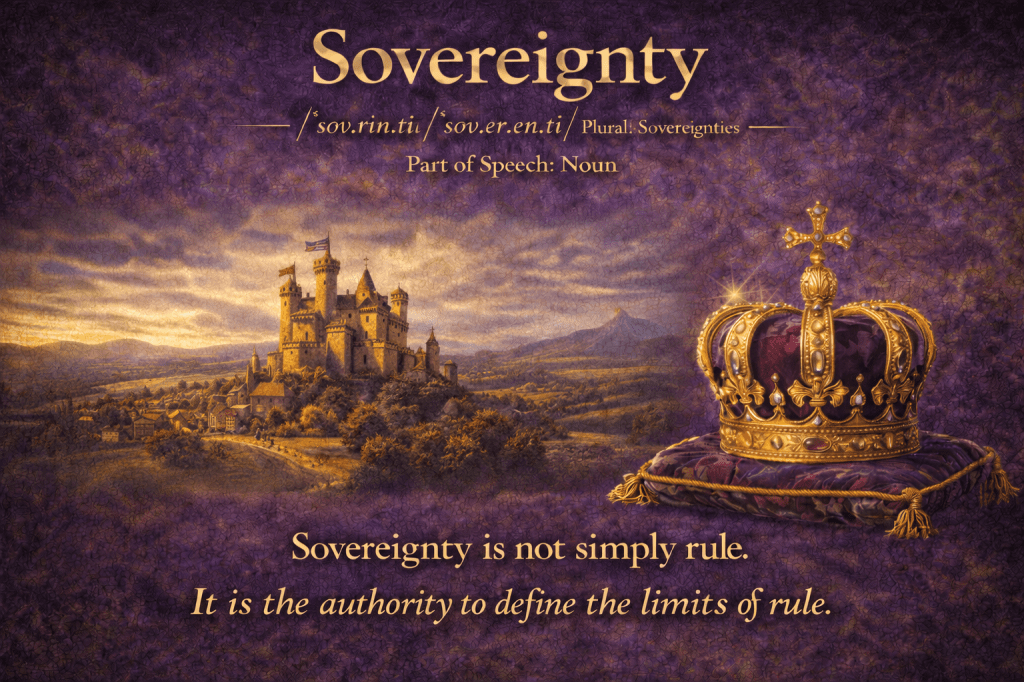
Sovereignty
IPA Pronunciation: /ˈsɒv.rɪn.ti/ or /ˈsɒv.ər.ən.ti/
Plural: Sovereignties
Part of Speech: Noun
Origin
Sovereignty emerges from medieval political thought to name supreme authority — the power that recognizes no higher rule. Initially tied to monarchs and divine right, the concept later expanded to include states, peoples, and even individuals.
Across history, sovereignty has functioned less as a stable fact than as a contested claim. It is invoked most forcefully at moments of crisis: war, revolution, colonization, and law’s suspension. Sovereignty reveals itself not in routine governance, but in the power to decide when rules apply — and when they do not.
Sovereignty is not simply rule.
It is the authority to define the limits of rule.
Etymology
Old French: soverain — supreme, highest
From Latin: superānus — above, over, exceeding
The word carries the vertical image of standing above all others.
Core Definitions
Supreme Political Authority
The ultimate power within a territory or system.
“The state asserts its sovereignty.”
Independence from External Control
Freedom from domination by outside forces.
“National sovereignty was restored.”
The Power to Decide Exceptions
Authority to suspend law in extraordinary circumstances.
“Sovereignty reveals itself in crisis.”
Explanation & Nuance
Sovereignty is both legal and symbolic.
Its defining characteristics include:
- Supremacy — no higher authority
- Territoriality — power anchored to space
- Decisionism — authority to declare exceptions
- Legitimacy Claims — authority must be recognized
- Violence Potential — enforcement at the limit
Sovereignty is not merely exercised; it must be performed and believed.
Historical Development
Monarchical Sovereignty
Power embodied in a ruler.
State Sovereignty
Authority vested in institutions.
Popular Sovereignty
Power derived from “the people.”
Colonial & Postcolonial Sovereignty
Struggles over legitimacy and control.
Each shift exposes sovereignty as constructed rather than natural.
Philosophical Perspectives
- Jean Bodin: Sovereignty as absolute and indivisible
- Thomas Hobbes: Sovereignty as protection from chaos
- Carl Schmitt: Sovereign as “he who decides the exception”
- Michel Foucault: Power diffused beyond sovereignty
- Giorgio Agamben: Sovereignty through exclusion and bare life
Philosophically, sovereignty marks the boundary between law and force.
Sovereignty & Exclusion
Sovereignty defines itself by excluding:
- Who belongs
- Who is protected
- Who can be sacrificed
The outlaw, refugee, and stateless person reveal sovereignty’s limits.
Examples in Context
Political:
“The nation defended its sovereignty.”
Legal:
“Sovereignty permits emergency powers.”
Cultural:
“Art asserts creative sovereignty.”
Psychological:
“He reclaimed personal sovereignty.”
Ethical:
“Moral sovereignty resists coercion.”
Symbolic Dimensions
- The Crown — embodied authority
- Borders — territorial claim
- The Exception — suspended law
- The Signature — legitimizing act
- The Body — site of power’s reach
Sovereignty symbolizes command backed by force.
Synonyms & Near-Relations
- Supremacy — dominance emphasis
- Autonomy — self-rule
- Authority — legitimacy focus
- Power — general capacity
- Jurisdiction — legal scope
(Only sovereignty unites law, force, and exception.)
Conceptual Relations
- Outlaw — exclusion from protection
- Interzone — overlapping authority
- Anomie — breakdown of norms
- Biopolitics — governance of life
- State of Exception — suspended law
Cultural & Intellectual Resonance
International Relations
Borders and recognition.
Political Philosophy
Legitimacy and violence.
Literature
Power and its moral cost.
Postcolonial Studies
Contested sovereignty.
Psychology
Autonomy and agency.
Takeaway
Sovereignty names the ultimate claim of authority —
the power to rule, to protect, and to exclude.
It appears most clearly not in everyday order,
but in moments of rupture,
when law falters and decision replaces procedure.
Sovereignty asks a final question:
who decides — and at what cost?
Sovereignty begins where no appeal remains.
Curious about what happened today in history? Want to learn a new word every day?
You’ll find it all—first and in one place—at The-English-Nook.com!
If you love languages, this is your space.
Enjoy bilingual short stories, fun readings, useful vocabulary, and so much more in both English and Spanish.
Come explore!
 Word of the Day - The English Nook
Leave a comment