
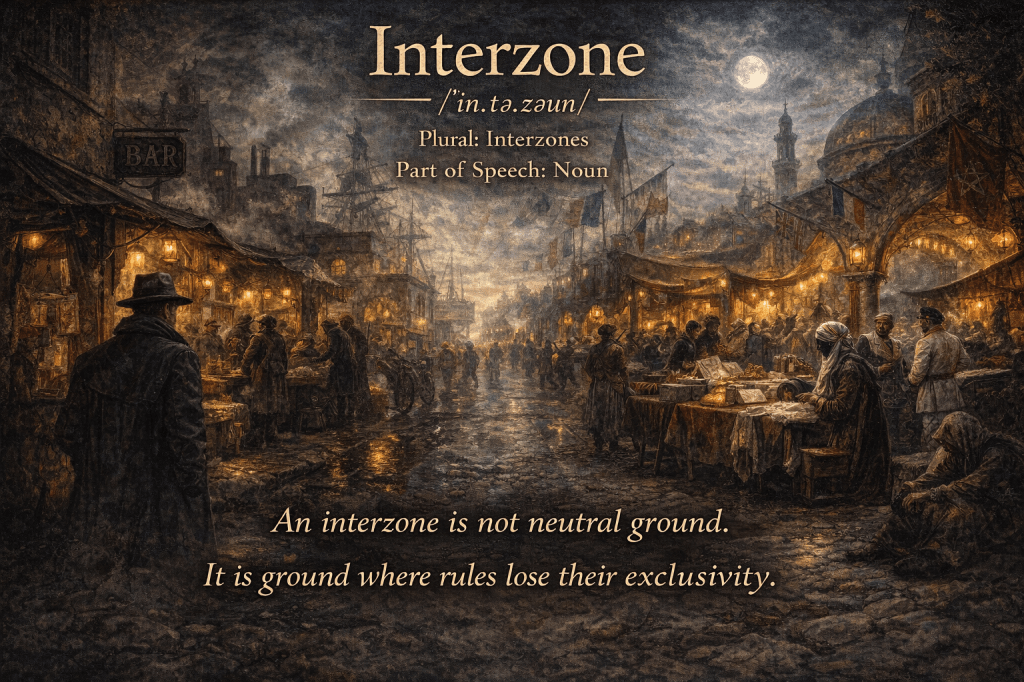
Interzone
IPA Pronunciation: /ˈɪn.tə.zəʊn/
Plural: Interzones
Part of Speech: Noun
Origin
Interzone originally refers to a territory that exists between jurisdictions — a space not fully governed by any single authority. Historically, the term gained prominence in the mid-20th century through its application to Tangier, the International Zone administered jointly by multiple colonial powers between 1923 and 1956.
From this geopolitical usage, interzone migrated into literature and cultural theory, where it came to signify spaces of legal ambiguity, cultural hybridity, and moral suspension. It names environments where norms dissolve, borders blur, and identities become provisional.
An interzone is not neutral ground.
It is ground where rules lose their exclusivity.
Etymology
Latin: inter — between
Greek: zōnē — belt, girdle, region
The word literally denotes a belt of betweenness.
Core Definitions
A Territory Between Jurisdictions
A zone governed by overlapping or suspended authority.
“Tangier functioned as an interzone.”
A Space of Legal and Moral Ambiguity
An area where normative rules are unclear or unenforced.
“The port became an interzone of trade and crime.”
A Liminal Cultural or Psychological Space
A condition of in-between identity or consciousness.
“The city exists as an interzone of cultures.”
Explanation & Nuance
Interzone implies structural indeterminacy.
Its defining characteristics include:
- Jurisdictional Overlap — no single authority dominates
- Moral Suspension — rules applied selectively or inconsistently
- Cultural Hybridity — identities intermingle without synthesis
- Flux — constant movement of people, goods, ideas
- Precarity — freedom paired with instability
An interzone offers possibility, but no guarantees.
Historical Context
Tangier International Zone
From 1923 to 1956, Tangier operated under multinational governance, becoming:
- A hub for espionage
- A refuge for exiles and fugitives
- A marketplace of illicit trade
- A crossroads of languages and cultures
This real interzone became a powerful metaphor for modernity’s fault lines.
Literary & Cultural Significance
William S. Burroughs
Popularized Interzone as a surreal, decaying, and hallucinatory cityscape representing addiction, control, and psychic fragmentation.
In Burroughs’s work, the interzone becomes:
- A psychic territory
- A black market of desire
- A breakdown of narrative coherence
- A space where control systems fail
Modern & Postmodern Literature
Interzones appear as:
- Border cities
- Free ports
- Underground networks
- Dreamlike urban spaces
They function as sites where identity, power, and reality destabilize.
Psychological & Conceptual Dimensions
Psychologically, an interzone can represent:
- Transitional identity
- Dissociation
- Exile or displacement
- Addiction or obsession
- Creative liminality
It is a space where the self is temporarily unregulated.
Examples in Context
Geopolitical:
“The city functioned as an interzone.”
Literary:
“The novel unfolds in an interzone of lawlessness.”
Cultural:
“The port became an interzone of cultures.”
Psychological:
“He lived in an interzone of consciousness.”
Digital:
“Online spaces form new interzones.”
Symbolic Dimensions
- Ports — arrival without belonging
- Borders — permeability and tension
- Markets — exchange without regulation
- Shadow Cities — informal economies
- Dream Spaces — logic suspended
Interzone symbolizes freedom without sovereignty.
Synonyms & Near-Relations
- Liminal Zone — anthropological framing
- Borderland — geographic emphasis
- No-man’s-land — conflict framing
- Free Port — economic emphasis
- Grey Zone — ethical ambiguity
(Only interzone carries the weight of overlapping power and cultural excess.)
Conceptual Relations
- Liminality — threshold states
- Outlaw — existence beyond law
- Anomie — normlessness
- Parallax — shifting perspectives
- Psychogeography — space shaping mind
Cultural & Intellectual Resonance
Colonial History
Zones of imposed ambiguity.
Modernism
Fragmented urban experience.
Postmodernism
Collapse of coherent authority.
Political Theory
Spaces of exception.
Psychology
States of unanchored identity.
Takeaway
Interzone names a space where authority thins and identity loosens —
where cultures overlap without merging,
and where freedom exists without protection.
It is a territory of risk and invention,
a zone where norms dissolve and meaning mutates,
revealing what remains when systems lose their grip.
The interzone is where order hesitates —
and something unstable, generative, and dangerous emerges.
Where rules weaken, meaning mutates.
Curious about what happened today in history? Want to learn a new word every day?
You’ll find it all—first and in one place—at The-English-Nook.com!
If you love languages, this is your space.
Enjoy bilingual short stories, fun readings, useful vocabulary, and so much more in both English and Spanish.
Come explore!
 Word of the Day - The English Nook
Leave a comment