
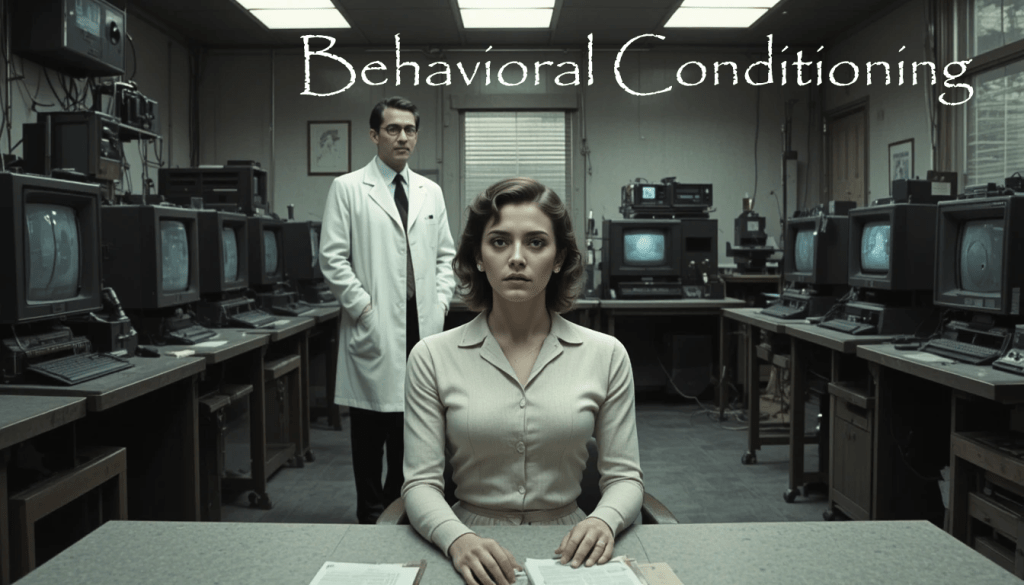
Behavioral Conditioning
IPA Pronunciation: /bɪˈheɪ.vjə.rəl kənˈdɪʃ.ən.ɪŋ/
Part of Speech: Noun (Psychological / Behavioral Science Term)
Origin
Behavioral conditioning emerges from early 20th-century psychology, particularly behaviorism, which sought to study behavior as observable, measurable response rather than subjective mental states. Rejecting introspection, behaviorists argued that learning occurs through patterns of association shaped by the environment.
The concept became central through the work of Ivan Pavlov, John B. Watson, and B. F. Skinner, who demonstrated that behavior could be modified systematically through controlled stimuli, reinforcement, and repetition.
Behavioral conditioning reframes behavior not as expression,
but as adaptation.
Etymology
Behavioral: from behave — to conduct oneself
Conditioning: from condiciō (Latin) — agreement, stipulation
To condition is to set the terms under which responses occur.
Core Definitions
The Process of Learning Through Association
Behavior shaped by repeated pairing of stimuli and responses.
“The subject learned through conditioning.”
Behavior Modification via Reinforcement or Punishment
Responses strengthened or weakened by consequences.
“Behavioral conditioning altered the habit.”
Environmental Shaping of Action
Learning driven externally rather than internally.
“The system relies on conditioning.”
Primary Forms of Conditioning
Classical Conditioning
Learning through association between stimuli.
(Pavlov’s dogs)
Operant Conditioning
Learning through consequences of behavior.
(Skinner’s reinforcement schedules)
Explanation & Nuance
Behavioral conditioning is not persuasion.
Its defining qualities include:
- Repetition — learning through recurrence
- Predictability — reliable stimulus-response patterns
- External Control — environment as primary agent
- Incremental Change — behavior shifts gradually
- Neutrality of Content — morally indifferent mechanism
Conditioning alters behavior without requiring belief or understanding.
Examples in Context
Psychological:
“Phobias can develop through conditioning.”
Educational:
“Positive reinforcement encourages learning.”
Clinical:
“Therapy used conditioning techniques.”
Animal Training:
“Commands were reinforced through conditioning.”
Social:
“Advertising exploits behavioral conditioning.”
Symbolic Dimensions
- Bell — cue triggering response
- Lever — action and reward
- Pattern — repetition shaping behavior
- Loop — stimulus, response, reinforcement
- Environment — silent instructor
Behavioral conditioning symbolizes learning without awareness.
Synonyms & Near-Relations
- Learning by Association – descriptive
- Behavior Modification – applied
- Habit Formation – outcome-focused
- Reinforcement Learning – technical
- Training – informal
(Behavioral conditioning emphasizes mechanism rather than intent.)
Cultural & Intellectual Resonance
Psychology
Foundational learning theory.
Education
Reward-based systems.
Marketing
Consumer behavior shaping.
Technology
Algorithmic feedback loops.
Ethics
Debates on autonomy and control.
Behavioral Conditioning vs. Socialization
- Conditioning operates through consequence.
- Socialization operates through norms and meaning.
Conditioning shapes what we do.
Socialization shapes what we believe.
Critiques & Limits
- Reduction of human complexity
- Neglect of internal states
- Ethical concerns over manipulation
- Limited explanatory power for creativity
Modern psychology integrates conditioning with cognition rather than replacing it.
Takeaway
Behavioral conditioning reveals how behavior can be shaped without appeal to reason, intention, or insight.
It exposes the quiet power of repetition and consequence —
how environments teach without speaking,
how habits form without consent,
and how behavior often reflects the conditions that produced it
more than the will that enacts it.
Understanding conditioning is not about submission —
it is about recognizing the forces already at work.
Behavior is often trained long before it is understood.
Curious about what happened today in history? Want to learn a new word every day?
You’ll find it all—first and in one place—at The-English-Nook.com!
If you love languages, this is your space.
Enjoy bilingual short stories, fun readings, useful vocabulary, and so much more in both English and Spanish.
Come explore!
 Word of the Day - The English Nook
Leave a comment