
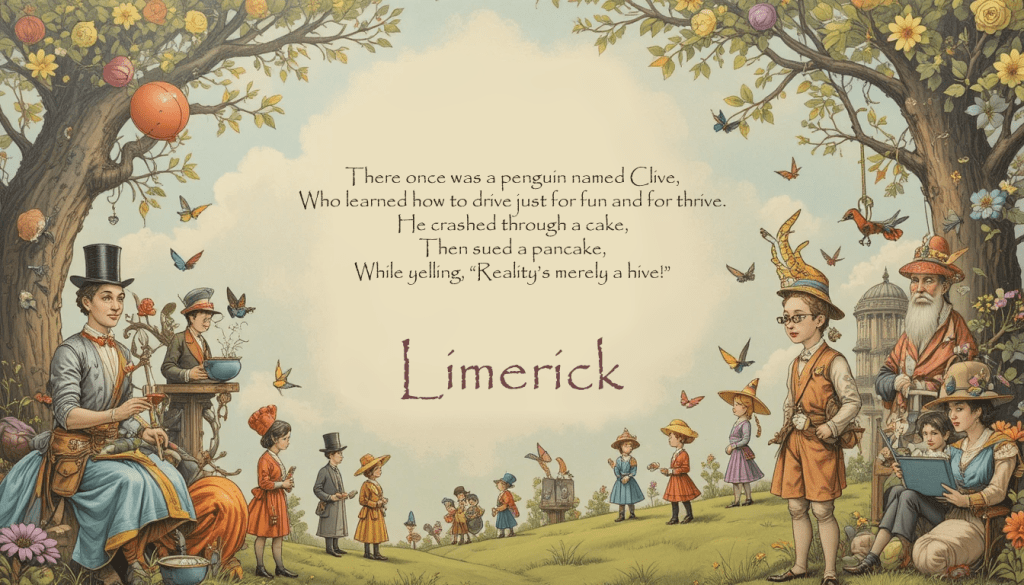
Limerick
IPA Pronunciation: /ˈlɪm.ər.ɪk/
Plural: Limericks
Part of Speech: Noun (Poetic Form)
Origin
The limerick is a compact poetic form distinguished by its rigid structure, rhythmic bounce, and comic intent. Though often associated with light verse and bawdy humor, the limerick’s endurance lies in its technical precision: a tightly governed meter designed to deliver surprise with maximum efficiency.
Its name is traditionally linked—perhaps apocryphally—to the Irish city of Limerick, via a refrain (“Will you come up to Limerick?”) used in song games. Regardless of origin myths, the form achieved literary prominence in the 19th century, especially through the work of Edward Lear, who codified its modern conventions.
The limerick thrives on constraint.
Its humor depends on obedience.
Etymology
Likely derived from Limerick, Ireland
First recorded in English in the early 18th century
While its geographic origin remains uncertain, the term came to denote a poem whose identity is inseparable from sound pattern and closure.
A limerick is not merely short —
it is engineered.
Core Definitions
A Five-Line Poem with a Fixed Rhyme Scheme
Structured as AABBA, with strict rhythmic expectations.
“He wrote a limerick.”
A Verse Form Built Around a Punchline
Narrative compressed toward surprise or absurdity.
“The final line delivers the turn.”
A Mode of Comic or Nonsense Poetry
Often humorous, irreverent, or subversive.
“The poem is deliberately outrageous.”
Formal Structure
A traditional limerick follows:
- Five lines
- Rhyme scheme: AABBA
- Meter:
- Lines 1, 2, and 5: anapestic trimeter (longer)
- Lines 3 and 4: anapestic dimeter (shorter)
The final line typically delivers a twist, punchline, or reversal, often echoing the first line.
Explanation & Nuance
Despite its reputation for frivolity, the limerick is a form of high formal discipline.
Its defining qualities include:
- Strict Meter — deviation breaks the spell
- Narrative Compression — story in miniature
- Expectation and Release — rhythm primes surprise
- Circularity — ending loops back to beginning
- Controlled Irreverence — order enabling disorder
The limerick’s humor arises not from chaos, but from precision under pressure.
Examples in Context
Literary:
“Lear popularized the limerick.”
Educational:
“Students study limericks to learn meter.”
Cultural:
“The form is associated with nonsense verse.”
Oral Tradition:
“Limericks are designed to be spoken aloud.”
Satirical:
“The limerick skewers authority through humor.”
Thematic Range
While commonly comic, limericks may explore:
- Absurdity
- Sexual innuendo
- Social satire
- Linguistic play
- Deliberate bad taste
Their content often tests boundaries precisely because the form itself is so contained.
Symbolic Dimensions
- Clockwork — mechanical precision
- Bounce — rhythm as propulsion
- Trapdoor — punchline as sudden drop
- Circle — narrative returns to origin
- Mask — humor concealing craft
The limerick symbolizes discipline disguised as play.
Synonyms & Near-Relations
- Nonsense Verse – broader category
- Doggerel – cruder, less controlled
- Epigram – shorter, sharper
- Clerihew – biographical verse
- Light Verse – tonal classification
(Only the limerick combines strict meter with narrative punch.)
Cultural & Intellectual Resonance
Victorian Literature
Codification of light verse.
Oral Poetry
Designed for recitation.
Children’s Literature
Playful entry into poetic form.
Satire
Safe vessel for transgression.
Prosody
Demonstration of metrical control.
Limerick vs. Epigram
- Epigram aims for wit through brevity.
- Limerick aims for humor through rhythm.
Epigram cuts.
Limerick bounces.
Takeaway
Limerick is poetry at its most mischievous and exacting —
a form where laughter depends on obedience to rule.
Behind its sing-song cadence lies craftsmanship,
and beneath its absurdity, a deep understanding of timing, sound, and closure.
The limerick reminds us that
constraint does not stifle creativity —
it sharpens it.
Laughter lands hardest when rhythm refuses to slip.
Curious about what happened today in history? Want to learn a new word every day?
You’ll find it all—first and in one place—at The-English-Nook.com!
If you love languages, this is your space.
Enjoy bilingual short stories, fun readings, useful vocabulary, and so much more in both English and Spanish.
Come explore!
 Word of the Day - The English Nook
Leave a comment