
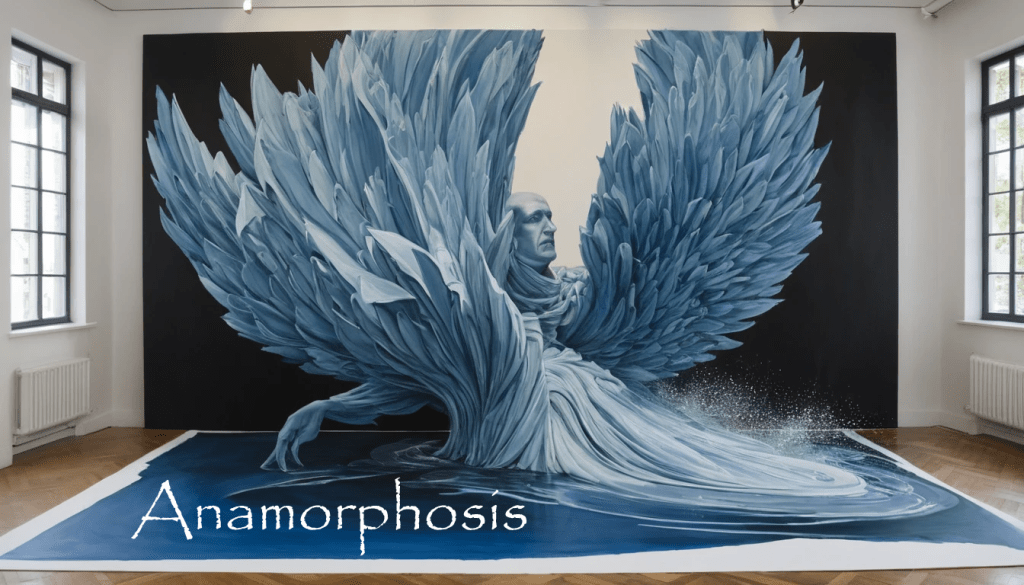
Anamorphosis
IPA Pronunciation: /ˌæn.əˈmɔːr.fə.sɪs/
Plural: Anamorphoses
Part of Speech: Noun
Origin
Anamorphosis arises at the intersection of art, optics, and philosophy, naming a mode of representation in which an image appears distorted—often unintelligible—until viewed from a particular angle, through a reflective surface, or with specific knowledge.
First developed in Renaissance visual art, anamorphosis challenged the idea of a single, authoritative perspective. It insists that meaning depends on position, that truth may be present but unreadable without the right stance.
The image is not false.
The viewer is simply not yet aligned.
Etymology
Greek: anamorphoûn — to transform, to form again
From ana- (again, back) + morphē (form)
Anamorphosis is form recovered through displacement.
Core Definitions
A Distorted Representation Corrected by Perspective
An image that resolves only from a specific viewpoint.
“The painting includes an anamorphosis.”
A Technique of Visual or Conceptual Reformation
Distortion that encodes hidden meaning.
“The skull is an anamorphosis.”
A Metaphor for Perceptual Truth
Understanding dependent on context or position.
“Memory works by anamorphosis.”
Explanation & Nuance
Anamorphosis is not illusion.
Its defining qualities include:
- Intentional Distortion — misalignment by design
- Conditional Clarity — truth requires repositioning
- Viewer Participation — meaning is activated, not given
- Hidden Order — coherence concealed within chaos
- Epistemic Humility — perspective governs knowledge
Anamorphosis suggests that error may be positional, not factual.
Historical & Artistic Context
- Renaissance Art: Optical experiments with perspective
- Holbein’s The Ambassadors: The famous skewed skull
- Baroque Architecture: Illusory depth and scale
- Modern Art: Fragmented viewpoints
- Cinema & Literature: Truth revealed through reframing
Examples in Context
Visual Art:
“The skull appears only through anamorphosis.”
Philosophical:
“Truth emerges by anamorphosis.”
Literary:
“The narrative resolves anamorphically.”
Psychological:
“Trauma distorts memory through anamorphosis.”
Cultural:
“History requires anamorphosis to be understood.”
Symbolic Dimensions
- Skewed Image — misperception
- Mirror / Lens — corrective mediation
- Angle — positional truth
- Hidden Figure — latent meaning
- Reversal — distortion as access
Anamorphosis symbolizes truth that resists frontal view.
Synonyms & Near-Relations
- Perspective Shift – explanatory, less formal
- Distortion – lacks recovery
- Parallax – observational difference
- Defamiliarization – literary technique
- Reframing – conceptual
(Only anamorphosis encodes correction within distortion.)
Cultural & Intellectual Resonance
Art Theory
Perspective as ideology.
Philosophy
Knowledge as positional.
Psychoanalysis
Hidden structures of meaning.
Literary Theory
Narrative perspective.
Epistemology
Truth requires alignment.
Anamorphosis vs. Illusion
- Illusion deceives.
- Anamorphosis instructs.
Illusion hides truth.
Anamorphosis waits for it.
Takeaway
Anamorphosis teaches that clarity is conditional —
that distortion may be the price of concealment,
and that understanding sometimes requires us
to move, to tilt, to change our position.
What appears meaningless may already be whole —
waiting for the right angle of attention.
Sometimes truth waits for you to move.
Curious about what happened today in history? Want to learn a new word every day?
You’ll find it all—first and in one place—at The-English-Nook.com!
If you love languages, this is your space.
Enjoy bilingual short stories, fun readings, useful vocabulary, and so much more in both English and Spanish.
Come explore!
 Word of the Day - The English Nook
Leave a comment