
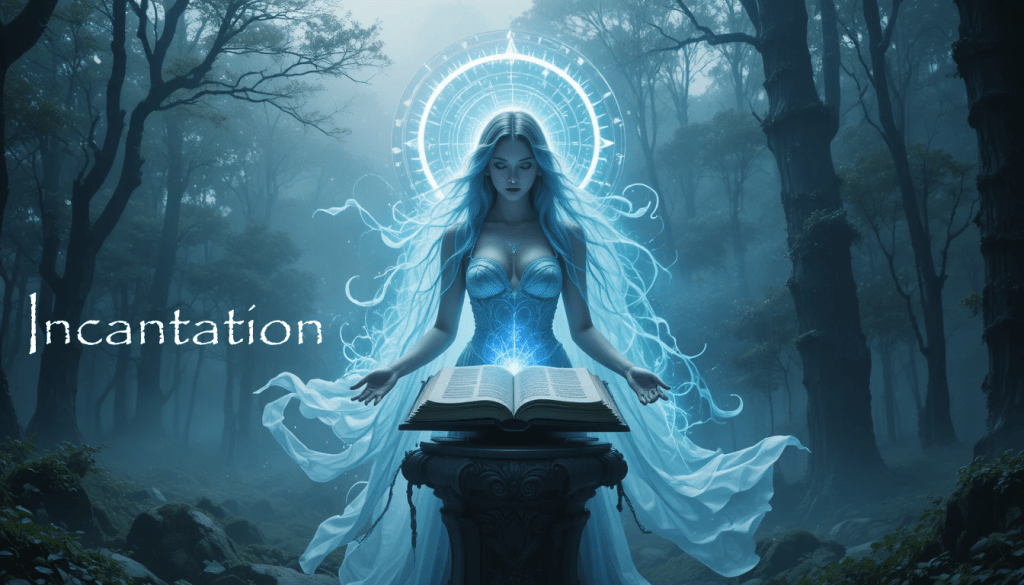
Incantation
IPA Pronunciation: /ˌɪn.kænˈteɪ.ʃən/
Plural: Incantations
Part of Speech: Noun
Origin
Incantation emerges from humanity’s earliest attempts to shape reality through sound. Long before writing, law, or science, spoken rhythm and repeated phrase were believed to exert influence over the unseen — summoning protection, healing, curse, or transformation.
Across cultures, incantations appear in religious rites, folk magic, shamanic traditions, and ceremonial poetry. They occupy the space between prayer and spell, where language is not merely expressive but operative.
To speak an incantation is not to describe change —
it is to attempt to cause it.
Etymology
Latin: incantātiō — a chanting, spell
From incantāre — to chant upon, to bewitch
(in- “upon” + cantāre “to sing”)
The root emphasizes voiced repetition — language heightened into rhythm.
An incantation is speech performed, not said.
Core Definitions
A Ritualized Spoken Formula
Words believed to carry supernatural effect.
“The priest uttered an incantation.”
Language Used to Invoke or Influence
Speech intended to summon, protect, bind, or transform.
“The incantation called forth the spirit.”
Poetic or Rhetorical Chant
Language whose power lies in sound and repetition.
“The refrain functions like an incantation.”
Explanation & Nuance
Incantation differs from ordinary speech in intent and form.
Its defining qualities include:
- Repetition — rhythm reinforces belief
- Cadence — musical structure
- Opacity — meaning may be secondary to sound
- Authority — spoken by designated voices
- Threshold State — between worlds, states, or meanings
Even stripped of belief, incantations retain affective power:
the voice changes, the listener leans in.
Examples in Context
Mythic:
“The witch whispered an incantation.”
Religious:
“The chant operates as incantation.”
Literary:
“The poem reads like an incantation.”
Psychological:
“The phrase became a private incantation.”
Political:
“The slogan was repeated as incantation.”
Symbolic Dimensions
- Voice — breath as power
- Circle — containment and focus
- Refrain — meaning through return
- Threshold — speech at the edge of action
- Spell — language binding reality
Incantation symbolizes belief activated by sound.
Synonyms & Near-Relations
- Spell – effect-driven magic
- Chant – rhythmic repetition
- Invocation – calling upon power
- Mantra – sacred repetition
- Enchantment – result rather than process
(Incantation uniquely centers vocal performance as power.)
Cultural & Intellectual Resonance
Anthropology
Speech as ritual action.
Religion
Prayer and sacred chant.
Literature
Language performing meaning.
Music
Voice as instrument.
Psychology
Repetition shaping belief.
Incantation vs. Prayer
- Prayer appeals to will beyond oneself.
- Incantation asserts influence through form.
Prayer asks.
Incantation acts.
Takeaway
Incantation is language at its most ancient and dangerous —
words believed to matter beyond meaning.
It reminds us that speech is not neutral,
that rhythm persuades,
that repetition reshapes reality,
and that the voice — raised, whispered, or sung —
still carries the echo of old power.
When words are spoken to act rather than explain.
Curious about what happened today in history? Want to learn a new word every day?
You’ll find it all—first and in one place—at The-English-Nook.com!
If you love languages, this is your space.
Enjoy bilingual short stories, fun readings, useful vocabulary, and so much more in both English and Spanish.
Come explore!
 Word of the Day - The English Nook
Leave a comment