
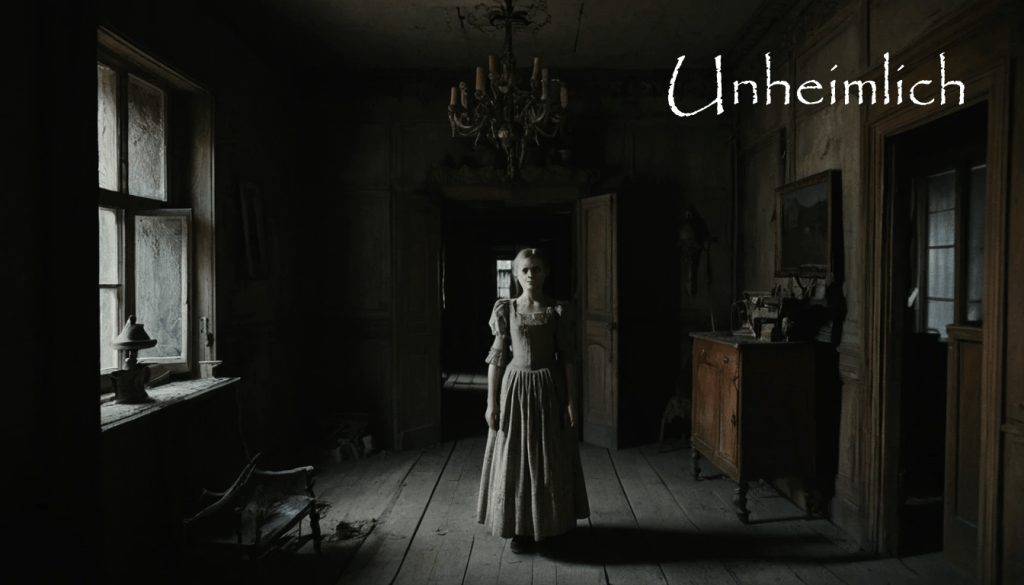
Unheimlich
IPA Pronunciation: /ʊnˈhaɪ̯mlɪç/ (German)
Approximate English Rendering: /ʌnˈhaɪm.lɪk/
Part of Speech: Adjective / Noun (Conceptual)Literal Meaning: Un-homely, not at home
Origin
Unheimlich is a German term most famously theorized by Sigmund Freud in his 1919 essay Das Unheimliche (“The Uncanny”). While the word existed in everyday German before Freud, his analysis transformed it into a central concept in psychology, aesthetics, and literary theory.
Unlike simple fear or horror, unheimlich names a more subtle disturbance: the moment when something familiar becomes alien, when what should feel safe instead provokes unease.
It is not the unknown that unsettles —
it is the too-known, returned in distorted form.
Etymology
German: heim — home
Heimlich: homely, familiar, intimate, concealed
Unheimlich: un-homely, eerie, estranged
Crucially, heimlich also carries a secondary meaning: hidden, secret.
Thus unheimlich emerges not as the opposite of familiarity, but as its reversal.
What was once hidden becomes visible.
What was intimate becomes exposed.
Core Definitions
The Uncanny
A sensation of eerie discomfort caused by the return of the familiar in unfamiliar form.
Psychological Estrangement
A feeling of not being at home in what should be known.
“The house felt unheimlich.”
Aesthetic or Narrative Effect
An atmosphere produced through doubling, repetition, or distortion.
“The novel cultivates the unheimlich.”
Explanation & Nuance
The unheimlich is not terror.
Its defining qualities include:
- Familiarity distorted, not erased
- Recognition without comfort
- Intimacy turned threatening
- Repetition with difference
- Exposure of what was meant to stay hidden
A doll that looks alive.
A reflection that lingers too long.
A childhood home, unchanged — and wrong.
Freud’s Theory of the Unheimlich
Freud identified several sources of the uncanny:
- The Double — mirrors, twins, alter egos
- Repetition Compulsion — recurring events or numbers
- Automata — lifelike but lifeless figures
- Repressed Material — childhood fears resurfacing
- Blurred Boundaries — between life/death, animate/inanimate
The uncanny arises when repression fails —
when the psyche encounters itself unexpectedly.
Examples in Context
Literary:
“The story’s power lies in its unheimlich atmosphere.”
Psychological:
“The dream was deeply unheimlich.”
Architectural:
“The empty house felt unheimlich rather than abandoned.”
Cinematic:
“The film uses doubles to create the unheimlich.”
Everyday:
“Seeing her handwriting after years felt unheimlich.”
Symbolic Dimensions
- The Double — fractured selfhood
- Mirror — recognition without reassurance
- Doll / Automaton — life simulated
- Empty Home — presence without inhabitants
- Echo — sound returning altered
The unheimlich symbolizes the instability of the familiar.
Synonyms & Near-Relations
- Uncanny – closest English equivalent
- Eerie – colder, less psychological
- Creepy – more visceral, less intellectual
- Strange – too neutral
- Grotesque – more bodily or exaggerated
(Only unheimlich preserves the tension between intimacy and dread.)
Cultural & Intellectual Resonance
Psychoanalysis
Return of the repressed.
Literature
Gothic, modernist, and postmodern unease.
Film
Horror without monsters; dread without violence.
Architecture
Spaces that feel “wrong” rather than ruined.
Philosophy
The fragility of belonging and identity.
Unheimlich vs. Horror
- Horror shocks.
- Terror threatens.
- Unheimlich unsettles quietly.
It lingers.
It does not scream.
It whispers recognition.
Takeaway
Unheimlich names the moment when home turns strange —
when what we know best refuses to comfort us.
It is the chill of recognition without refuge,
the disturbance of seeing oneself
where one expected safety.
The uncanny is not elsewhere.
It is inside the familiar, waiting to be noticed.
Home is most frightening when it recognizes you
Curious about what happened today in history? Want to learn a new word every day?
You’ll find it all—first and in one place—at The-English-Nook.com!
If you love languages, this is your space.
Enjoy bilingual short stories, fun readings, useful vocabulary, and so much more in both English and Spanish.
Come explore!
 Word of the Day - The English Nook
Leave a comment