
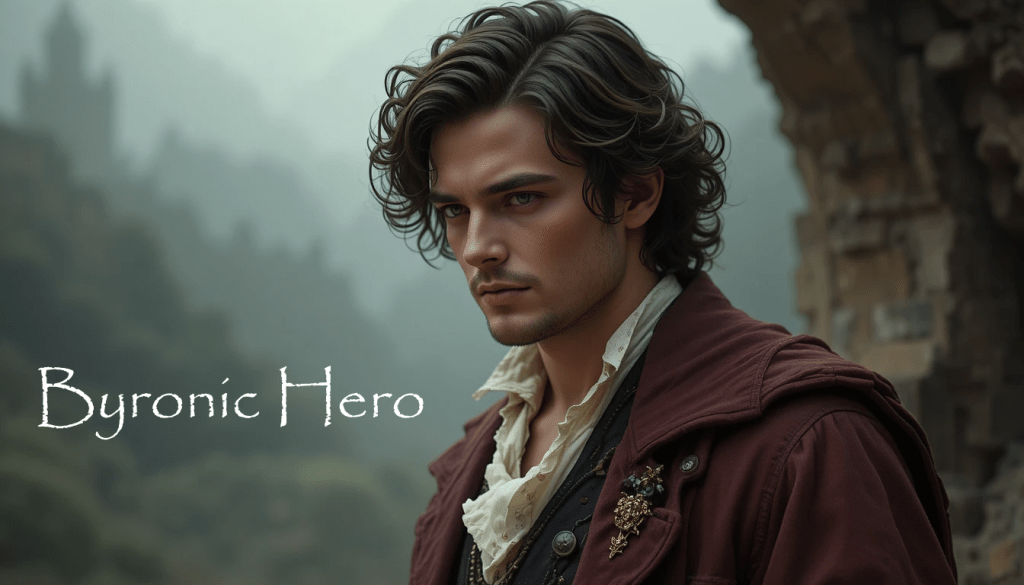
Byronic Hero
IPA Pronunciation: /baɪˈrɒn.ɪk ˈhɪə.roʊ/
Plural: Byronic Heroes
Part of Speech: Noun (Literary Archetype)
Origin
The Byronic hero emerges from the life and works of Lord Byron (George Gordon Byron, 1788–1824), one of the central figures of Romanticism. Unlike classical heroes defined by virtue, duty, or public honor, Byron’s protagonists were private, conflicted, and transgressive.
This archetype took shape in narrative poems such as Childe Harold’s Pilgrimage, Manfred, and The Corsair, whose protagonists bore striking similarities to Byron himself: aristocratic, emotionally intense, morally ambiguous, and resistant to social norms.
The Byronic hero arose during a cultural moment that questioned Enlightenment rationality and celebrated individual passion, alienation, and defiance.
Etymology
Byronic — relating to Lord Byron or his style
Hero — protagonist or central figure
The term names a hero defined less by action than by inner turmoil.
Core Definitions
A Brooding, Charismatic Antihero
Emotionally intense and morally complex.
“The novel’s protagonist is a Byronic hero.”
A Figure Marked by Rebellion and Alienation
In conflict with society and self.
“His defiance is distinctly Byronic.”
A Protagonist Defined by Inner Conflict Rather Than Triumph
Victory is internal, if it exists at all.
“The story traces a Byronic struggle.”
Explanation & Nuance
The Byronic hero is not admirable in the traditional sense.
Key characteristics include:
- Pride and Defiance
- Emotional Depth and Volatility
- Isolation or Self-Imposed Exile
- A Dark or Mysterious Past
- Contempt for Social Convention
- Self-Awareness of Flaws
Unlike villains, Byronic heroes possess conscience and suffering. Unlike traditional heroes, they lack moral clarity or redemption.
Psychological Profile
- Deeply introspective
- Haunted by guilt or regret
- Driven by passion rather than duty
- Often self-destructive
- Capable of love but resistant to trust
The Byronic hero dramatizes the cost of radical individuality.
Examples in Literature & Culture
Romantic Literature
- Manfred (Manfred)
- Childe Harold (Childe Harold’s Pilgrimage)
Later Literature
- Heathcliff (Wuthering Heights)
- Mr. Rochester (Jane Eyre)
Modern Culture
- Antiheroes in noir and gothic fiction
- Brooding protagonists in film and television
Examples in Context
Literary:
“He is unmistakably a Byronic hero.”
Critical:
“The character draws on the Byronic tradition.”
Cultural:
“The trope persists in modern storytelling.”
Psychological:
“A Byronic self-conception.”
Symbolic Dimensions
- Storm — emotional turbulence
- Ruins — inner decay
- Wanderer — restless exile
- Shadow — moral ambiguity
- Confession — tortured self-knowledge
The Byronic hero symbolizes romanticized alienation.
Synonyms & Near-Relations
- Antihero – broader category
- Romantic Rebel – descriptive
- Dark Protagonist – tonal
- Tragic Hero – partial overlap
- Outlaw Figure – externalized rebellion
(Only the Byronic hero fuses charisma, guilt, and defiance so completely.)
Cultural & Intellectual Resonance
Romanticism
Emotion elevated over reason.
Psychology
Inner conflict as narrative engine.
Gender Studies
Masculinity defined by brooding intensity.
Modern Fiction
Template for sympathetic darkness.
Pop Culture
Enduring appeal of flawed protagonists.
Critiques & Limits
- Can glamorize toxicity or cruelty
- Risks self-indulgent melancholy
- Often gendered male by tradition
- May eclipse quieter forms of heroism
The Byronic hero is compelling, but not a moral ideal.
Takeaway
The Byronic Hero is rebellion made introspective —
a figure defined not by conquest,
but by conflict with self and world.
He reminds us that heroism can be haunted,
that charisma can coexist with guilt,
and that some narratives are driven not by victory,
but by the cost of refusing to belong.
Not all heroes conquer, some burn from within
Curious about what happened today in history? Want to learn a new word every day?
You’ll find it all—first and in one place—at The-English-Nook.com!
If you love languages, this is your space.
Enjoy bilingual short stories, fun readings, useful vocabulary, and so much more in both English and Spanish.
Come explore!
 Word of the Day - The English Nook
Leave a comment