
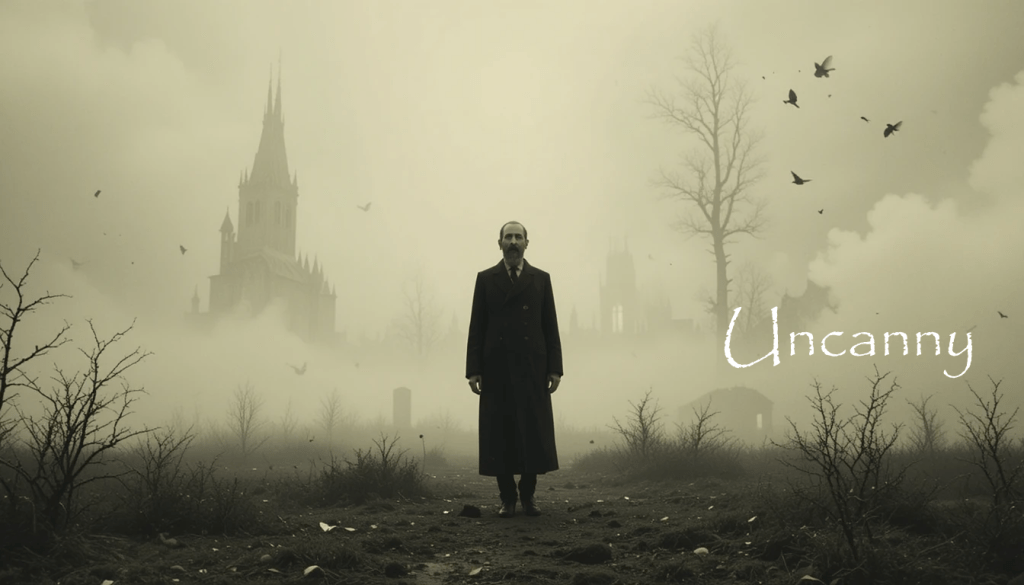
Uncanny
IPA Pronunciation: /ʌnˈkæn.i/
Comparative: More uncanny
Superlative: Most uncanny
Part of Speech: Adjective
Origin
The uncanny occupies a psychological borderland: the space where the familiar becomes strange without becoming wholly alien. While the sensation itself is ancient, the term gained its modern intellectual weight through 19th- and early 20th-century thought, particularly in aesthetics and psychology.
Its most influential articulation comes from Sigmund Freud’s 1919 essay “Das Unheimliche”, which explored how things once known, intimate, or repressed can return in distorted form, producing unease. The uncanny thus emerges not from novelty, but from recognition gone awry.
Rather than confronting the unknown, the uncanny confronts the almost-known.
Etymology
German: unheimlich
- heimlich — homely, familiar, belonging to the home
- un- — negation
Literally: “not homely.”
The uncanny is what should feel safe, but doesn’t.
Core Definitions
Strangely Familiar in a Disturbing Way
Recognition tinged with unease.
“The house felt uncanny.”
Producing Discomfort Without Clear Threat
Unease without explanation.
“An uncanny resemblance.”
Suggesting Something Hidden or Repressed
The return of what was meant to stay buried.
“An uncanny memory surfaced.”
Explanation & Nuance
The uncanny is subtle.
It is not terror, which overwhelms.
It is not mystery, which invites curiosity.
It is not horror, which shocks.
Instead, it manifests as:
- Doubling — mirrors, replicas, doppelgängers
- Repetition — patterns that feel intentional
- Automation — lifelike but lifeless entities
- Temporal Slippage — past intruding on present
- Emotional Mismatch — feeling without cause
The uncanny unsettles because it disturbs boundaries.
Common Triggers of the Uncanny
- Dolls and mannequins
- Human-like machines
- Familiar spaces altered
- Déjà vu
- Coincidences that feel orchestrated
These phenomena blur distinctions between animate/inanimate, past/present, self/other.
Examples in Context
Psychological:
“The dream was deeply uncanny.”
Literary:
“The novel cultivates an uncanny atmosphere.”
Technological:
“The robot’s face was uncanny.”
Everyday:
“Their voices sounded uncannily alike.”
Critical:
“The film relies on the uncanny rather than fear.”
Symbolic Dimensions
- Doppelgänger — fractured self
- Mirror — recognition without comfort
- Automaton — life without soul
- Haunted Home — intimacy turned hostile
- Echo — repetition without origin
The uncanny symbolizes repressed familiarity returning uninvited.
Synonyms & Near-Relations
- Eerie – atmospheric unease
- Weird – broader strangeness
- Creepy – informal discomfort
- Haunting – lingering effect
- Strange – lacks psychological depth
(Only uncanny names the discomfort of distorted familiarity.)
Cultural & Intellectual Resonance
Psychoanalysis
Return of the repressed.
Literature
Gothic and modernist unease.
Film & Animation
Uncanny valley phenomenon.
Philosophy
Instability of perception.
Technology
Human likeness without humanity.
Critiques & Limits
- Overuse dilutes impact
- Misapplied to simple weirdness
- Often confused with horror
- Requires restraint and context
The uncanny loses power when explained too fully.
Takeaway
Uncanny describes the moment when familiarity turns against itself —
when recognition no longer reassures
but unsettles.
It reveals that comfort depends on boundaries,
and that when those boundaries blur,
even home can feel strange.
When recognition stops feeling safe
Curious about what happened today in history? Want to learn a new word every day?
You’ll find it all—first and in one place—at The-English-Nook.com!
If you love languages, this is your space.
Enjoy bilingual short stories, fun readings, useful vocabulary, and so much more in both English and Spanish.
Come explore!
 Word of the Day - The English Nook
Leave a comment