
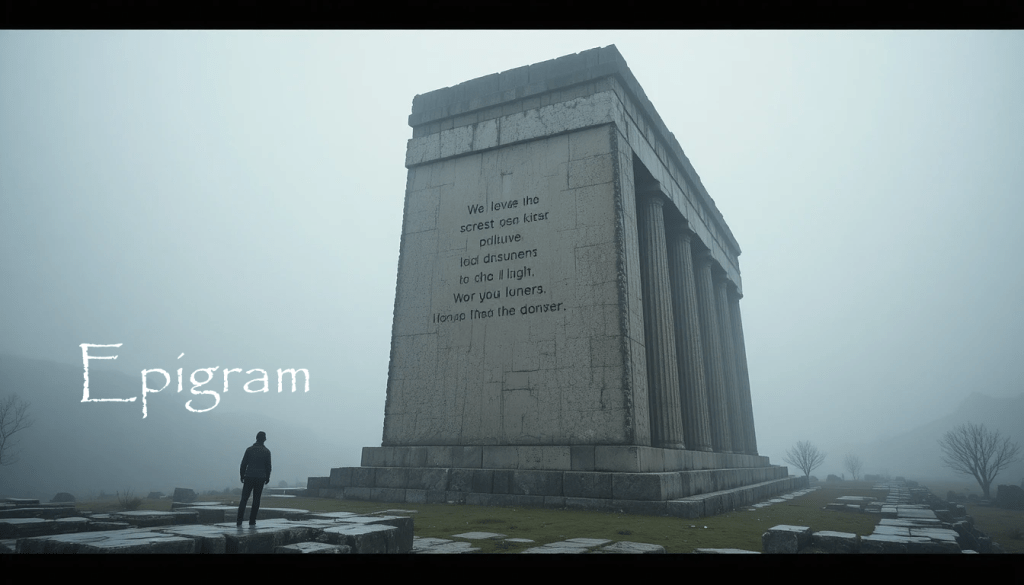
Epigram
IPA Pronunciation: /ˈɛp.ɪ.ɡræm/
Plural: Epigrams
Part of Speech: Noun (Literary Form)
Origin
The epigram began not as a literary flourish but as a physical inscription—short texts engraved on stone, metal, or monuments in ancient Greece. These brief statements marked graves, offerings, or public dedications, requiring clarity, economy, and permanence.
Over time, the epigram migrated from stone to page, evolving into a literary form defined by brevity sharpened into meaning. By the Roman period, particularly through poets like Martial, the epigram acquired its now-familiar tone: pointed, witty, often barbed.
Across centuries, the epigram has remained a favored form for writers seeking to distill insight, irony, or judgment into a few enduring lines.
Etymology
Greek: epigramma — inscription, something written upon
From epi- (upon) + graphein (to write)
An epigram is literally writing placed upon something—originally stone, later thought itself.
Core Definitions
A Brief, Pointed Statement or Poem
Compressed expression with a sharp conclusion.
“The line reads like an epigram.”
A Literary Form Defined by Wit or Insight
Economy of language as virtue.
“She excels at epigrammatic prose.”
A Saying That Concludes with a Turn or Sting
Meaning crystallized at the end.
“The epigram ends in irony.”
Explanation & Nuance
An epigram is not merely short.
Its defining characteristics include:
- Compression: meaning distilled
- Precision: every word counts
- Turn: a twist or realization
- Finality: a sense of closure or judgment
Epigrams often deliver pleasure through recognition—the sudden clarity of a truth made crisp.
They can be:
- Playful
- Satirical
- Moral
- Aphoristic
- Cutting
But they are always deliberate.
Historical Evolution
Classical
Inscriptions, commemorative verse.
Roman
Wit, satire, social commentary.
Renaissance
Moral and intellectual refinement.
Modern
Aphorism, quotation, micro-essay.
Examples in Context
Literary:
“The poem functions as an epigram.”
Critical:
“His prose is epigrammatic.”
Historical:
“Martial perfected the epigram.”
Everyday:
“She ended the speech with an epigram.”
Aesthetic:
“The line lands like an epigram.”
Symbolic Dimensions
- Engraved Stone — permanence
- Chisel — language shaped by force
- Blade — wit that cuts
- Seal — finality of thought
- Spark — insight ignited briefly
The epigram symbolizes thought made durable through brevity.
Synonyms & Near-Relations
- Aphorism – philosophical emphasis
- Maxim – moral instruction
- Bon mot – conversational wit
- Witticism – lighter tone
- Proverb – folk wisdom
(Epigram uniquely balances wit, form, and literary intention.)
Cultural & Intellectual Resonance
Literary Craft
Mastery of concision.
Rhetoric
Impact through brevity.
Philosophy
Truth compressed.
Satire
Judgment sharpened.
Modern Media
Quotes, captions, micro-texts.
Critiques & Limits
- Can oversimplify complex truths
- Risks cleverness over depth
- May harden into cliché
- Dependent on timing and tone
A weak epigram is merely short; a strong one endures.
Takeaway
Epigram is thought cut to its edge —
language honed until meaning flashes cleanly.
It proves that insight need not be expansive,
only exact,
and that sometimes the sharpest truths
fit in a single line.
Thought sharpened until it cuts through time
Curious about what happened today in history? Want to learn a new word every day?
You’ll find it all—first and in one place—at The-English-Nook.com!
If you love languages, this is your space.
Enjoy bilingual short stories, fun readings, useful vocabulary, and so much more in both English and Spanish.
Come explore!
 Word of the Day - The English Nook
Leave a comment