
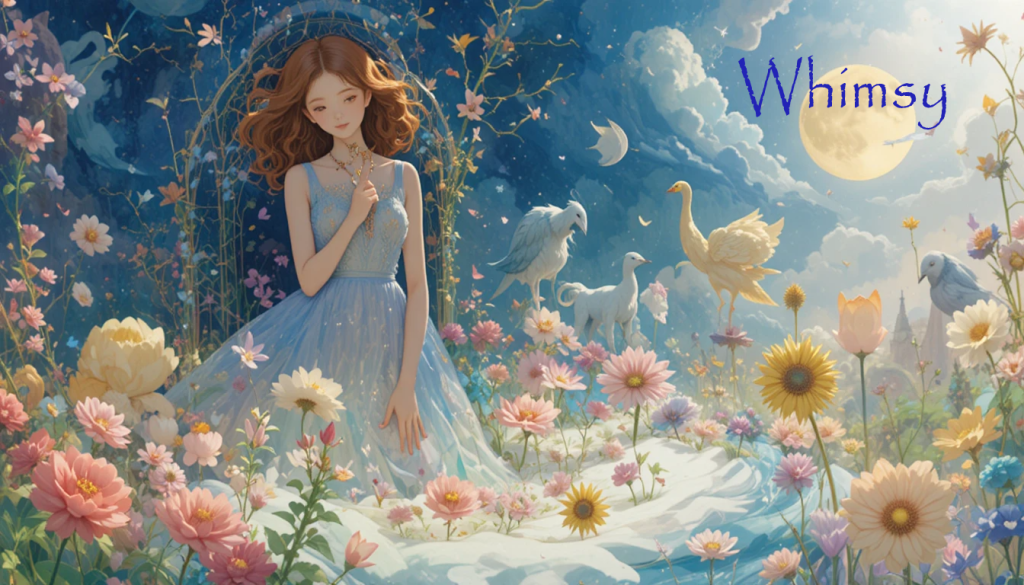
Whimsy
IPA Pronunciation: /ˈwɪm.zi/
Plural: Whimsies
Part of Speech: Noun (Aesthetic Quality / Disposition)
Origin
Whimsy arises from the lighter edges of imagination—where play, curiosity, and unpredictability override strict logic or solemn purpose. Historically, it has hovered between delight and dismissal, often admired for its charm yet suspected of frivolity.
The term gained particular cultural resonance in literary and artistic traditions that valued fancy, invention, and playful deviation from realism. In the modern imagination, whimsy is associated with works that invite surprise, tenderness, or gentle absurdity, often resisting the demands of seriousness without rejecting meaning altogether.
Whimsy thrives where rules are bent, not broken—where creativity wanders without becoming chaos.
Etymology
From whim-wham (17th-century English) — a trifle, fancy, or odd notion
Related to whim — a sudden idea or impulse
The word carries a history of lightness and motion, thought as play.
Core Definitions
Playful or Lightly Imaginative Quality
An inclination toward fanciful expression.
“The story is full of whimsy.”
Gentle Absurdity or Delightful Oddity
Surprise without menace.
“Her illustrations carry a quiet whimsy.”
An Aesthetic of Tender Playfulness
Imagination expressed with charm.
“The film balances melancholy with whimsy.”
Explanation & Nuance
Whimsy is not nonsense.
Its defining features include:
- Imagination without urgency
- Surprise without shock
- Play without mockery
- Delight without excess
Whimsy invites curiosity rather than awe, smiles rather than laughter. It often coexists with melancholy, acting as soft resistance to despair.
Unlike satire, whimsy does not criticize.
Unlike fantasy, it need not build worlds.
Unlike humor, it does not demand punchlines.
Contexts of Whimsy
Literature
Light metaphor, imaginative detours.
Visual Art
Delicate exaggeration, unexpected juxtapositions.
Film & Animation
Moments of wonder within realism.
Design
Playful details, gentle surprise.
Everyday Life
Small acts of imaginative joy.
Examples in Context
Literary:
“The novel is threaded with whimsy.”
Artistic:
“Her drawings radiate whimsy.”
Critical:
“Too much whimsy can dilute tension.”
Personal:
“He approaches life with whimsy.”
Aesthetic:
“The set design favors whimsy over realism.”
Symbolic Dimensions
- Paper Kite — lightness and lift
- Curlicue Line — playful deviation
- Clock Running Backward — defiance of order
- Teacup Ride — controlled disorientation
- Child’s Question — curiosity unburdened
Whimsy symbolizes imagination at ease.
Synonyms & Near-Relations
- Playfulness – broader, behavioral
- Fancy – older, literary
- Lightheartedness – emotional tone
- Quirkiness – personality-driven
- Caprice – more impulsive
(Whimsy uniquely blends gentleness, imagination, and charm.)
Cultural & Intellectual Resonance
Romanticism
Celebration of imagination.
Children’s Literature
Wonder without peril.
Modern Aesthetics
Balance against cynicism.
Animation
Visualized fancy.
Psychology
Creativity as play.
Critiques & Limits
- Can appear evasive or unserious
- Risks sentimentality
- May undercut gravity
- Easily commodified
Whimsy is most effective when anchored by sincerity.
Takeaway
Whimsy is imagination smiling —
a gentle tilt away from the expected,
where delight emerges not from spectacle
but from surprise softly offered.
It reminds us that play can be meaningful,
and that lightness, when chosen,
is not the absence of depth
but another way of holding it.
Lightness is not shallow when it is chosen with care
Curious about what happened today in history? Want to learn a new word every day?
You’ll find it all—first and in one place—at The-English-Nook.com!
If you love languages, this is your space.
Enjoy bilingual short stories, fun readings, useful vocabulary, and so much more in both English and Spanish.
Come explore!
 Word of the Day - The English Nook
Leave a comment