
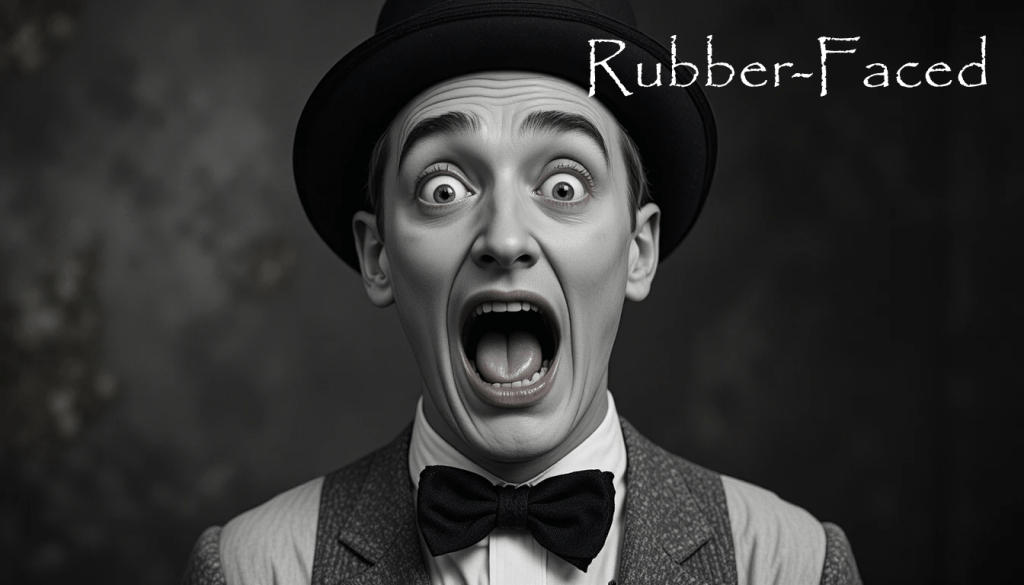
Rubber-Faced
IPA Pronunciation: /ˈrʌb.ər feɪst/
Plural: (adjectival; no plural form)
Part of Speech: Adjective (Descriptive / Performance-Oriented)
Origin
Rubber-faced arises from the visual language of early physical comedy, particularly in silent film, vaudeville, and slapstick traditions of the late 19th and early 20th centuries. The term describes performers whose facial muscles appeared preternaturally flexible—capable of extreme distortion, rapid transformation, and elastic exaggeration.
Such expressiveness was not mere novelty. In silent cinema, the face carried narrative weight normally borne by dialogue. The “rubber-faced” performer transformed emotion into pure visual language, readable at a distance and across cultures.
Over time, the term expanded metaphorically to describe any face or expression marked by excessive malleability or theatricality.
Etymology
Rubber:
From the elastic material — stretchable, resilient, returning to form
Faced:
Having a particular kind of face or expression
The compound suggests a face that bends without breaking.
Core Definitions
Marked by Extreme Facial Expressiveness
Capable of exaggerated, elastic expressions.
“A rubber-faced comedian.”
Associated with Physical or Visual Comedy
Expression as performance.
“His rubber-faced reactions drew laughter.”
Metaphorically: Emotionally or Socially Malleable
Adaptable, sometimes insincere.
“A rubber-faced smile.”
Explanation & Nuance
Rubber-faced expressiveness functions on multiple levels:
- Technical: mastery of facial musculature
- Comedic: exaggeration for humor
- Communicative: clarity without words
- Psychological: emotion heightened to absurdity
While often playful, the term can carry a critical edge when applied metaphorically, suggesting artificiality or performative emotion.
Contexts of Use
Silent Film & Slapstick
Visual storytelling without dialogue.
Vaudeville
Broad expressiveness for live audiences.
Animation & Caricature
Faces stretched beyond realism.
Comedy Criticism
Evaluating performance style.
Social Commentary
Describing insincere or exaggerated affect.
Examples in Context
Performance:
“His rubber-faced antics delighted the crowd.”
Film History:
“Rubber-faced comedy dominated early cinema.”
Animation:
“The character’s rubber-faced reactions defy realism.”
Critical:
“The humor leaned too heavily on rubber-faced exaggeration.”
Metaphorical:
“She offered a rubber-faced grin.”
Symbolic Dimensions
- Elastic Mask — identity as performance
- Mirror of Emotion — feeling amplified
- Caricature — distortion for clarity
- Living Cartoon — body as illustration
- Social Mask — adaptability and concealment
Rubber-faced symbolizes expression pushed beyond natural limits.
Synonyms & Near-Relations
- Expressive – broader, neutral
- Elastic-Faced – descriptive variant
- Cartoonish – visual exaggeration
- Mugging – overacting (often pejorative)
- Slapstick – genre-adjacent
(Rubber-faced uniquely emphasizes facial elasticity as performance.)
Cultural & Intellectual Resonance
Film Studies
Key to understanding silent-era acting.
Comedy Theory
Exaggeration as clarity.
Animation
Human face as malleable object.
Performance Studies
Body as communicative medium.
Social Psychology
Facial expression as social signal.
Takeaway
Rubber-faced names a style of expression where the face becomes instrument rather than surface —
stretched, contorted, animated for effect.
It celebrates the human face as elastic theater,
capable of turning muscle into meaning
and exaggeration into language.
When the face speaks louder than words
Curious about what happened today in history? Want to learn a new word every day?
You’ll find it all—first and in one place—at The-English-Nook.com!
If you love languages, this is your space.
Enjoy bilingual short stories, fun readings, useful vocabulary, and so much more in both English and Spanish.
Come explore!
 Word of the Day - The English Nook
Leave a comment