
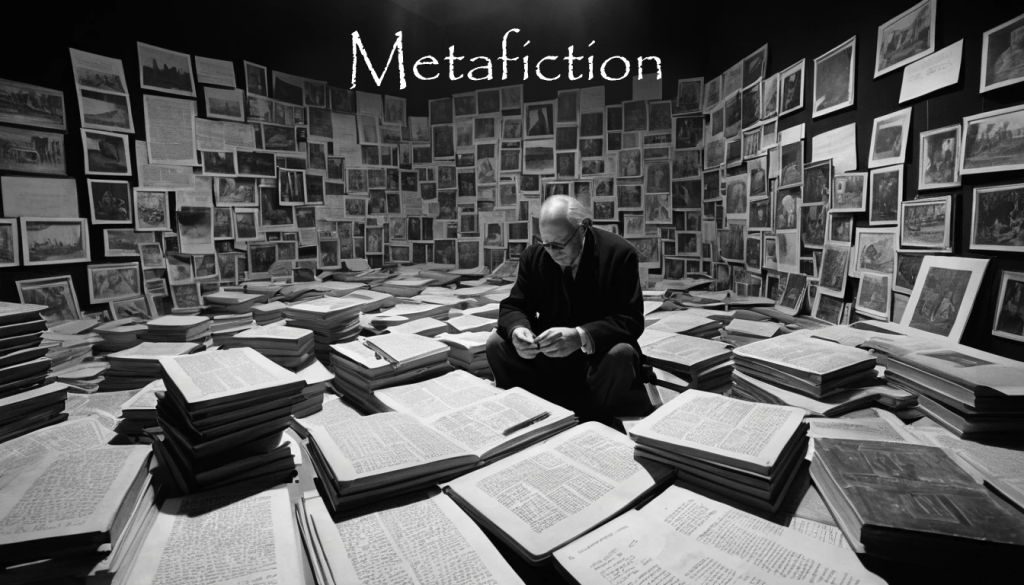
Metafiction
IPA Pronunciation: /ˌmɛt.əˈfɪk.ʃən/
Plural: (uncountable; occasionally metafictions when referring to distinct works)
Part of Speech: Noun (Literary Mode / Narrative Strategy)
Origin
Metafiction emerged as a critical term in the mid-20th century, though the practice itself is far older. Writers have long experimented with narratives that draw attention to their own artifice, but metafiction crystallized during periods of literary self-consciousness, particularly in postmodernism.
As traditional realism came under scrutiny, metafiction arose as a response to the question: What does it mean to tell a story? Rather than concealing its mechanisms, metafiction exposes them, making narrative construction itself the subject of inquiry.
The term gained prominence as critics sought language for works that resisted immersion in favor of reflection, foregrounding the act of storytelling as a constructed, contingent process.
Etymology
Meta-:
- Greek metá — beyond, about, after
Fiction:
- Latin fictio — shaping, forming, inventing
Metafiction literally means fiction about fiction.
It signals narrative that turns back upon itself, examining its own creation.
Core Definitions
Fiction That Self-Consciously Acknowledges Its Artifice
Narrative that draws attention to its status as a constructed text.
“The novel employs metafictional techniques.”
A Mode That Reflects on Storytelling Itself
The act of narration becomes a thematic concern.
“Metafiction interrogates narrative authority.”
A Strategy That Disrupts Reader Immersion
Breaking illusion to provoke awareness and analysis.
“The metafiction refuses seamless realism.”
Explanation & Nuance
Metafiction does not seek to destroy narrative; it seeks to understand it.
Its defining features include:
- Self-Reference: the text refers to its own making
- Narrative Interruption: authors, narrators, or characters address the reader
- Exposed Structure: plot and form become visible
- Ontological Play: questioning what is real within the story
- Reader Awareness: engagement through reflection rather than absorption
Metafiction replaces illusion with intellectual intimacy.
Common Metafictional Techniques
- Stories within stories
- Narrators who question their own reliability
- Characters aware they are fictional
- Direct address to the reader
- Commentary on genre conventions
These techniques transform reading into co-creation.
Examples in Context
Literary:
“The novel’s ending collapses into metafiction.”
Critical:
“Metafiction resists naïve realism.”
Narrative:
“The author inserts herself into the story.”
Postmodern:
“The book foregrounds metafictional play.”
Philosophical:
“Metafiction mirrors epistemological doubt.”
Symbolic Dimensions
- Mirror — text reflecting itself
- Broken Frame — narrative boundaries exposed
- Authorial Voice — authority questioned
- Open Script — story as process
- Labyrinth — reading as navigation
Metafiction symbolizes conscious storytelling.
Synonyms & Near-Relations
- Self-Reflexive Fiction – descriptive
- Narrative Self-Consciousness – analytical
- Postmodern Narrative – historical context
- Experimental Fiction – broader category
- Anti-Illusionist Prose – critical term
(Only metafiction explicitly names fiction that thinks about itself.)
Cultural & Intellectual Resonance
Literary Theory
Engages questions of authorship, authority, and meaning.
Philosophy
Echoes skepticism about truth and representation.
Modern Media
Influences film, television, and digital storytelling.
Reader Studies
Repositions the reader as active interpreter.
Postmodern Culture
Reflects fragmentation and self-awareness.
Criticism & Limits
Metafiction is sometimes critiqued for:
- Emotional distance
- Excessive cleverness
- Alienating readers
- Undermining narrative stakes
At its weakest, it becomes self-indulgent; at its strongest, it becomes clarifying.
Takeaway
Metafiction is storytelling that pauses to examine itself —
narrative aware of its own seams,
fiction that invites the reader behind the curtain.
It reminds us that stories do not merely reflect reality;
they construct it —
and that understanding the construction
is itself a form of meaning.
When fiction looks at itself, the reader learns how stories think.
Curious about what happened today in history? Want to learn a new word every day?
You’ll find it all—first and in one place—at The-English-Nook.com!
If you love languages, this is your space.
Enjoy bilingual short stories, fun readings, useful vocabulary, and so much more in both English and Spanish.
Come explore!
 Word of the Day - The English Nook
Leave a comment