
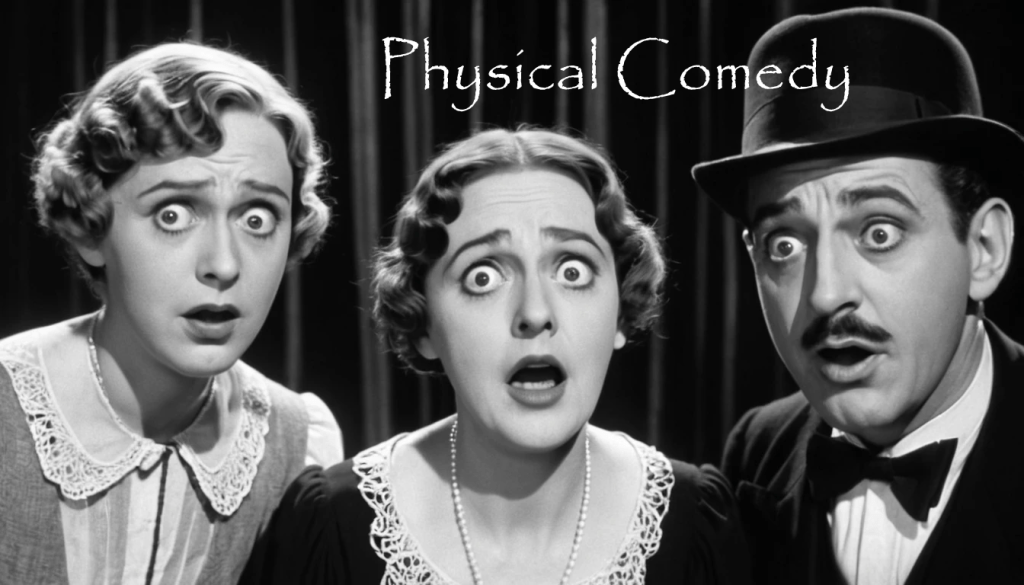
Physical Comedy
IPA Pronunciation: /ˈfɪz.ɪ.kəl ˈkɒm.ə.di/
Plural: Physical Comedies
Part of Speech: Noun (Genre / Comedic Mode)
Origin
Physical comedy is among the oldest forms of humor, predating written language and formal theater. Its roots lie in gesture, movement, and bodily exaggeration, where meaning is conveyed through action rather than words.
The tradition flourished in ancient Greek and Roman theater, medieval farce, and commedia dell’arte, later finding iconic expression in silent film, where performers like Charlie Chaplin and Buster Keaton transformed the human body into an instrument of timing, tension, and surprise.
Because it bypasses language, physical comedy has remained universally legible, crossing cultures and generations with ease.
Etymology
Physical:
- Greek phýsis — nature, body
Comedy:
- Greek kōmōidía — festive song, humor
Together, physical comedy means laughter generated by the body in motion.
Core Definitions
A Form of Comedy Based on Bodily Action
Humor arising from movement, gesture, or physical mishap.
“The scene relies on physical comedy rather than dialogue.”
Visual Humor That Transcends Language
Comedy understood through sight and timing alone.
“Physical comedy communicates instantly.”
Performance Emphasizing Timing, Balance, and Exaggeration
The body becomes the narrative medium.
“Her mastery of physical comedy is precise.”
Explanation & Nuance
Physical comedy is deceptively demanding.
Its subtleties include:
- Timing: humor depends on rhythm and pause
- Control: chaos choreographed with precision
- Risk: the appearance of danger without harm
- Exaggeration: reality stretched, not broken
- Empathy: laughter arises from recognition, not cruelty
At its best, physical comedy evokes both laughter and tenderness.
Examples in Context
Theatrical:
“The farce depends on physical comedy.”
Cinematic:
“Silent films perfected physical comedy.”
Television:
“The show revives slapstick physical comedy.”
Performative:
“His pratfalls are carefully rehearsed.”
Cultural:
“Physical comedy remains globally accessible.”
Symbolic Dimensions
- Falling Body — human vulnerability
- Elastic Reality — rules bent for laughter
- Mechanical Gesture — humans as contraptions
- Collision — surprise as humor
- Recovery — resilience after failure
Physical comedy symbolizes the body’s refusal to behave as planned.
Synonyms & Near-Relations
- Slapstick – exaggerated, impact-based humor
- Visual Comedy – emphasis on sight
- Farce – narrative-driven physical humor
- Clowning – theatrical embodiment
- Mime – silent, gestural performance
(Only physical comedy foregrounds the body as primary comic language.)
Cultural & Intellectual Resonance
Film History:
Central to early cinema and modern visual humor.
Performance Studies:
Demonstrates embodiment and nonverbal communication.
Cross-Cultural Comedy:
Functions beyond linguistic boundaries.
Psychology:
Engages surprise, empathy, and release.
Modern Media:
Continues in animation and digital comedy.
Takeaway
Physical Comedy reminds us that humor begins in the body —
in imbalance, collision, and recovery.
It laughs at gravity,
reveals dignity in clumsiness,
and finds joy in the fragile mechanics of being human.
When the body speaks, laughter understands
Curious about what happened today in history? Want to learn a new word every day?
You’ll find it all—first and in one place—at The-English-Nook.com!
If you love languages, this is your space.
Enjoy bilingual short stories, fun readings, useful vocabulary, and so much more in both English and Spanish.
Come explore!
 Word of the Day - The English Nook
Leave a comment