
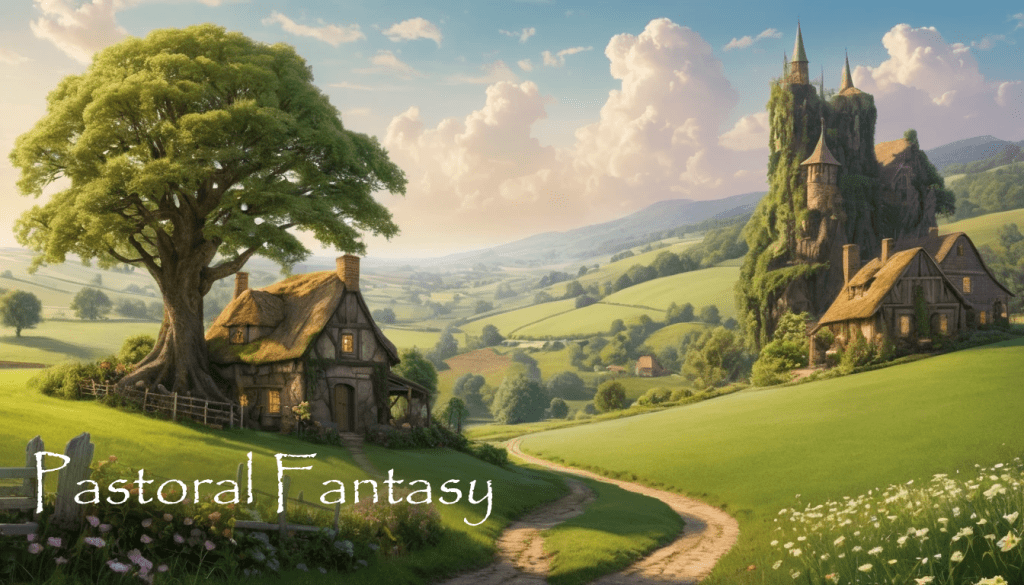
Pastoral Fantasy
IPA Pronunciation: /ˈpæs.tər.əl ˈfæn.tə.si/
Plural: Pastoral Fantasies
Part of Speech: Noun (Genre / Aesthetic Mode)
Origin
Pastoral fantasy arises from the convergence of two ancient imaginative traditions: the pastoral, rooted in classical poetry’s idealization of rural life, and fantasy, the creation of worlds shaped by magic, myth, and the unreal.
The pastoral tradition dates back to Theocritus and Virgil, who depicted shepherds, fields, and simple labor as refuges from political and urban complexity. Fantasy, meanwhile, supplied mythic beings, enchanted landscapes, and alternate realities.
When combined, pastoral fantasy does not merely escape into the countryside — it reimagines nature as enchanted, where the land itself possesses memory, agency, and moral weight. The genre flourished in Romanticism and later in modern fantasy literature, animation, and visual art.
Etymology
Pastoral:
- Latin pastor — shepherd
Fantasy:
- Greek phantasía — imagination, appearance
Together, pastoral fantasy means imagined worlds shaped by shepherded landscapes, where nature is both home and myth.
Core Definitions
A Fantasy Genre Centered on Rural or Natural Settings
Stories set in enchanted countrysides, forests, fields, or villages.
“The novel is a pastoral fantasy.”
An Aesthetic Ideal of Harmonized Nature and Magic
Where supernatural elements coexist with agrarian life.
“Pastoral fantasy softens epic conflict.”
A Mode of Escapism Rooted in Simplicity and Care
Retreat from industrial or violent modernity.
“Pastoral fantasy imagines gentler worlds.”
Explanation & Nuance
Pastoral fantasy is not naïve nostalgia.
Its deeper tensions include:
- Idealization vs. Reality: beauty alongside hardship
- Nature as Moral Force: landscapes that respond to human action
- Slowness: time measured by seasons rather than conquest
- Labor as Meaning: work depicted as sustaining rather than alienating
- Fragility: harmony is temporary, always at risk
Conflict exists, but it is often ecological or ethical, not purely martial.
Examples in Context
Literary:
“The Shire exemplifies pastoral fantasy.”
Cinematic:
“Miyazaki’s villages are steeped in pastoral fantasy.”
Visual Art:
“The illustration blends folklore with pastoral fantasy.”
Critical:
“Pastoral fantasy resists grimdark conventions.”
Mythic:
“Spirits inhabit the fields in pastoral fantasy.”
Symbolic Dimensions
- Meadow — cultivated peace
- Forest Edge — threshold between worlds
- Shepherd — care and stewardship
- Seasonal Cycle — time as renewal
- Hearth — communal warmth
Pastoral fantasy symbolizes hope rooted in place.
Synonyms & Near-Relations
- Rural Fantasy – descriptive, less mythic
- Arcadian Fantasy – classical emphasis
- Low Fantasy – overlaps in scale, not tone
- Mythic Pastoral – poetic variant
- Eco-Fantasy – modern environmental focus
(Only pastoral fantasy unites magic with agrarian intimacy.)
Cultural & Intellectual Resonance
Literature:
Counterbalance to epic and grimdark fantasy.
Environmental Thought:
Imagines reciprocal relationships with land.
Animation & Film:
Uses landscape as emotional language.
Philosophy:
Explores simplicity without primitivism.
Modern Longing:
Responds to industrial alienation.
Takeaway
Pastoral Fantasy envisions worlds where magic grows quietly —
in fields, kitchens, and woodlands,
where heroism is care,
and power lies in preservation rather than conquest.
It is fantasy at human scale,
where the land remembers those who tend it,
and wonder survives in ordinary places.
Where magic doesn’t conquer the land — it tends it.
Curious about what happened today in history? Want to learn a new word every day?
You’ll find it all—first and in one place—at The-English-Nook.com!
If you love languages, this is your space.
Enjoy bilingual short stories, fun readings, useful vocabulary, and so much more in both English and Spanish.
Come explore!
 Word of the Day - The English Nook
Leave a comment