
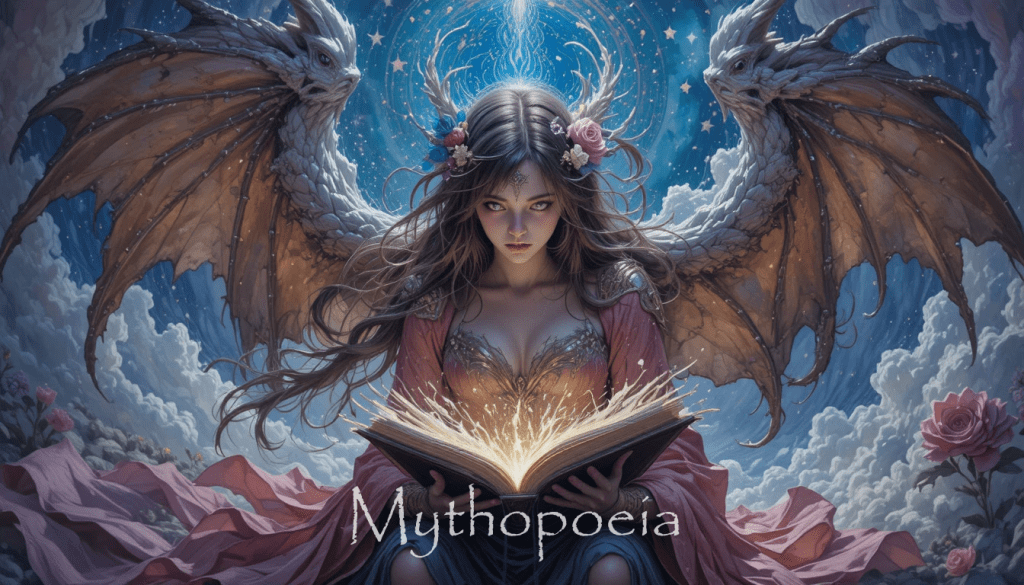
Mythopoeia
IPA Pronunciation: /ˌmɪθ.oʊˈpiː.ə/ or /ˌmaɪ.θoʊˈpiː.ə/
Plural: (uncountable; occasionally mythopoeias when referring to distinct works or traditions)
Part of Speech: Noun
Origin
Mythopoeia entered modern critical vocabulary in the late 19th and early 20th centuries, during a renewed scholarly and artistic interest in myth as a living, generative force rather than a primitive relic. The term gained particular resonance among writers and thinkers who sought to create new mythic structures for a disenchanted modern world.
It is most closely associated with Romanticism and modern fantasy, especially the work of figures such as J. R. R. Tolkien, who argued that myth-making was not escapism but a fundamental human activity — a way of expressing truths that resist literal language.
Etymology
Greek:
- mŷthos (μῦθος) — story, speech, legend
- poieîn (ποιεῖν) — to make, to create
Mythopoeia literally means “the making of myth.”
The word emphasizes creation rather than inheritance — not merely retelling ancient myths, but forging new symbolic worlds.
Core Definitions
The Act or Art of Creating Myths
The imaginative construction of mythic narratives, worlds, or systems.
“The novel is an act of modern mythopoeia.”
A Literary or Cultural Practice of Myth-Making
The deliberate shaping of symbolic narratives to convey meaning.
“Fantasy literature often engages in mythopoeia.”
A Worldview Expressed Through Mythic Form
Understanding reality through symbolic, archetypal stories.
“Mythopoeia gives structure to collective imagination.”
Explanation & Nuance
Mythopoeia is not imitation, but invention with archetypal depth.
Its nuances include:
- Symbolic Density: meaning carried through image and story
- World-Building: coherent cosmologies and histories
- Archetypal Resonance: characters larger than individuality
- Timelessness: stories set outside linear history
- Truth Beyond Fact: meaning conveyed through metaphor
Mythopoeia does not ask to be believed literally; it asks to be entered imaginatively.
Examples in Context
Literary:
“Tolkien’s legendarium is a monumental act of mythopoeia.”
Poetic:
“The poem performs mythopoeia through symbolic language.”
Cultural:
“Nations engage in mythopoeia when crafting founding narratives.”
Critical:
“The film’s mythopoeia borrows freely from ancient motifs.”
Philosophical:
“Mythopoeia restores meaning where rationalism alone falters.”
Symbolic Dimensions
- Forged World — reality shaped by imagination
- Sacred Story — narrative as vessel of truth
- Cosmic Pattern — order rendered through myth
- Hero’s Journey — archetype reborn
- Name-Giving — creation through language
Mythopoeia symbolizes meaning made durable through story.
Synonyms & Near-Relations
- Myth-Making – plain-language equivalent
- Legend-Building – narrative emphasis
- Cosmogony – creation of worlds, narrower scope
- World-Building – technical term, less symbolic
- Archetypal Storytelling – descriptive phrase
(Only mythopoeia carries the full sense of conscious, creative myth formation.)
Cultural & Intellectual Resonance
Literature:
Central to fantasy, epic, and speculative fiction.
Religion & Mythology:
Explains origins, values, and cosmic order.
Philosophy:
Engages with symbolic truth and meaning-making.
Psychology:
Links to archetypes and collective imagination.
Modern Culture:
Visible in cinematic universes and national narratives.
Takeaway
Mythopoeia names the human impulse to make meaning vast —
to shape imagination into cosmos,
and story into structure.
It is creation as remembrance,
the forging of symbols where facts fall silent,
and the art of giving the world a soul through narrative.
Mythopoeia doesn’t explain the world—it gives the world a soul through story.
Curious about what happened today in history? Want to learn a new word every day?
You’ll find it all—first and in one place—at The-English-Nook.com!
If you love languages, this is your space.
Enjoy bilingual short stories, fun readings, useful vocabulary, and so much more in both English and Spanish.
Come explore!
 Word of the Day - The English Nook
Leave a comment