
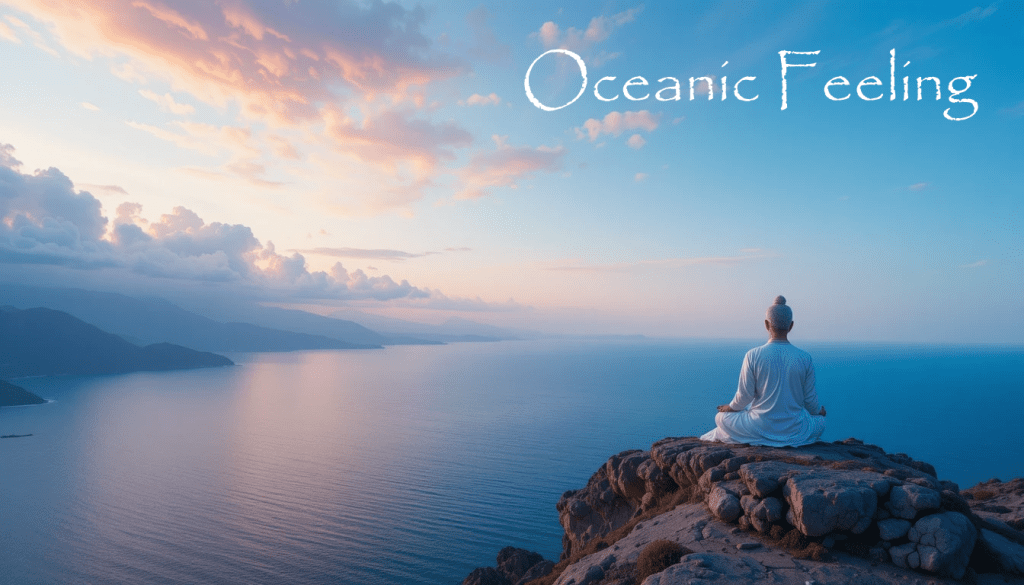
Oceanic Feeling
IPA Pronunciation: /ˌoʊ.ʃiˈæn.ɪk ˈfiː.lɪŋ/
Plural: (uncountable)
Part of Speech: Noun Phrase
Origin
The term oceanic feeling was introduced into modern intellectual discourse by Romain Rolland in the early 20th century and later examined by Sigmund Freud in Civilization and Its Discontents (1930). Rolland used the phrase to describe a sensation of limitless expansion, a feeling of unity with the world that precedes rational thought and personal identity.
Though Freud remained skeptical of its spiritual interpretation, he acknowledged the oceanic feeling as a profound psychological state — one rooted in early consciousness, when the boundary between self and world had not yet fully formed.
Etymology
Oceanic:
- Greek ōkeanós — the great encircling sea
Feeling:
- Old English fēlan — to perceive, to sense
The phrase evokes vastness without edge, sensation without containment.
Oceanic feeling names an experience that resists definition, existing prior to language and structure.
Core Definitions
A Sense of Limitless Unity with the Whole
A feeling in which the self dissolves into a larger totality.
“Meditation evoked an oceanic feeling of belonging.”
A Pre-Egoic or Transcendent Psychological State
Often associated with infancy, mysticism, or deep contemplation.
“Freud linked the oceanic feeling to early ego formation.”
A Spiritual or Mystical Experience of Boundlessness
Interpreted as communion with the divine or the universe.
“The prayer culminated in an oceanic feeling.”
Explanation & Nuance
The oceanic feeling is not emotion alone, but altered perception.
Its nuances include:
- Boundary Dissolution: self and world merge
- Timelessness: past and future collapse into presence
- Calm or Awe: intensity without agitation
- Ineffability: experience exceeds language
- Ambiguity: can be comforting or overwhelming
Unlike ecstasy, the oceanic feeling is often quiet, expansive, and deeply still.
Examples in Context
Psychological:
“The oceanic feeling reflects an early state of undifferentiated selfhood.”
Spiritual:
“Mystics across traditions describe an oceanic feeling.”
Literary:
“The novel’s climax drifts into oceanic feeling.”
Aesthetic:
“The music induces an oceanic feeling of immersion.”
Personal:
“Standing alone beneath the stars, she felt an oceanic feeling.”
Symbolic Dimensions
- Open Sea — infinity without borders
- Horizon — self dissolving into distance
- Salt Water — origin of life and tears
- Breath and Tide — rhythm without will
- Flooded Light — awareness without edge
Oceanic feeling symbolizes belonging without possession.
Synonyms & Near-Relations
- Mystical Unity – theological framing
- Cosmic Consciousness – philosophical
- Transcendence – broader, less sensory
- Nondual Awareness – Eastern philosophical term
- Ego Dissolution – psychological phrasing
(Only oceanic feeling preserves the metaphor of vastness and gentleness.)
Cultural & Intellectual Resonance
Psychoanalysis:
Debated as developmental memory or illusion.
Mysticism:
Described as union with the divine.
Literature:
Used to express awe, loss of self, or profound peace.
Philosophy:
Challenges the primacy of the bounded self.
Neuroscience:
Studied in relation to meditation and altered states.
Takeaway
Oceanic feeling names the experience of boundlessness —
the self loosening its edges,
the world felt as continuous rather than divided.
It is the memory of unity,
the quiet vastness beneath identity,
where being feels larger than the self that names it.
When the self goes quiet, the world suddenly feels infinite.
Curious about what happened today in history? Want to learn a new word every day?
You’ll find it all—first and in one place—at The-English-Nook.com!
If you love languages, this is your space.
Enjoy bilingual short stories, fun readings, useful vocabulary, and so much more in both English and Spanish.
Come explore!
 Word of the Day - The English Nook
Leave a comment