
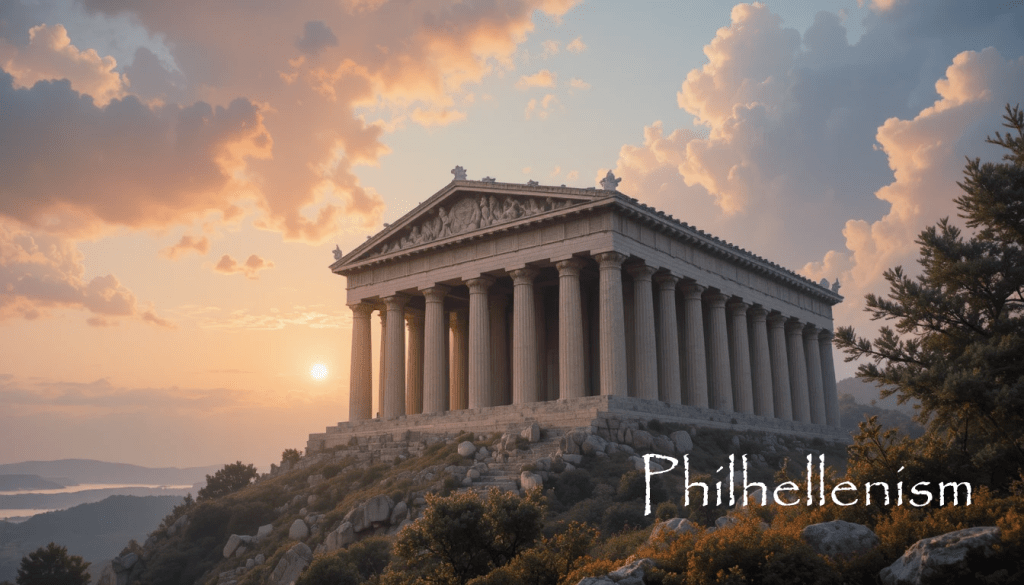
Philhellenism
IPA Pronunciation: /ˌfɪlˈhɛl.ɪ.nɪ.zəm/
Plural: (uncountable; occasionally philhellenisms when referring to specific movements or expressions)
Part of Speech: Noun
Origin
Philhellenism emerged as a formal term in the late 18th and early 19th centuries, during a period of renewed European fascination with ancient Greek culture, art, philosophy, and political ideals. The movement reached its emotional and political height during the Greek War of Independence (1821–1830), when writers, artists, and intellectuals across Europe expressed admiration for Greece’s classical past and sympathy for its modern struggle.
To be a philhellene was not merely to admire Greece aesthetically, but to regard Greek civilization as a foundational source of Western thought, democracy, and beauty — a lineage to be revered, studied, and, at times, idealized.
Etymology
Greek:
- phílos — loving, fond of
- Hellēn — a Greek person; Greece
-ism:
- indicating a system of belief, attitude, or movement
Philhellenism literally means “love of Greece”, though in practice it often signifies love of an imagined Greece — classical, heroic, and idealized.
Core Definitions
Admiration for Greek Culture and Civilization
Aesthetic, intellectual, or emotional devotion to Greek art, literature, philosophy, or history.
“Romantic poets were deeply influenced by philhellenism.”
A Cultural and Political Movement Supporting Greece
Especially support for Greek independence from Ottoman rule.
“Philhellenism galvanized European support for the revolution.”
An Ideological Alignment with Classical Greek Ideals
Identification with perceived Greek values such as reason, harmony, and democracy.
“Neoclassical architecture reflects philhellenism in stone.”
Explanation & Nuance
Philhellenism is both reverence and projection.
Its nuances include:
- Idealization: ancient Greece elevated as cultural origin
- Selective Memory: emphasis on classical eras over others
- Aesthetic Authority: Greek forms as models of beauty
- Political Symbolism: Greece as emblem of liberty
- Cultural Mediation: modern identities shaped through ancient reference
Philhellenism often says as much about the admirer as about Greece itself.
Examples in Context
Historical:
“Lord Byron’s philhellenism led him to fight in Greece.”
Artistic:
“The sculpture’s proportions reflect 19th-century philhellenism.”
Academic:
“Classical studies grew under the influence of philhellenism.”
Political:
“Philhellenism framed the revolution as a return to ancient freedom.”
Critical:
“Modern scholars interrogate the romantic excesses of philhellenism.”
Symbolic Dimensions
- Ruined Temple — grandeur filtered through loss
- Marble Ideal — purity abstracted from history
- Olive Branch — peace and antiquity
- Lyre — harmony and poetic origin
- Classical Column — order as inheritance
Philhellenism symbolizes cultural ancestry imagined as destiny.
Synonyms & Near-Relations
- Hellenophilia – affectionate admiration
- Classicism – broader aesthetic alignment
- Neoclassicism – artistic movement inspired by antiquity
- Graecophilia – rare variant
- Antiquarianism – historical interest without devotion
(Only philhellenism carries emotional, ideological, and political weight together.)
Cultural & Intellectual Resonance
Literature:
Inspired Romantic poetry and travel writing.
Art & Architecture:
Shaped neoclassical forms and ideals.
Politics:
Mobilized international sympathy for Greek independence.
Education:
Anchored Western curricula in Greek texts.
Postcolonial Critique:
Reexamined as idealization that erased modern Greece.
Takeaway
Philhellenism names devotion to a cultural origin —
love directed not only toward Greece,
but toward what Greece is imagined to represent.
It is admiration shaped by distance,
heritage filtered through longing,
and the past invoked to define the present.
Philhellenism is the past admired so deeply that it begins to speak for the present.
Curious about what happened today in history? Want to learn a new word every day?
You’ll find it all—first and in one place—at The-English-Nook.com!
If you love languages, this is your space.
Enjoy bilingual short stories, fun readings, useful vocabulary, and so much more in both English and Spanish.
Come explore!
 Word of the Day - The English Nook
Leave a comment