
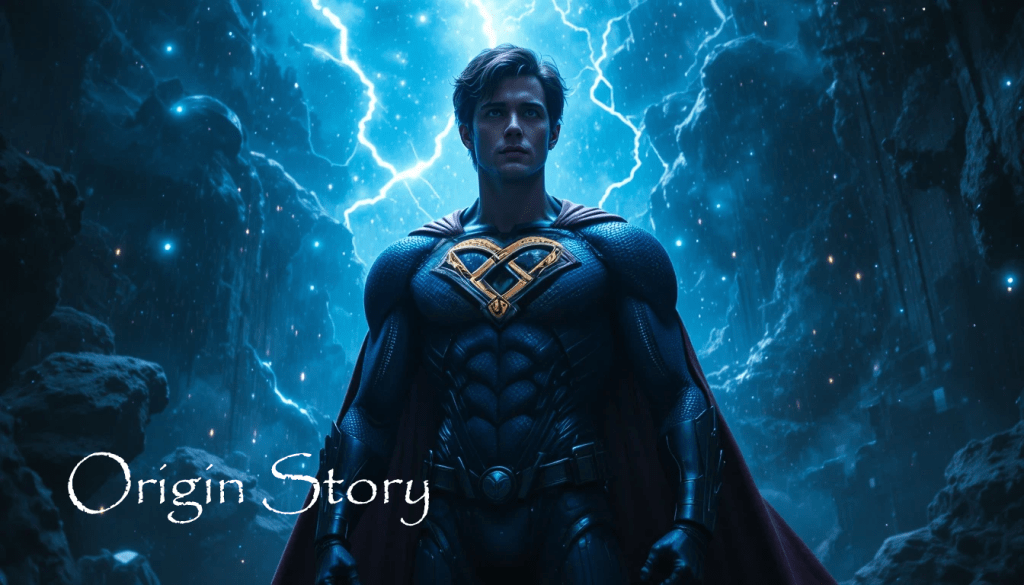
Origin Story
IPA Pronunciation: /ˈɒr.ɪ.dʒɪn ˈstɔːr.i/
Plural: Origin Stories
Part of Speech: Noun
Origin
The phrase origin story gained prominence in the late 20th century, particularly within comic books, film, and popular mythology, where it described the narrative that explains how a hero, villain, or figure came to possess a defining identity or power.
Yet the concept long predates the phrase. Cultures have always told stories to explain beginnings — of gods, nations, families, and selves. What modern usage formalized was the recognition that identity is not only what one is, but how one came to be.
An origin story does not merely recount events; it frames meaning. It selects, emphasizes, and interprets the past to make the present legible.
Etymology
Origin:
- Latin ōrīgō — beginning, source, rise
Story:
- Old French estoire — narrative, account
- from Latin historia — inquiry, learning by investigation
Together, the phrase unites source and narration — the beginning shaped into explanation.
An origin story is not raw history, but history told with purpose.
Core Definitions
A Narrative Explaining the Beginning of an Identity
A story that accounts for how a person, character, institution, or idea came to be.
“Every superhero has an origin story.”
A Foundational Myth of Selfhood
A selective account that stabilizes identity.
“She returned often to her origin story.”
A Retrospective Meaning-Making Device
The past arranged to justify the present.
“The brand’s origin story emphasizes struggle and innovation.”
Explanation & Nuance
An origin story is less about chronology than coherence.
Its nuances include:
- Selection: not everything is included
- Causality: events are framed as formative
- Mythmaking: fact and interpretation entwined
- Justification: current identity made inevitable
- Repetition: origins retold to reaffirm meaning
Origin stories often grow simpler over time, shedding contradiction in favor of clarity.
Examples in Context
Pop Culture:
“The reboot retells the hero’s origin story.”
Personal:
“Therapy revisited his origin story.”
Corporate:
“The company’s origin story begins in a garage.”
Political:
“Nations construct origin stories to legitimize power.”
Literary:
“The novel interrogates the reliability of its origin story.”
Symbolic Dimensions
- First Wound — trauma as beginning
- Spark — moment of transformation
- Threshold Crossing — entry into identity
- Before and After — life divided
- Rewritten Past — memory shaped by need
Origin stories symbolize identity anchored in narrative rather than pure fact.
Synonyms & Near-Relations
- Founding Myth – collective origin
- Genesis Narrative – biblical or formal
- Backstory – technical, less symbolic
- Creation Story – cosmological scope
- Provenance – factual lineage without narrative
(Only origin story emphasizes identity emerging through narrative selection.)
Cultural & Intellectual Resonance
Mythology:
Explains gods, heroes, and worlds.
Psychology:
Shapes self-understanding and continuity.
Literature & Film:
Structures character motivation.
Sociology:
Legitimizes institutions and social orders.
Marketing:
Humanizes brands through narrative struggle.
Takeaway
Origin story names the act of beginning made meaningful —
the past shaped into explanation,
the self stabilized through story.
It reminds us that who we are
is inseparable from how we tell
where we came from.
An origin story doesn’t tell where you started—it tells why you became.
Curious about what happened today in history? Want to learn a new word every day?
You’ll find it all—first and in one place—at The-English-Nook.com!
If you love languages, this is your space.
Enjoy bilingual short stories, fun readings, useful vocabulary, and so much more in both English and Spanish.
Come explore!
 Word of the Day - The English Nook
Leave a comment