
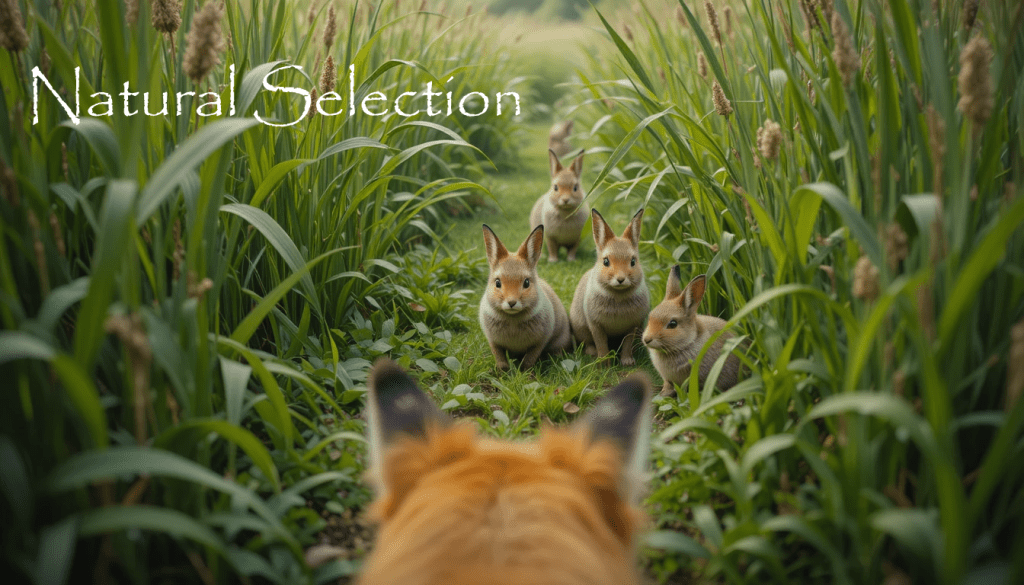
Natural Selection
IPA Pronunciation: /ˈnætʃ.ər.əl sɪˈlɛk.ʃən/
Plural: (uncountable; sometimes pluralized as natural selections in theoretical contexts)
Part of Speech: Noun
Origin
Natural selection emerged as a formal concept in the mid-19th century, most famously articulated by Charles Darwin in On the Origin of Species (1859). It arose from attempts to explain how complex life forms could evolve without divine orchestration, guided instead by lawful processes embedded in nature itself.
The phrase names a quiet but relentless mechanism: traits that enhance survival and reproduction tend to persist, while those that hinder them gradually disappear. Unlike artificial selection, which implies human intention, natural selection operates without foresight, shaping life through cumulative consequence rather than conscious design.
Etymology
Natural:
- Latin nātūrā — birth, constitution, inherent order
Selection:
- Latin selectiō — a choosing out
- from seligere — to pick apart, to distinguish
Together, the term paradoxically unites blind process and apparent choice — a metaphor that grants intelligibility to an impersonal force.
Natural selection is not a chooser, but a filter, shaping form through survival.
Core Definitions
A Mechanism of Evolution
The process by which heritable traits that improve survival or reproduction become more common over generations.
“Natural selection explains adaptation without intention.”
Differential Survival and Reproduction
Organisms better suited to their environment tend to leave more offspring.
“Camouflage evolved through natural selection.”
A Non-Teleological Shaper of Life
Change without goal, direction without design.
“Natural selection has no end in mind.”
Explanation & Nuance
Natural selection operates through variation, inheritance, and differential success.
Its nuances include:
- Blindness: no foresight or moral aim
- Gradualism: small changes accumulate over time
- Context Dependence: what is advantageous varies by environment
- Wastefulness: countless lives discarded without record
- Creativity through Constraint: complexity emerges from limitation
Natural selection explains not perfection, but fitness — adequacy for survival, not optimality.
Examples in Context
Biological:
“Antibiotic resistance is a clear case of natural selection in action.”
Historical Science:
“Darwin reframed life as process rather than product.”
Ecological:
“Environmental change alters the direction of natural selection.”
Philosophical:
“Natural selection undermines notions of fixed essence.”
Metaphorical:
“Ideas, like organisms, undergo natural selection.”
Symbolic Dimensions
- Filter — survival through narrowing
- River Current — pressure shaping form
- Invisible Hand — order without intention
- Open Field — variation without hierarchy
- Graveyard and Garden — loss and continuity entwined
Natural selection symbolizes order emerging from indifference, meaning arising without meaning intended.
Synonyms & Near-Relations
- Evolutionary Selection – explanatory variant
- Survival of the Fittest – popular but misleading phrase
- Adaptive Filtering – descriptive, nonstandard
- Differential Reproduction – technical phrasing
- Evolutionary Pressure – partial emphasis
(Only natural selection captures both mechanism and metaphor.)
Cultural & Intellectual Resonance
Biology:
The central explanatory principle of modern life science.
Philosophy:
Challenges teleology, essence, and divine design.
Sociology & Economics:
Borrowed metaphorically — sometimes dangerously — to justify hierarchy.
Literature:
Invoked to explore chance, struggle, and contingency.
Psychology:
Frames behavior as adaptive response rather than moral choice.
Takeaway
Natural selection names the quiet architecture of life —
change without intention,
order without author.
It is the patience of consequence,
the shaping power of survival,
and the reminder that complexity need not be planned to endure.
Natural selection doesn’t plan life—it filters it.
Curious about what happened today in history? Want to learn a new word every day?
You’ll find it all—first and in one place—at The-English-Nook.com!
If you love languages, this is your space.
Enjoy bilingual short stories, fun readings, useful vocabulary, and so much more in both English and Spanish.
Come explore!
 Word of the Day - The English Nook
Leave a comment