
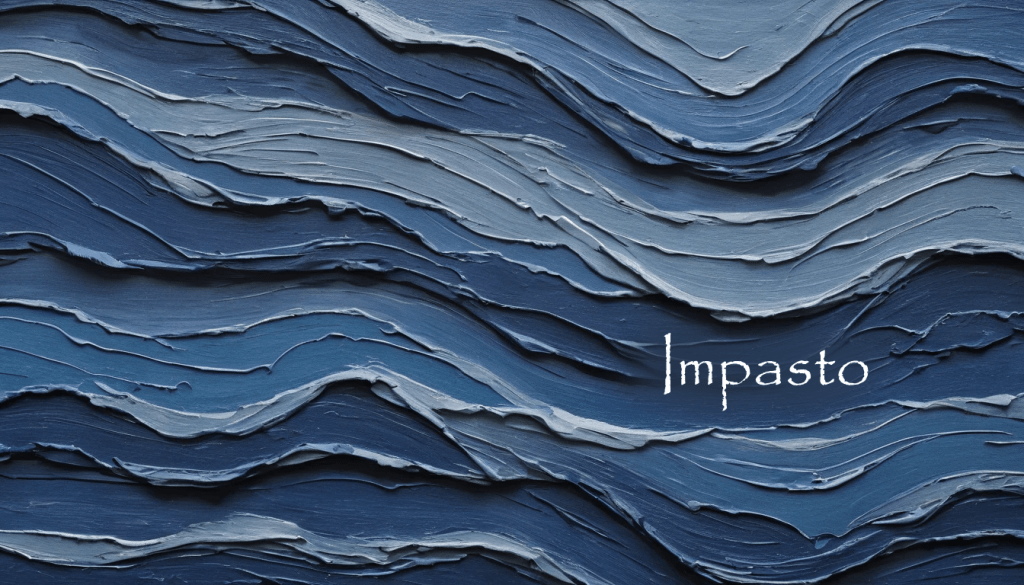
Impasto
IPA Pronunciation: /ɪmˈpæs.toʊ/
Plural: Impastos (also Impasti)
Part of Speech: Noun
Origin
Impasto entered English in the mid-17th century through Italian art theory, at a time when painters began to emphasize materiality and gesture as expressive forces. The term originally described the physical mixture or “paste” of pigment and binder, but quickly evolved to denote a painting technique in which paint is laid on thickly enough to retain visible texture.
From the Baroque through Impressionism and into modern abstraction, impasto became a declaration: paint no longer pretended to be invisible. Instead, it announced its own presence — pigment as substance, surface as event.
Etymology
Italian:
- impasto — dough, paste, mixture
- from impastare — to knead, to mix
Latin Root:
- in- (“into”) + pastāre (“to paste, to knead”)
The culinary origin is deliberate: impasto treats paint as matter to be worked, shaped, and felt.
Thus, impasto is texture made expressive — surface given agency.
Core Definitions
A Painting Technique Using Thick, Textured Layers of Paint
Paint applied so heavily that brushstrokes or palette-knife marks remain visible.
“The impasto catches the light, animating the canvas.”
The Physical Build-Up of Pigment on a Surface
Paint as relief rather than illusion.
“Van Gogh’s impasto transforms color into structure.”
A Deliberate Emphasis on Material Presence
Using texture to convey emotion, energy, or movement.
“The impasto makes the painting feel urgent, almost sculptural.”
Explanation & Nuance
Impasto rejects smoothness.
It insists on touch, resistance, and weight.
Nuanced aspects include:
- Visibility of Gesture: the artist’s hand remains legible
- Light Interaction: raised surfaces refract illumination
- Emotional Intensity: thickness conveys urgency or passion
- Time Frozen: movement arrested mid-stroke
- Defiance of Illusion: paint refuses to disappear into representation
Where glazing whispers, impasto declares.
Examples in Context
Art Historical:
“Rembrandt’s impasto brings flesh and fabric into tactile presence.”
Modern Art:
“Abstract expressionists embraced impasto to foreground process.”
Critical:
“The impasto disrupts depth, pulling the viewer back to the surface.”
Descriptive:
“The sky is rendered in violent impasto, clouds piled like stone.”
Metaphorical:
“Her prose works in impasto — dense, layered, textured with emotion.”
Symbolic Dimensions
- Raised Scar — history written on the surface
- Frozen Motion — gesture preserved
- Thick Skin — protection and exposure combined
- Light Trap — illumination caught and fractured
- Material Truth — refusal of concealment
Impasto symbolizes honesty of medium — emotion made physical, effort left visible.
Synonyms & Near-Relations
- Heavy Texture – descriptive, nontechnical
- Relief Painting – emphasizes dimensionality
- Painterly Surface – broader stylistic term
- Thick Application – neutral phrasing
- Expressionist Technique – contextual rather than precise
(Only impasto precisely names paint applied with sculptural intent.)
Cultural & Intellectual Resonance
Art & Aesthetics:
A shift from illusion toward material truth.
Philosophy:
Aligns with phenomenology — experience through surface and presence.
Psychology:
Texture as emotional residue.
Modernism:
A rebellion against polish and concealment.
Literary Metaphor:
Used to describe dense, layered language or emotional expression.
Takeaway
Impasto names paint that refuses to be quiet —
color given weight, gesture given permanence,
surface made expressive.
It is the mark that does not retreat,
the trace of the hand left unapologetically visible,
where texture becomes meaning.
When paint stops pretending, the surface starts speaking.
Curious about what happened today in history? Want to learn a new word every day?
You’ll find it all—first and in one place—at The-English-Nook.com!
If you love languages, this is your space.
Enjoy bilingual short stories, fun readings, useful vocabulary, and so much more in both English and Spanish.
Come explore!
 Word of the Day - The English Nook
Leave a comment