
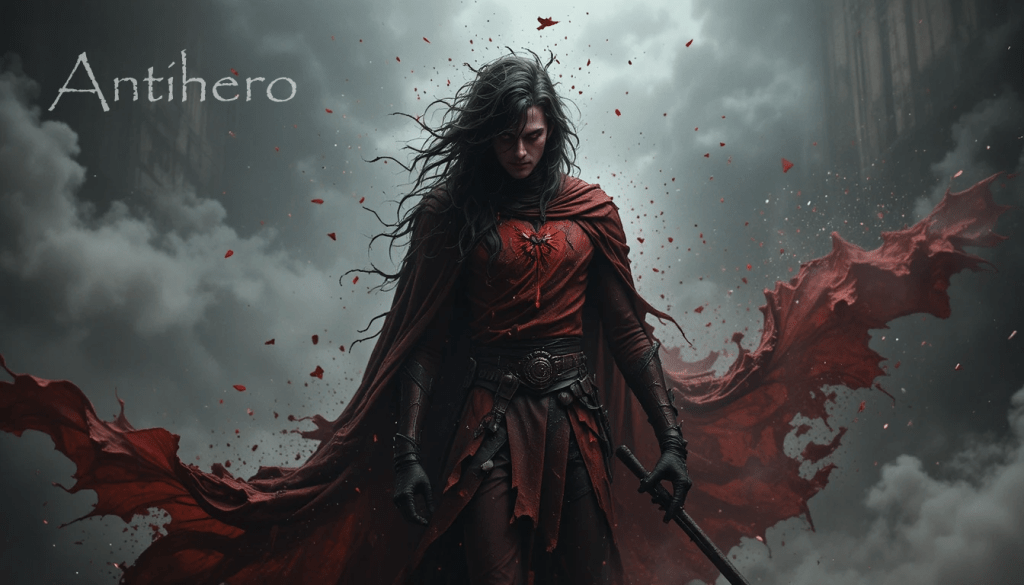
Antihero
IPA Pronunciation: /ˈæn.tiˌhɪə.roʊ/
Plural: Antiheroes
Part of Speech: Noun
Origin
The concept of the antihero emerges from literary tradition rather than mythic epic. While classical heroes embodied virtue, honor, and moral clarity, the antihero arose as literature turned inward — toward psychological realism, moral ambiguity, and fractured identity.
The term gained prominence in the 18th and 19th centuries, alongside the novel as a form attentive to interior conflict. As societies grew skeptical of absolutes, protagonists began to reflect contradiction: selfish yet compelling, flawed yet central, resistant to heroic ideals.
The antihero does not conquer evil; they endure it, negotiate with it, or embody it in partial form.
Etymology
Greek Roots:
- anti- (ἀντί) — “against, in place of”
- hērōs (ἥρως) — hero, protector, demigod
The prefix does not mean “villain,” but counterpart — one who stands opposite traditional heroism.
An antihero is not the absence of heroism, but its reconfiguration.
Core Definitions
A Central Character Lacking Traditional Heroic Qualities
A protagonist who may be morally ambiguous, self-interested, or flawed.
“The novel’s antihero survives through compromise rather than courage.”
A Figure Who Challenges Conventional Moral Ideals
One whose actions resist clear categorization as noble or righteous.
“The antihero exposes the fragility of heroic myths.”
A Reflection of Human Contradiction
A character whose appeal lies in complexity rather than virtue.
“Readers recognize themselves in the antihero’s failures.”
Explanation & Nuance
The antihero thrives in moral gray zones.
They act not from purity, but from need, habit, resentment, or reluctant conscience.
Nuanced traits often include:
- Moral Ambiguity: choices driven by survival or desire rather than principle
- Psychological Depth: inner conflict foregrounded
- Resistance to Idealism: skepticism toward grand narratives
- Unheroic Means: deception, passivity, or violence
- Reluctant Agency: action taken without belief in redemption
The antihero asks a destabilizing question:
What if goodness is not clean, and survival is the true victory?
Examples in Context
Literary:
“The modern novel favors the antihero over the knight.”
Cinematic:
“The film’s antihero dismantles the fantasy of moral certainty.”
Television:
“Serialized storytelling has elevated the antihero to cultural dominance.”
Philosophical:
“The antihero reflects existential doubt about meaning and virtue.”
Cultural:
“Audiences are drawn to antiheroes in eras of institutional mistrust.”
Symbolic Dimensions
- Cracked Shield — protection compromised
- Shadowed Path — progress without clarity
- Mirror with Flaws — identification through imperfection
- Tarnished Crown — authority stripped of nobility
- Survivor’s Compass — navigation by necessity, not ideals
The antihero symbolizes the collapse of absolutes — heroism adjusted to reality.
Synonyms & Near-Relations
- Flawed Protagonist – descriptive, less charged
- Byronic Hero – romantic, brooding variant
- Reluctant Hero – morally hesitant but still ideal-oriented
- Tragic Hero – undone by flaw, but noble
- Villain-Protagonist – lacks moral center entirely
(Only antihero captures sustained centrality without moral idealization.)
Cultural & Intellectual Resonance
Literature:
From Dostoevsky to postmodern fiction, the antihero dominates interior narratives.
Philosophy:
Aligned with existentialism, skepticism, and moral relativism.
Psychology:
Reflects fragmented identity and the self under pressure.
Media & Pop Culture:
A defining figure of late modern storytelling.
Ethics:
Challenges simplistic moral binaries.
Takeaway
Antihero names the protagonist of contradiction —
a figure who moves through the story without virtue as guarantee,
whose survival, not purity, defines their arc.
They are not role models,
but mirrors —
revealing what remains of heroism when certainty collapses.
When certainty dies, the antihero steps forward—scarred, human, and still standing.
Curious about what happened today in history? Want to learn a new word every day?
You’ll find it all—first and in one place—at The-English-Nook.com!
If you love languages, this is your space.
Enjoy bilingual short stories, fun readings, useful vocabulary, and so much more in both English and Spanish.
Come explore!
 Word of the Day - The English Nook
Leave a comment