
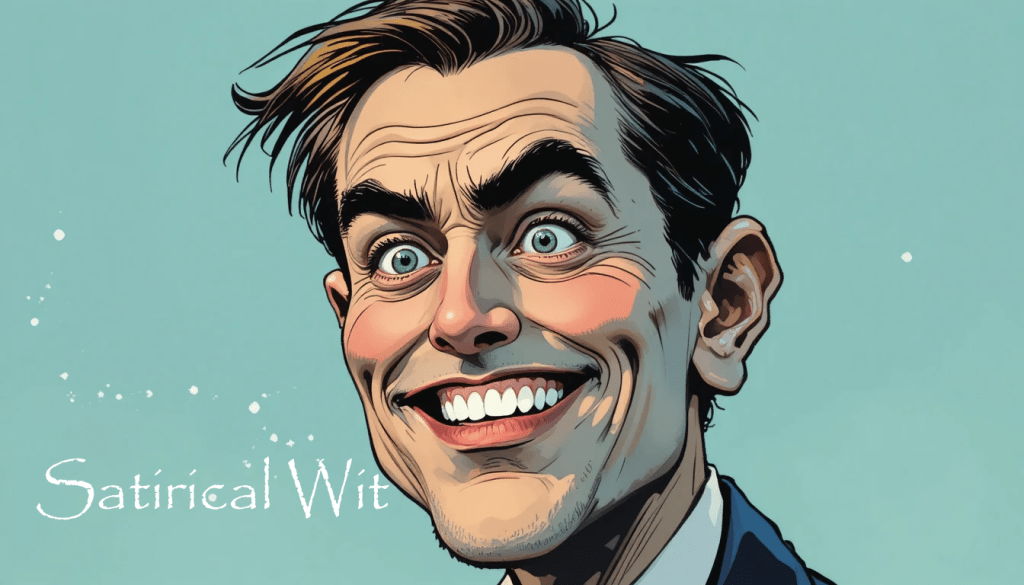
Satirical Wit
IPA Pronunciation: /səˈtɪr.ɪ.kəl wɪt/
Also Known As: Satiric Wit
Part of Speech: Noun Phrase
Origin
Satirical wit combines two ancient intellectual traditions: satire, the art of critique through exaggeration and irony, and wit, the sharpness of mind that perceives and articulates incongruity with speed and elegance.
Satire traces back to classical Rome — particularly to writers like Horace and Juvenal — where it functioned as a literary weapon against vice, corruption, and folly. Wit, from Old English witt (“mind, understanding”), has long implied mental agility rather than mere humor.
Together, they form a mode of expression that is not only funny, but diagnostic — humor used as analysis.
Etymology
Satire:
- Latin satura — “a mixed dish,” a medley
- Later associated with satira — moral critique through ridicule
Wit:
- Old English witt — mind, intellect, perception
- Proto-Germanic witją — knowledge, awareness
The phrase unites moral observation with intellectual sharpness — laughter sharpened into judgment.
Core Definitions
Humor Used to Critique or Expose Folly, Vice, or Hypocrisy
A form of comedy that targets human or institutional flaws with precision and irony.
“Her satirical wit spared no one, least of all the powerful.”
Intellectual Sharpness Expressed Through Irony and Humor
Cleverness that reveals contradictions beneath appearances.
“His satirical wit transformed political speech into comedy and indictment.”
A Mode of Social or Cultural Commentary
Using humor as a tool for reflection and reform.
“Satirical wit thrives where power resists scrutiny.”
Explanation & Nuance
Satirical wit is laughter with intent.
It entertains, but it also interrogates.
Its nuances include:
- Irony: saying one thing while meaning another
- Exaggeration: amplifying traits to expose absurdity
- Brevity: sharpness delivered economically
- Moral Aim: humor directed toward reform or awareness
- Distance: emotional detachment that sharpens clarity
Unlike slapstick or light humor, satirical wit cuts cleanly — its pleasure lies in recognition rather than surprise alone.
Examples in Context
Literary:
“Swift’s satirical wit in Gulliver’s Travels disguises savage critique beneath fantasy.”
Political:
“Satirical wit has long served as a safer language for dissent.”
Conversational:
“Her satirical wit turned a polite dinner into a quiet reckoning.”
Journalistic:
“The column relies on satirical wit to expose institutional hypocrisy.”
Cultural:
“Late-night shows translate outrage into satirical wit.”
Symbolic Dimensions
- Scalpel — precise, surgical critique
- Mirror — reflecting flaws back to their source
- Mask — truth disguised as humor
- Pinprick — small, sharp, effective
- Raised Eyebrow — skepticism rendered visible
Satirical wit symbolizes intelligence armed with humor, critique disguised as play.
Synonyms & Near-Relations
- Irony – indirect meaning, broader and subtler
- Sarcasm – often harsher, more personal
- Parody – imitation for comic effect
- Mockery – ridicule, less intellectual
- Lampoon – exaggerated satirical attack
(Only satirical wit balances humor, intelligence, and ethical critique so precisely.)
Cultural & Intellectual Resonance
Literature:
A dominant mode for social critique from classical antiquity to modern essays.
Philosophy:
Aligned with skepticism — laughter as a way of seeing clearly.
Politics:
A tool for resistance where direct critique is dangerous.
Media:
A defining feature of modern commentary and political comedy.
Psychology:
Requires cognitive agility — recognizing contradictions and reframing them humorously.
Takeaway
Satirical Wit names the sharp intelligence that laughs in order to reveal —
humor honed into critique, comedy sharpened into insight.
It is laughter that thinks,
amusement with moral teeth,
and the art of exposing truth by making it unmistakably funny.
Laugh first. Understand immediately. Never forget.
Curious about what happened today in history? Want to learn a new word every day?
You’ll find it all—first and in one place—at The-English-Nook.com!
If you love languages, this is your space.
Enjoy bilingual short stories, fun readings, useful vocabulary, and so much more in both English and Spanish.
Come explore!
 Word of the Day - The English Nook
Leave a comment