
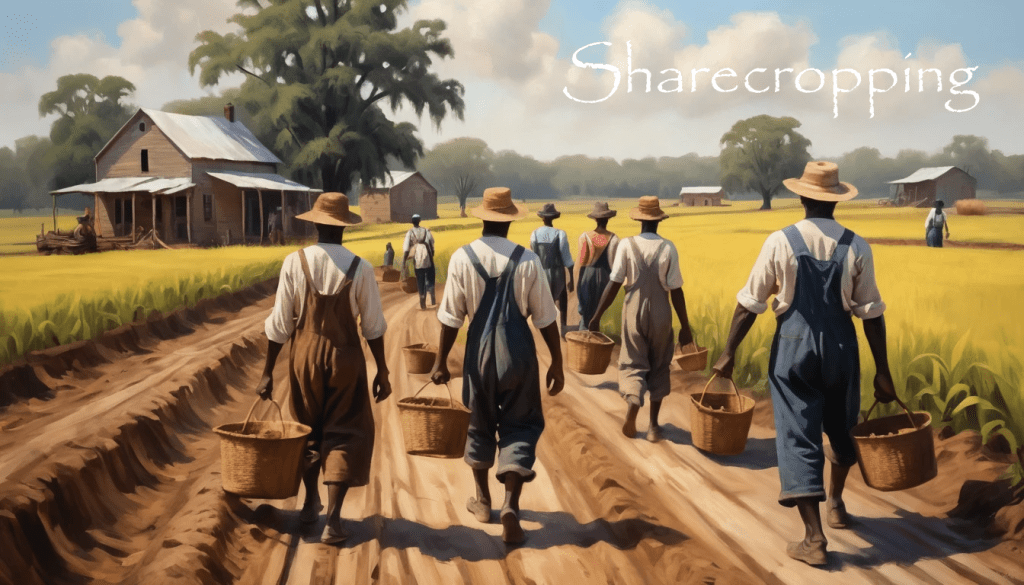
Sharecropping
IPA Pronunciation: /ˈʃɛrˌkrɒp.ɪŋ/
Plural: Sharecroppings (rare; usually uncountable)
Part of Speech: Noun
Origin
Sharecropping emerged as a formal system in the post–American Civil War era, particularly in the Southern United States. With the abolition of slavery in 1865, landowners faced a labor shortage, while newly freed Black Americans possessed labor but little to no land, capital, or legal protection.
The system developed as a compromise born of economic necessity and racial inequality: landowners provided land, seed, tools, and housing; laborers cultivated the crops and paid rent with a share of the harvest. Though framed as mutual dependence, sharecropping quickly became a mechanism of economic control, binding generations to cycles of debt.
Etymology
English:
- share — portion, division, allotment
- crop — cultivated produce of the land
- -ing — denoting process or system
The compound is literal: farming by division. Yet beneath its neutral construction lies a deeply asymmetrical reality — labor divided from ownership, effort separated from reward.
Core Definitions
An Agricultural System Based on Crop Sharing
A tenancy arrangement in which a laborer farms land owned by another in exchange for a share of the crops produced.
“Under sharecropping, payment came not in wages but in harvested cotton.”
A Post-Emancipation Labor System
A historical system that replaced slavery with economic dependency, particularly affecting African American farmers.
“Sharecropping shaped rural Southern life for decades after Reconstruction.”
A Cycle of Debt and Limited Mobility
A structure that often trapped laborers through credit systems controlled by landowners and merchants.
“By season’s end, sharecropping left many families owing more than they earned.”
Explanation & Nuance
Sharecropping was not merely agricultural; it was structural.
Key nuances include:
- Debt Peonage: laborers advanced supplies on credit at inflated prices
- Legal Imbalance: contracts favored landowners, often enforced through coercion
- Lack of Ownership: labor without accumulation of wealth
- Intergenerational Trap: poverty inherited rather than escaped
- Illusion of Autonomy: freedom in name, constraint in practice
Though some sharecroppers valued relative independence compared to wage labor, the system overwhelmingly functioned as a continuation of economic subjugation.
Examples in Context
Historical:
“Sharecropping dominated Southern agriculture well into the 20th century.”
Literary:
“The novel portrays sharecropping as a quiet war against time, weather, and debt.”
Economic:
“Sharecropping limited capital accumulation among tenant farmers.”
Sociological:
“Migration northward was fueled by the failures of sharecropping.”
Educational:
“Understanding sharecropping is essential to understanding Reconstruction.”
Symbolic Dimensions
- Broken Ledger — labor tallied against impossible debt
- Borrowed Land — work without ownership
- Weighing Scales — imbalance disguised as fairness
- Seasonal Clock — time measured in cycles that never advance
- Harvest Without Gain — effort unconverted into security
Sharecropping symbolizes freedom constrained by economics, the gap between legal emancipation and lived reality.
Synonyms & Near-Relations
- Tenant Farming – broader category, less specific
- Peonage – forced labor through debt
- Indenture – contractual labor, historically limited in time
- Serfdom – feudal parallel, tied to land
- Agrarian Exploitation – descriptive but abstract
(Only sharecropping precisely names the crop-based system of post-slavery dependency.)
Cultural & Intellectual Resonance
History:
Central to Reconstruction, Jim Crow economics, and the Great Migration.
Literature:
Appears in Southern and African American narratives as a symbol of endurance and injustice.
Economics:
A case study in structural poverty and labor imbalance.
Sociology:
Illustrates how systems can reproduce inequality without overt coercion.
Collective Memory:
An often-overlooked chapter linking slavery to modern economic disparity.
Takeaway
Sharecropping names a system where freedom met constraint —
labor divorced from land, effort severed from advancement.
It stands as a reminder that emancipation without equity
can preserve injustice under a different name,
and that ownership, not labor alone, determines power.
Freedom was declared—but the harvest still belonged to someone else.
Curious about what happened today in history? Want to learn a new word every day?
You’ll find it all—first and in one place—at The-English-Nook.com!
If you love languages, this is your space.
Enjoy bilingual short stories, fun readings, useful vocabulary, and so much more in both English and Spanish.
Come explore!
 Word of the Day - The English Nook
Leave a comment