
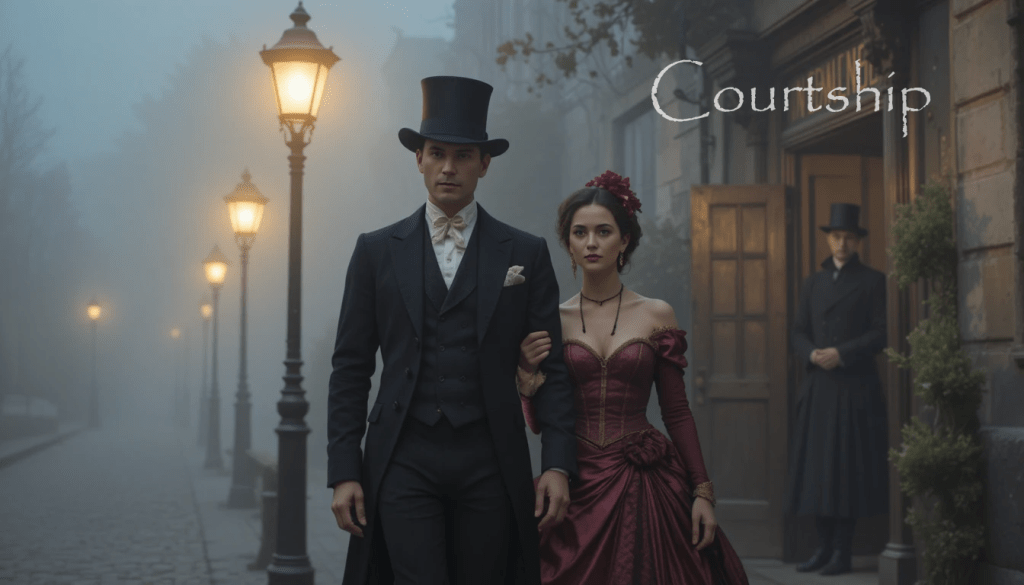
Courtship
IPA Pronunciation: /ˈkɔːrt.ʃɪp/
Plural: Courtships
Part of Speech: Noun
Origin
Courtship originates from the medieval concept of the court — not merely a place of law or royalty, but a social space governed by etiquette, ritual, and display. The term entered English in the 14th century, shaped by the traditions of aristocratic society, where romantic pursuit followed formalized patterns of behavior.
Originally, to court meant to seek favor through attention, deference, and charm. Over time, this expanded into the romantic domain, where affection was expressed not through immediacy but through measured gestures, patience, and symbolic acts.
Thus, courtship carries an inherited sense of ceremony — love approached as a social art.
Etymology
Old French:
- corter — “to woo, to seek affection”
Latin:
- cohors / curia — enclosure, assembly, court
English Formation:
- court + -ship (state, condition, practice)
The word reflects both place and process: a structured environment in which relationships unfold through rules, signals, and performance.
Core Definitions
The Ritualized Process of Seeking Romantic Affection
A series of actions intended to attract, impress, or bond with a potential partner.
“Their courtship unfolded slowly, marked by letters and deliberate silences.”
A Socially Structured Approach to Romantic Union
Romantic pursuit shaped by cultural norms, expectations, or traditions.
“In earlier centuries, courtship followed prescribed forms of conduct.”
A Period of Relational Testing and Discovery
A phase in which compatibility, intention, and commitment are explored.
“Courtship allowed them to learn each other’s rhythms before union.”
Explanation & Nuance
Courtship differs from romance in that it is procedural.
It unfolds over time, governed by rhythm, restraint, and mutual signaling.
Key nuances include:
- Intentionality: pursuit with purpose
- Performance: gestures of worth, devotion, or suitability
- Delay: affection measured rather than immediate
- Reciprocity: advancement depends on response
- Cultural Coding: rules vary across societies
Courtship transforms desire into narrative, turning attraction into a story with stages.
Examples in Context
Literary:
“The novel traces their courtship through glances, letters, and carefully chosen words.”
Historical:
“Victorian courtship required supervision, decorum, and restraint.”
Anthropological:
“Birdsong and plumage serve as courtship displays in the natural world.”
Modern:
“Digital courtship compresses rituals once stretched across years.”
Psychological:
“Courtship behaviors communicate commitment and reliability.”
Symbolic Dimensions
- Dance — coordinated movement, approach and retreat
- Gift — offering of value or attention
- Threshold — standing between solitude and union
- Letter — mediated intimacy, intention made visible
- Mask & Reveal — self-presentation balanced with sincerity
Courtship symbolizes love as process, not impulse — affection shaped by time and form.
Synonyms & Near-Relations
- Wooing – earnest romantic pursuit
- Romancing – broader, more emotional
- Pursuit – goal-oriented, less mutual
- Seduction – persuasive, often asymmetrical
- Dating – modern, informal iteration
(Only courtship preserves the ceremonial, narrative quality of romantic pursuit.)
Cultural & Intellectual Resonance
Literature & Drama:
A foundational plot engine, rich with tension and restraint.
Sociology:
Reflects social norms governing gender, power, and commitment.
Biology:
Parallels animal courtship displays, ritualized to ensure selection.
History:
A mirror of changing attitudes toward marriage, autonomy, and desire.
Psychology:
A stage for attachment formation and trust-building.
Takeaway
Courtship names the deliberate choreography of affection —
a sequence of gestures, pauses, and signals
through which desire becomes commitment.
It is love approached with patience,
intention shaped by ritual,
and longing given form through time.
Courtship is desire that takes its time—and tells its story first.
Curious about what happened today in history? Want to learn a new word every day?
You’ll find it all—first and in one place—at The-English-Nook.com!
If you love languages, this is your space.
Enjoy bilingual short stories, fun readings, useful vocabulary, and so much more in both English and Spanish.
Come explore!
 Word of the Day - The English Nook
Leave a comment