
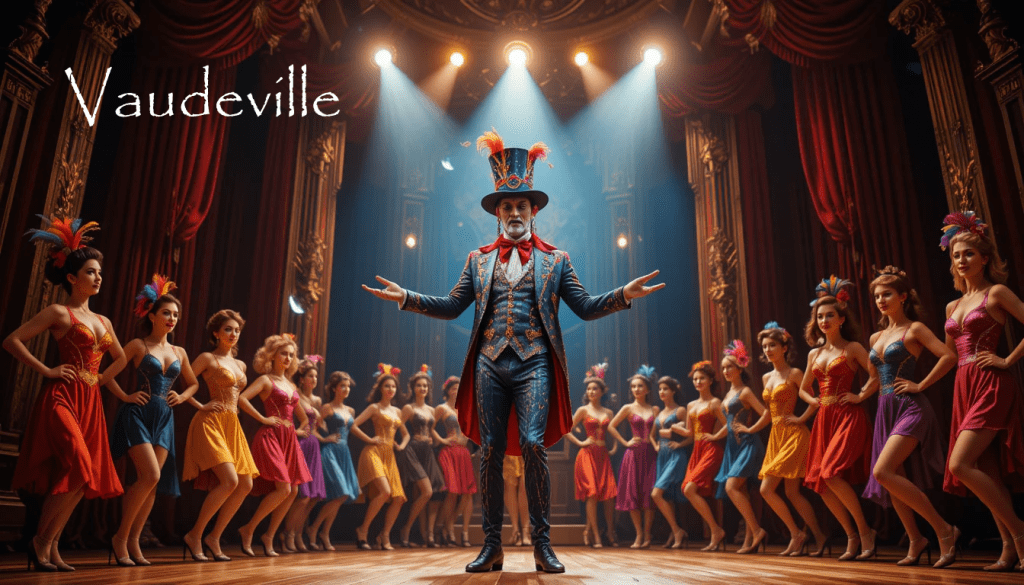
Vaudeville
IPA Pronunciation: /ˈvɔːd.vɪl/ or /ˈvɔːd.vəl/
Plural: Vaudevilles
Part of Speech: Noun
Origin
The word vaudeville entered English in the late 19th century via French, where it originally signified a light, satirical song. The deeper French roots trace to voix de ville (“voice of the town”) or vaux-de-vire, referencing the satirical songs of the Vire valley in Normandy.
As the form crossed the Atlantic, the meaning transformed: from witty French street choruses to the eclectic, multi-act American theatrical tradition that dominated popular entertainment from the 1880s through the early 1930s.
By the early 20th century, vaudeville had become a sprawling cultural phenomenon — a stage that welcomed comedians, magicians, dancers, jugglers, animal acts, acrobats, singers, ventriloquists, and every imaginable variant of the spectacular.
Etymology
French: vaudeville — originally a comic or satirical song
Possible roots:
- voix de ville — “voice of the town,” urban folk wit
- vaux-de-vire — “valleys of the Vire,” birthplace of rustic, satirical ballads
These roots share a common thread: popular humor expressed through art, grounded in everyday life and collective entertainment.
Thus, vaudeville carries the lineage of street song, social commentary, and communal amusement — later amplified into full theatrical variety.
Core Definitions
A Theatrical Variety Show
A stage performance composed of multiple unrelated acts — comedy, music, dance, magic, acrobatics, novelty routines.
“The vaudeville program featured a sword swallower, a banjo duo, and a comedian with impeccable timing.”
A Genre of Light, Popular Entertainment
Playful, humorous, fast-paced, and accessible — designed for broad audiences rather than elite salons.
“Her performance had the exuberant charm of old vaudeville, lively and unpretentious.”
A Cultural Era in American Entertainment
The network of theaters, circuits, and performers that shaped popular humor, early celebrity culture, and eventually radio and film.
“Hollywood was built on the bones of vaudeville — the comedians trained on its unforgiving stages.”
Explanation & Nuance
Vaudeville is less a single style than a kaleidoscope of styles — a stage where genres collide. Its structure resisted hierarchy: a trained opera singer might follow a trained seal; a monologist might share billing with a slapstick troupe.
Its nuances include:
- Democratic entertainment: open to all ages, classes, languages.
- Rhythmic pacing: fast turnover, brief acts, swift transitions.
- Adaptability: performers tailored routines to each region, audience, or theater.
- Inventiveness: new bits, gags, and routines were constantly invented and borrowed.
Vaudeville valued wit over depth, energy over narrative, and variety over cohesion — the joy of seeing multiple worlds in a single evening.
Examples in Context
Historical:
“On the vaudeville circuit, performers carried their entire career in a single trunk — costumes, props, hopes.”
Cultural:
“Vaudeville shaped American humor, giving rise to legends like Buster Keaton, the Marx Brothers, and Fanny Brice.”
Aesthetic:
“The scene unfolded with vaudevillian flair — exaggerated gestures, quick jokes, and restless charm.”
Sociological:
“Vaudeville theaters were melting pots, spaces where immigrant voices and regional dialects found equal applause.”
Media Evolution:
“Radio and film did not kill vaudeville so much as absorb it — its timing, archetypes, and banter echoed for decades.”
Symbolic Dimensions
- Footlights — the shimmer and precariousness of live performance
- Curtain Call — the ephemeral life of the stage
- Patchwork — many pieces forming an unexpected whole
- Carnivalesque Energy — humor as a communal ritual
- Dusty Trunks & Train Tickets — the itinerant life of performers
Vaudeville symbolizes the spirit of improvisation, the joy of the unexpected, and the collective laughter of crowded rooms.
Synonyms & Near-Relations
- Variety Show – the closest modern equivalent
- Revue – more structured and theme-driven than vaudeville
- Music Hall – British counterpart focused on song and comedy
- Cabaret – smaller, more intimate, often more risqué
- Burlesque (classic) – comedic parody with suggestive elements
(Of these, only vaudeville evokes the grand, itinerant circuits and eclectic American tradition of live variety entertainment.)
Cultural & Intellectual Resonance
Performance History:
The cornerstone of American popular entertainment before film and radio.
Comedy:
The birthplace of timing, banter, slapstick, and character-driven routines that shaped modern humor.
Cinema:
Early film comedians learned their craft on vaudeville stages, and the medium inherited its pacing and physicality.
Immigrant Culture:
A rare space where diverse communities could see their languages and stories reflected onstage.
Folklore of Show Business:
The archetype of the traveling performer, the triumph of applause, the heartbreak of empty seats.
Takeaway
Vaudeville names the exuberant, chaotic, and deeply human tradition of popular entertainment —
a world of bright lights, quick jokes, daring acts, and restless creativity.
It is the art of many voices on one stage,
the spectacle of a culture inventing itself in real time.
Vaudeville: where many voices hit one stage and the whole culture took a bow.
Curious about what happened today in history? Want to learn a new word every day?
You’ll find it all—first and in one place—at The-English-Nook.com!
If you love languages, this is your space.
Enjoy bilingual short stories, fun readings, useful vocabulary, and so much more in both English and Spanish.
Come explore!
 Word of the Day - The English Nook
Leave a comment