
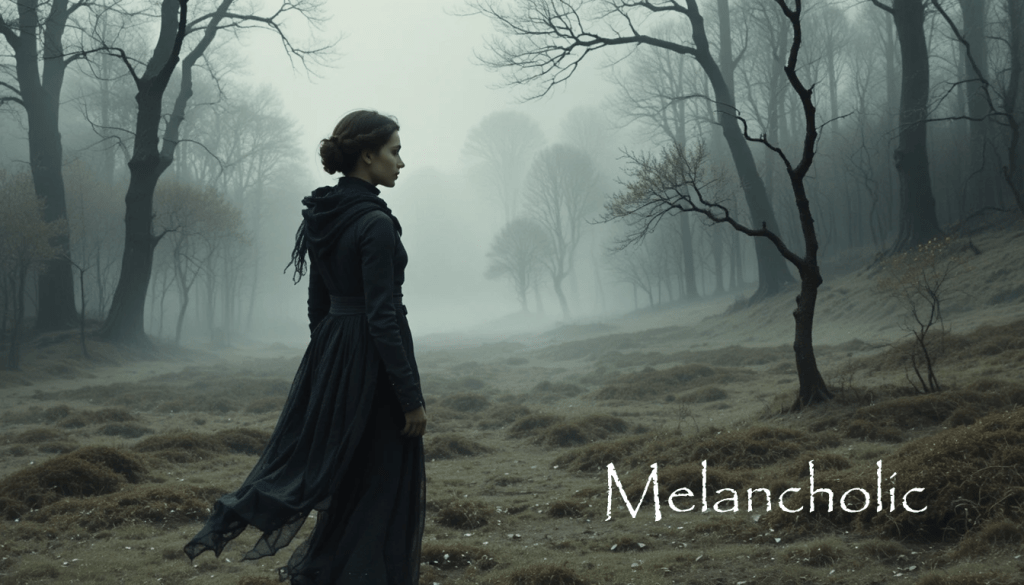
Melancholic
IPA Pronunciation: /ˌmɛl.ənˈkɒ.lɪk/
Plural: Melancholics
Part of Speech: Adjective (also a Noun)
Origin
From Middle English melancholik, rooted in Old French melancholique, descending from Latin melancholicus, and ultimately from Ancient Greek μελαγχολικός (melankholikós) — “pertaining to black bile.”
In ancient humoral theory, melancholy was thought to arise from an excess of melaina cholē — “black bile” — one of the four bodily fluids believed to govern temperament. This physiological theory faded, but its emotional resonance endured. Over centuries, melancholic evolved to signify not illness but a temperament, a poetic disposition, and a mode of reflective sorrow.
Etymology
Greek: melas (μέλας) — “black”
+
cholē (χολή) — “bile,” associated with mood and temperament
The ancient medical model cast the melancholic as contemplative, inward, and solemn — characteristics that persist metaphorically.
Thus, melancholic carries the legacy of both somber physiology and philosophical introspection, naming a sadness tinged with depth, beauty, and thought.
Core Definitions
A Deep, Reflective Sadness
A sorrow that is soft rather than violent, contemplative rather than chaotic.
“Her gaze held a melancholic stillness, as though remembering something she had never lived.”
A Temperament Oriented Toward Thoughtful Gloom
A personality marked by introspection, sensitivity, and a tendency toward somber reflection.
“He had the melancholic disposition of a poet — attuned to shadows, fluent in silence.”
Aesthetic or Atmosphere Expressing Tender Gloom
Describing works of art, music, or moments that evoke beautiful sadness.
“The film’s melancholic palette made every scene feel like a memory fading as it was being lived.”
Explanation & Nuance
Melancholic does not simply denote sadness; it denotes sadness with resonance — sorrow made meaningful by depth and awareness.
It can refer to:
- Emotional states painted in muted tones
- Temperamental types inclined toward reflection
- Artistic moods that linger like dusk
- Atmospheric qualities where beauty and sorrow coexist
Its tone is often poetic rather than clinical. Melancholy suggests gravity, not despair; tenderness, not catastrophe. It belongs to the language of memory, autumn, chamber music, and dim light — where sadness becomes an aesthetic, a mode of perception.
Examples in Context
Literary:
“The novel is steeped in a melancholic awareness of passing time, every chapter a soft elegy.”
Psychological:
“His melancholic temperament made him perceptive, though often caught in the gravity of his own thoughts.”
Aesthetic:
“A melancholic melody drifted through the café, turning the room into a sanctuary for unspoken feelings.”
Philosophical:
“There is something melancholic in the human condition — the knowledge that all beauty is transient.”
Historical/Cultural:
“Romanticism embraced the melancholic as a lens for profound artistic insight.”
Symbolic Dimensions
- Autumn — the beauty of decline
- Twilight — half-light, half-loss
- Elegy — remembrance shaped by absence
- Still Water — emotion contained, unbroken
- Dust & Echoes — the persistence of the past
The melancholic mood is the chiaroscuro of emotion: a blend of light and shadow that reveals more than brightness alone.
Synonyms & Near-Relations
- Woeful – sadness expressed plainly
- Pensive – thoughtful, though not necessarily sad
- Somber – dark or serious in tone
- Lugubrious – exaggeratedly mournful; more dramatic than melancholic
- Plaintive – soft sorrow, especially in voice or sound
- Wistful – sadness touched by desire or longing
(Of these, only melancholic carries the historic and aesthetic sense of sorrow refined by reflection.)
Cultural & Intellectual Resonance
Psychology:
Once a medical temperament, now a metaphor for reflective sadness.
Philosophy:
A state tied to existential awareness — the knowledge of finitude and fragility.
Art & Literature:
A mode of beauty: muted, atmospheric, infused with longing.
Music:
Minor keys, slow tempos, tones that dwell rather than rush.
Religion & Mysticism:
A spiritual ache: the soul’s longing for what is absent or transcendent.
Takeaway
Melancholic names a sadness that thinks, remembers, and contemplates —
a sorrow with depth, beauty, and quiet dignity.
It is the emotional twilight where feeling becomes reflection,
and reflection becomes a form of understanding.
Melancholic: where sorrow becomes art.
Curious about what happened today in history? Want to learn a new word every day?
You’ll find it all—first and in one place—at The-English-Nook.com!
If you love languages, this is your space.
Enjoy bilingual short stories, fun readings, useful vocabulary, and so much more in both English and Spanish.
Come explore!
 Word of the Day - The English Nook
Leave a comment