
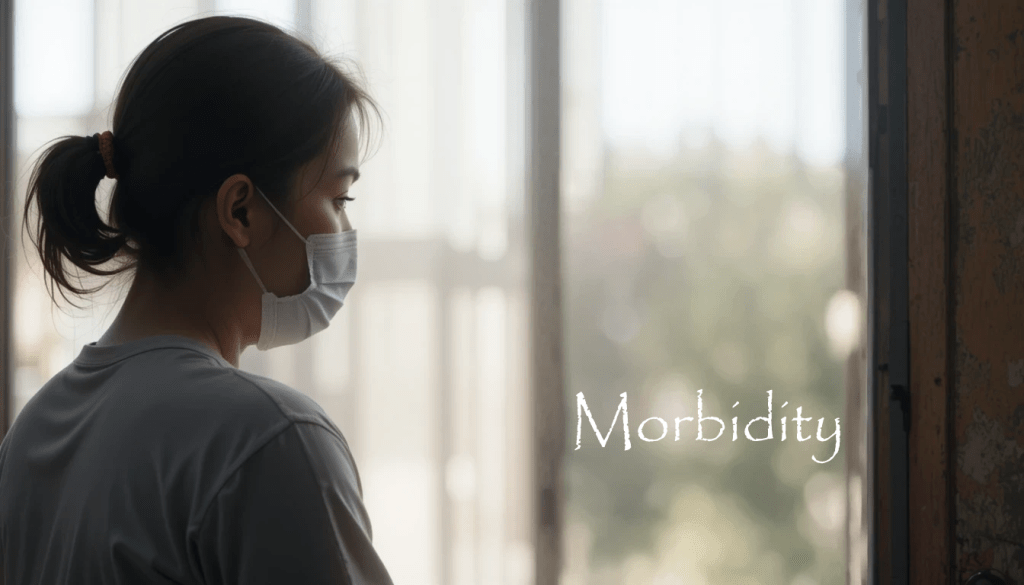
Morbidity
IPA Pronunciation: /mɔːrˈbɪdəti/
Part of Speech: Noun
Origin
First attested in English in the early 17th century, ultimately from the Latin morbidus — “diseased, unhealthy,” derived from morbēs or morbus, meaning “sickness, disease, ailment.”
Its deeper lineage traces to a Proto-Indo-European root commonly associated with weakness, decay, or illness, a semantic field encompassing the physical, the emotional, and the existential.
While originally clinical and medical in tone, morbidity gradually expanded into metaphorical and psychological realms, coming to describe not just literal illness but a fascination with the dark, the decaying, the deathward turn of thought.
Etymology
- Latin: morbus → “disease, sickness”
- Latin adjective: morbidus → “ill, unhealthy, diseased”
- Later English Usage: broadened from medical terminology to denote emotional or intellectual preoccupations with grim subjects.
Thus, morbidity carries both the factual weight of illness and the shadowed tone of the macabre, depending on context.
Core Definitions
1. The State of Being Diseased or Unhealthy (Medical)
A condition of illness, pathology, or compromised well-being.
“The report detailed the morbidity associated with the epidemic.”
2. The Rate of Disease Within a Population (Epidemiological)
A statistical measure of illness within a specific group or region.
“Seasonal change affects morbidity levels across the country.”
3. A Preoccupation With Dark, Gloomy, or Death-related Themes (Psychological/Literary)
Interest in decay, death, suffering, or the macabre.
“His poetry was tinged with a quiet morbidity, as though life’s shadows fascinated him more than its light.”
4. The Quality of Being Grim, Unwholesome, or Morbid
A tone or atmosphere characterized by darkness or decay.
“The room carried a morbidity that clung like damp to the walls.”
Explanation & Nuance
Morbidity operates on two primary registers:
Clinical
A precise, neutral measure of illness.
It speaks in the language of physicians, charts, and population studies.
Emotional / Philosophical / Literary
A fascination with the darker facets of existence — mortality, melancholy, ruin.
Here, morbidity becomes:
- the shadow behind beauty,
- the hush in an abandoned room,
- the whisper of mortality in art or thought.
The term in this second sense often suggests a sensitivity to life’s fragility, not merely gruesomeness. It can carry tones of romantic melancholy, existential curiosity, or aesthetic darkness.
Examples in Context
Medical:
“Morbidity increased sharply during the winter months, particularly among the elderly.”
Statistical/Epidemiological:
“The researchers tracked morbidity rates to understand long-term public health trends.”
Literary/Poetic:
“There was a tender morbidity in her writing — a willingness to sit with sorrow until it softened.”
Psychological:
“He worried that his constant dwelling on tragedy bordered on morbidity.”
Atmospheric:
“The fog and dim candlelight lent a slight morbidity to the chamber, as though time itself were unwell.”
Symbolic Dimensions
- Wilted flowers — beauty succumbing to decay
- Abandoned hospitals or asylums — history steeped in illness
- Winter graveyards — silent markers of mortality
- Dust on forgotten objects — slow, quiet decline
- Dark romanticism — emotion shaped by the awareness of impermanence
These images speak to morbidity’s deeper resonance:
the visibility of life’s vulnerability.
Synonyms & Related Terms
Clinical/Statistical
- Illness
- Disease rate
- Pathology
- Morbidity rate
Emotional/Literary
- Morbid fascination
- Melancholy
- Gloom
- Macabre interest
- Deathward contemplation
Notable contrast: Mortality refers to death itself; morbidity refers to illness, or fixation on it.
Cultural & Intellectual Resonance
Medicine & Public Health
Morbidity forms a central metric in understanding population health, the burden of disease, and the impact of social conditions.
Victorian Literature
Writers such as Poe, Brontë, and Dickens imbued their works with emotional morbidity — the gothic allure of sickness, ruin, or death.
Philosophy & Psychology
Explorations of human vulnerability, suffering, and mortality often employ the term metaphorically.
Art & Aesthetics
From chiaroscuro painting to symbolist poetry, morbidity shapes how artists evoke decay, transience, and the somber beauty of impermanence.
Takeaway
Morbidity is the vocabulary of illness and of shadow —
the factual record of disease,
and the emotional or aesthetic turning toward darkness.
It marks both the measurable strain on the body
and the inward gaze toward fragility, decline, or the solemn beauty of mortality.
Morbidity
The presence of illness, literal or symbolic — the body’s frailty, the mind’s dark curiosity, the quiet fascination with life’s shadowed edges.
Curious about what happened today in history? Want to learn a new word every day?
You’ll find it all—first and in one place—at The-English-Nook.com!
If you love languages, this is your space.
Enjoy bilingual short stories, fun readings, useful vocabulary, and so much more in both English and Spanish.
Come explore!
 Word of the Day - The English Nook
Leave a comment