
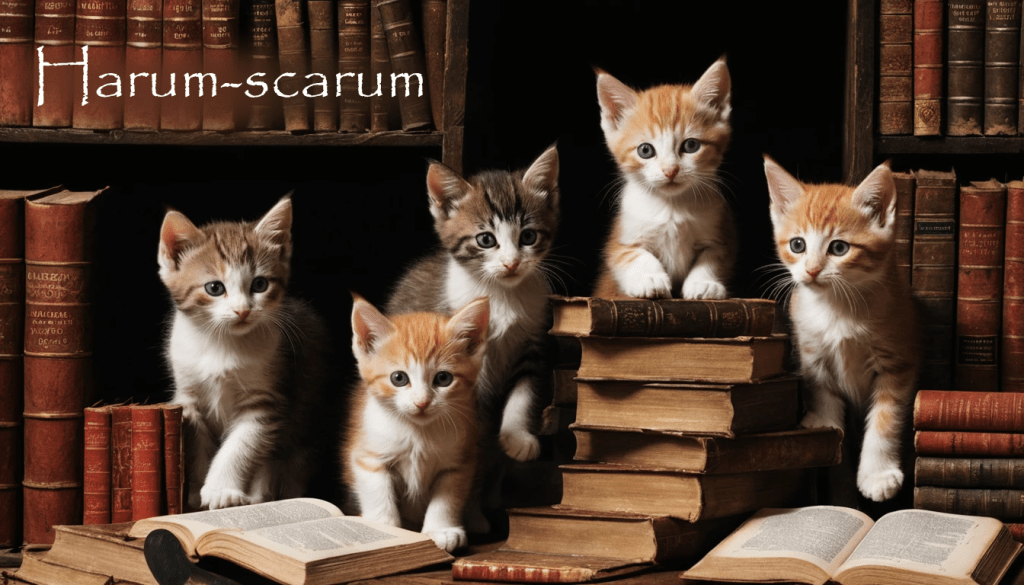
Harum-scarum
IPA Pronunciation: /ˌhɛərəmˈskɛərəm/
Part of Speech: Adjective, Adverb, Noun (colloquial)
Origin
First recorded in English in the mid-17th century as a lively, rhyming reduplication—likely coined for its sound rather than strict linguistic lineage.
It belongs to a long tradition of expressive English formations such as higgledy-piggledy, helter-skelter, and hurly-burly, where rhythm and repetition convey mood and motion.
Though its precise ancestry is uncertain, its structure suggests:
- a playfully chaotic blend of consonants and vowels meant to evoke recklessness, mischief, and wild energy,
- possibly influenced by harry (to disturb, harass) and scare (to startle, frighten),
though such links remain speculative.
The word’s primary force is sound-symbolic: the chaos it describes is built directly into its bouncing, unruly syllables.
Etymology
- Reduplicative English formation → spontaneous, rhythmic, intentionally disorderly.
- Expressive tradition → words that imitate emotional tone, not logical derivation.
- Primarily conveys a sense, not a lineage: swiftness, rashness, harum-scarum hurry.
Its history is less a family tree than a dramatic entrance — a word arriving breathlessly, hat askew, full of commotion.
Core Definitions
1. Reckless, Wild, or Carelessly Impulsive (Adjective)
Acting without thought, rushing headlong into trouble or delight.
“He lived in a harum-scarum fashion, never thinking beyond the next thrill.”
2. In a Disorderly, Hasty, or Unplanned Manner (Adverb)
Behavior carried out with cheerful chaos, haste, or abandon.
“The children ran harum-scarum through the meadow.”
3. A Reckless or Impulsive Person (Noun)
One marked by spirited unpredictability.
“She was the harum-scarum of the family — a comet blazing through propriety.”
Explanation & Nuance
Harum-scarum captures a particular type of chaos:
not destructive, but exuberant; not malicious, but ungoverned.
It suggests:
- untamed enthusiasm,
- headlong adventure,
- youthful wildness,
- disorderly charm,
- motion without map or caution.
It is the linguistic equivalent of:
- wind whipping through open fields,
- a horse galloping without bridle,
- laughter erupting where silence was expected,
- plans discarded because living feels more urgent.
It is chaos, but vibrant — a storm with a grin.
Examples in Context
Character Description:
“His harum-scarum energy filled the house with a constant rustle of mischief.”
Atmospheric/Poetic:
“The festival spilled into the streets in a harum-scarum whirl of lanterns, music, and bright disorder.”
Narrative/Plot:
“Through a harum-scarum escape down the alleyways, they outran the gathering storm.”
Humorous:
“Left on their own, the kittens staged a harum-scarum revolt against every neatly stacked book.”
Reflective:
“In youth we are harum-scarum, convinced the world will always bend for our daring.”
Symbolic Dimensions
- Wind-tossed leaves — motion without pattern
- A runaway horse — spirited, unstoppable vitality
- Tumbling laughter — joy without restraint
- A cluttered workshop — creativity in disarray
- A storm of papers — the poetry of mess
Harum-scarum embodies the joyful wildness that often precedes wisdom — and sometimes teaches it.
Synonyms & Related Terms
- Reckless
- Impetuous
- Haphazard
- Whimsical
- Wild-hearted
- Careless
- Flighty
- Devil-may-care
Less accurate synonyms: rash, chaotic, unruly — these lack the word’s inherent playfulness and verve.
Cultural & Literary Resonance
Harum-scarum belongs to the English tradition of old, vivid character words — terms that portray not simply actions but whole temperaments. Writers of the 18th and 19th centuries especially adored it for describing young gallants, mischievous heroines, and comic troublemakers.
Its sound is as important as its meaning:
a linguistic flourish that practically cartwheels across the page.
Modern use often carries affectionate nostalgia, describing those whose unpredictability is more charming than alarming.
Takeaway
Harum-scarum is the language of reckless delight —
wild-hearted, breathless, impulsive,
a whirlwind of bright disorder.
It names the spirit that rushes headlong into adventure,
laughs at caution,
and leaves the world slightly more alive in its wake.
Harum-scarum
The gleeful tumult of impulsive action — the reckless charm of those who live as though the world were made for joyous disorder.
Curious about what happened today in history? Want to learn a new word every day?
You’ll find it all—first and in one place—at The-English-Nook.com!
If you love languages, this is your space.
Enjoy bilingual short stories, fun readings, useful vocabulary, and so much more in both English and Spanish.
Come explore!
 Word of the Day - The English Nook
Leave a comment