
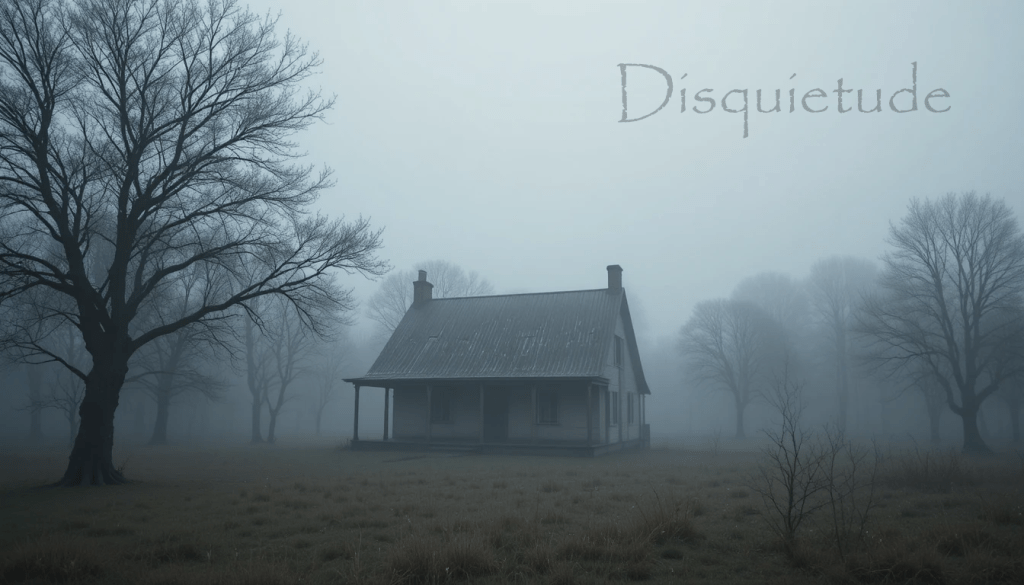
Disquietude
IPA Pronunciation: /dɪsˈkwaɪɪˌtjuːd/
Part of Speech: Noun
Origin
First attested in English in the early 17th century, built from dis- (“the opposite of,” “undoing”) + quietude (“calmness, tranquility”).
Quietude derives from Latin quiēs — “rest, repose, stillness.”
Thus disquietude originally meant the undoing of rest, the state in which calm is disturbed or inward ease is unsettled.
The word gradually came to denote sustained uneasiness, deeper than agitation but more controlled than panic — a low, persistent tremor beneath the surface of thought.
Etymology
- Latin: quiēs → “rest, quiet.”
- Late Latin / French: quietude → “tranquility, peacefulness.”
- Prefix: dis- → “negation, reversal, disturbance.”
- English formation: disquiet + -ude, forming an abstract state or condition.
The structure gives the term a tone of internal disturbance, suggesting a condition of mind rather than a momentary emotion.
Core Definitions
- A State of Persistent Uneasiness or Inner Disturbance
A subtle but enduring sense of trouble, restlessness, or anxiety.
“A disquietude settled in her heart as the silence lengthened.” - Emotional or Psychological Restlessness
A feeling of not being at ease, often without a clear cause.
“Despite the celebration, he felt a disquietude he couldn’t name.” - Atmospheric or Social Unrest
A broader mood of tension or unsettled expectation.
“Disquietude spread through the town after the unexpected decree.”
Explanation & Nuance
Disquietude is not panic or fear; it is the slow, simmering unease that lurks beneath composure.
It often manifests as:
- inner restlessness,
- the sense that something is amiss,
- emotional imbalance,
- anticipatory tension,
- a shadow across the mind’s calm.
Where anxiety may be acute, disquietude is typically ambient, lingering, a mood rather than an event.
Its tone is often introspective, the kind of disturbance that arises in silence, waiting, or uncertainty.
In literature, disquietude frequently symbolizes unseen pressures, approaching change, or the subconscious whisper of dread or doubt.
Examples in Context
Psychological / Internal:
“Though the path was familiar, an inexplicable disquietude accompanied each step.”
Social / Communal:
“There was a disquietude among the villagers, a hushed sense that the old order teetered.”
Atmospheric / Poetic:
“The house held a disquietude in its stillness, as if listening for something.”
Narrative / Characterization:
“His smile masked a disquietude that had grown in him for years.”
Philosophical / Reflective:
“Disquietude arises when the soul outgrows the certainties that once sustained it.”
Symbolic Dimensions
- Shadows: presence of uncertainty or tension.
- Wind before a storm: unsettled atmosphere.
- Uneven heartbeat: subtle but persistent disturbance.
- Flickering light: instability at the edge of calm.
- Unrested water: surface rippled by hidden currents.
These symbols reflect the word’s essence: a quiet disrupted, a calm undone.
Synonyms & Related Terms
- Unease
- Restlessness
- Perturbation
- Anxiety (broader, stronger)
- Apprehension
- Malaise
Among these, disquietude is the most literary and atmospheric, evoking psychological depth rather than simple discomfort.
Cultural & Intellectual Resonance
Romantic & Gothic Literature:
Used to convey tensions beneath beautiful surfaces — emotional turbulence under calm exteriors.
Philosophy:
Associated with existential restlessness, the unsettledness that precedes questioning or transformation.
Psychology:
Describes diffuse unease not tied to a specific stimulus — a mood state rather than a reaction.
Modern Fiction:
Often marks characters caught between worlds, identities, or moral choices.
Takeaway
Disquietude is the name for the soft trembling beneath a composed exterior — the whisper of unease, the quiet erosion of tranquility.
Disquietude
A lingering, inward restlessness — the subtle disturbance that unsettles calm and troubles the stillness of the mind.
Curious about what happened today in history? Want to learn a new word every day?
You’ll find it all—first and in one place—at The-English-Nook.com!
If you love languages, this is your space.
Enjoy bilingual short stories, fun readings, useful vocabulary, and so much more in both English and Spanish.
Come explore!
 Word of the Day - The English Nook
Leave a comment