
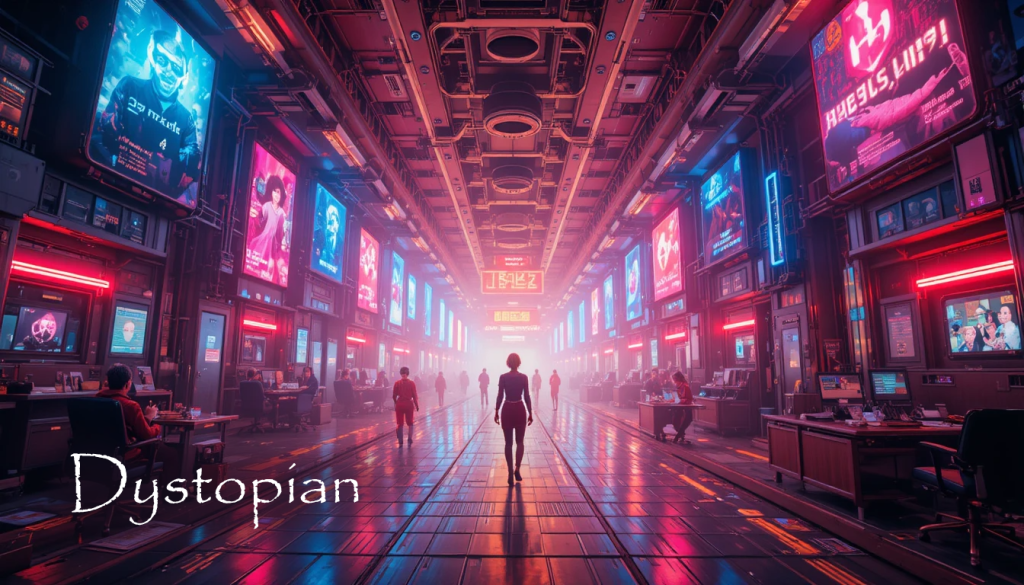
Dystopian
IPA Pronunciation: /dɪsˈtoʊpiən/
Part of Speech: Adjective
Origin
First recorded in English in the mid-19th century, built upon the earlier term dystopia — coined as the opposite of utopia.
Formed from Greek roots:
- dys- — “bad, difficult, ill,”
- -topia (from topos) — “place.”
The term originally appeared in political discourse to describe societies suffering from gross misrule or destructive policies. Over time, it came to designate imagined worlds marked by oppression, decay, and dehumanization, especially in literature and speculative fiction.
Etymology
- Greek: dys- → “bad, harsh, unhealthy.”
- Greek: topos → “place, region.”
- English: dystopia → “bad place,” often contrasted with utopia (“no place” or “good place”).
- Dystopian: adjective form meaning “relating to dystopia.”
The word evokes a location or society where the worst tendencies of humanity and governance are projected into stark extreme.
Core Definitions
- Relating to a Society Characterized by Oppression, Misery, or Dehumanization
Describing worlds shaped by authoritarian control, environmental collapse, or pervasive despair.
“The novel depicts a dystopian future ruled by surveillance and scarcity.” - Suggestive of Bleak, Nightmarish, or Oppressive Conditions
Applied metaphorically to real situations that feel harsh or degrading.
“The smog-darkened skyline gave the city a dystopian appearance.” - Pertaining to the Conventions of Dystopian Literature or Thought
Conforming to the narrative patterns of imagined oppressive futures.
“Her dystopian themes challenge readers to consider the fragility of freedom.”
Explanation & Nuance
A dystopian world is not merely unpleasant—it reflects a systematic breakdown of the ideals that sustain human dignity:
- freedom
- equality
- privacy
- community
- truth
- nature
- individuality
Dystopian environments often arise from:
- totalitarian governance,
- technological overreach,
- environmental ruin,
- unchecked capitalism,
- war or resource scarcity,
- social engineering or ideological purity movements.
Yet dystopian writing thrives not only on despair but on warning, critique, and the possibility—however faint—of resistance.
Examples in Context
Literary:
“The city’s rigid class system and state-controlled media reveal a distinctly dystopian structure.”
Environmental / Futuristic:
“The dried riverbeds and towering dust storms created a dystopian landscape.”
Political Commentary:
“He described the new policies as dystopian, eroding privacy under the guise of safety.”
Cultural Observation:
“Endless advertisements glowing from faceless towers lent the district a dystopian glow.”
Technological Concern:
“The algorithm’s power over daily life felt dystopian—not malicious, just indifferent.”
Symbolic Dimensions
- Fog / Smog — obscured truth, polluted future.
- Labyrinth — impossible systems; no escape.
- Glass & Steel — cold, impersonal architecture.
- Masks — loss of identity or enforced conformity.
- Ruins — collapse of past ideals.
- Surveillance Eye — watched, controlled existence.
Synonyms & Related Terms
- Apocalyptic / Post-apocalyptic — focusing on collapse or aftermath.
- Totalitarian — politically oppressive.
- Oppressive — general sense of crushing conditions.
- Bleak — emotionally desolate.
- Nightmarish — surreal, frightening.
- Dystopia (noun) — the society itself.
Dystopian specifically describes qualities or atmospheres that evoke grim, oppressive, speculative futures.
Cultural & Intellectual Resonance
Literature & Film:
A central genre in modern storytelling—Orwell, Huxley, Atwood, Bradbury, and countless others—using dystopian visions as cultural critique.
Philosophy & Politics:
Invoked to warn against trends that threaten civil liberties, justice, or ecological health.
Sociology & Technology Studies:
Used to analyze the consequences of surveillance, automation, digital dependency, and social fragmentation.
Art & Aesthetics:
Dystopian imagery shapes architecture, fashion, photography, and conceptual art exploring decay and alienation.
Takeaway
Dystopian describes a world where the flaws of society have grown into monstrous systems—where freedom narrows, hope thins, and humanity is tested by the shadows of its own creation.
Dystopian
A vision of the “bad place”: stark, oppressive, and cautionary—a future shaped by the failures of the present.
Curious about what happened today in history? Want to learn a new word every day?
You’ll find it all—first and in one place—at The-English-Nook.com!
If you love languages, this is your space.
Enjoy bilingual short stories, fun readings, useful vocabulary, and so much more in both English and Spanish.
Come explore!
 Word of the Day - The English Nook
Leave a comment