
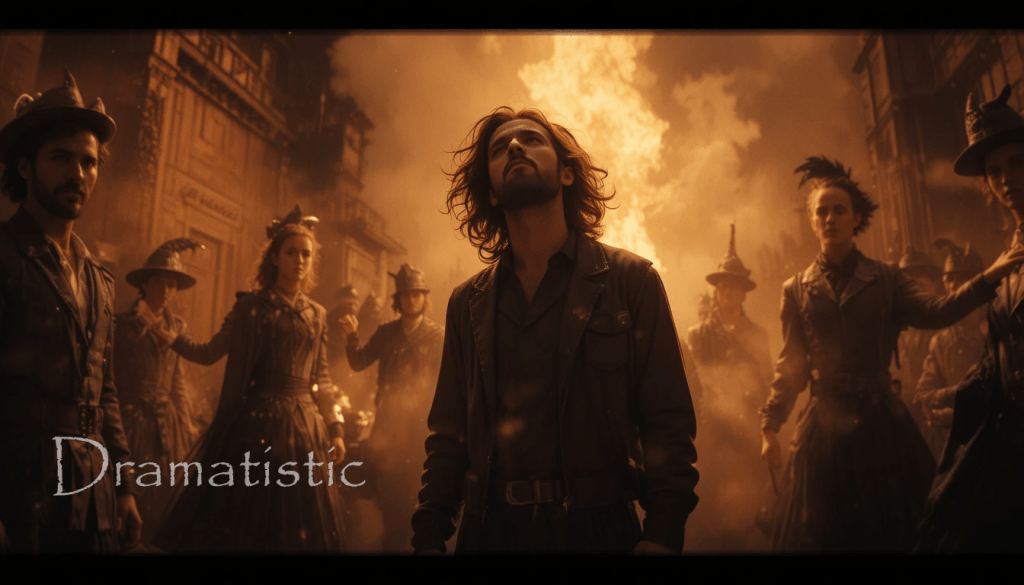
Dramatistic
IPA Pronunciation: /ˌdræməˈtɪstɪk/
Part of Speech: Adjective
Origin
First attested in English in the early 20th century, most widely associated with the terminology of rhetorical theorist Kenneth Burke, who developed dramatism—a method of understanding human action by analyzing it as though it were part of a drama.
The word extends the older term dramatic but shifts its meaning into the abstract and analytical, marking a movement from theater as performance to theater as metaphor.
Etymology
- Greek: drāma — “action, deed, play.”
- Latin: drama → adopted into English as “play, theatrical work.”
- English: dramatism → philosophical framework for interpreting human motives.
- -istic: forming adjectives meaning “relating to or characteristic of.”
Thus, dramatistic refers not simply to “dramatic” flair, but to a mode of interpreting behavior as structured like a narrative or performance, with roles, motives, scenes, and acts.
Core Definitions
- Relating to Dramatism as a Theory of Human Motivation
Concerning the idea that human behavior can be analyzed as though it were a drama with identifiable roles and purposes.
“Her analysis of political debates was thoroughly dramatistic, tracing each candidate’s role in the unfolding narrative.” - Concerning the Viewing of Events Through a Narrative or Performative Lens
Emphasizing plot, motive, scene, actor, agency, and purpose.
“The historian employed a dramatistic approach, framing the revolution as a clash of competing acts and intentions.” - Possessing a Quality Suggestive of Theoretical or Symbolic Performance
Not “dramatic” in flair or heightened emotion, but dynamic and structured like a drama.
“The negotiations took on a dramatistic form, with each side playing an archetypal part.”
Explanation & Nuance
Dramatistic should not be confused with dramatic:
- Dramatic refers to emotional intensity, theatrical display, or heightened effect.
- Dramatistic refers to interpretation, seeing actions as interlocking components of a performative structure.
Key features of dramatistic thinking include:
- Agency — how things are done.
- Act — what is done.
- Scene — where or in what context.
- Agent — who performs the act.
- Purpose — why it is done.
These elements form Burke’s famous “pentad.”
Dramatistic thought is most at home in rhetoric, sociology, psychology, literary criticism, philosophy, and political analysis—fields that explore motive and narrative.
Examples in Context
Rhetorical Analysis:
“Her paper offered a dramatistic reading of the protest, treating each chant and gesture as part of a coordinated act.”
Cultural Study:
“The critic used a dramatistic frame to explain celebrity culture, arguing that fame depends on actors, roles, and audiences.”
Political Interpretation:
“In a dramatistic sense, the debate resembled a staged confrontation, each candidate performing a carefully crafted persona.”
Psychological Insight:
“He adopted a dramatistic approach to family conflict, mapping out the unspoken roles everyone played.”
Narrative Theory:
“The memoir’s structure invites a dramatistic analysis, with each chapter marking an act in the author’s self-reinvention.”
Symbolic Dimensions
- Stage — the world conceived as a setting for human action.
- Roles — identities shaped by context and expectation.
- Narrative — events linked by motive, conflict, and resolution.
- Mask — the tension between inner motive and outer performance.
- Audience — the social world that interprets and evaluates action.
Synonyms & Related Terms
(Not strict synonyms, but conceptually adjacent)
- Narrative-analytic — focusing on story structure.
- Performative — relating to actions as expressive or role-based.
- Hermeneutic — concerned with interpretation.
- Symbolic-actional — a Burkean term for behavior as symbolic.
Dramatistic stands apart in its formal, philosophical framing of action as drama.
Cultural & Intellectual Resonance
Rhetoric & Communication Studies:
Dramatism remains a foundational analytical method, shaping how scholars interpret motives and public discourse.
Sociology & Anthropology:
Resonates with theories of social performance, ritual, and symbolic behavior (e.g., Goffman’s dramaturgy).
Literary Theory:
Useful in reading narratives in which character, motive, and setting interlock symbolically.
Political Theory:
Frames governance and campaigning as performative acts enacted before an audience.
Takeaway
Dramatistic is an interpretive lens—a way of seeing human behavior as an unfolding drama of motives, contexts, and actions.
Dramatistic
An analytic mode that views human life as performance: actions as scenes, choices as motives, and individuals as agents in the intricate theater of the world.
Curious about what happened today in history? Want to learn a new word every day?
You’ll find it all—first and in one place—at The-English-Nook.com!
If you love languages, this is your space.
Enjoy bilingual short stories, fun readings, useful vocabulary, and so much more in both English and Spanish.
Come explore!
 Word of the Day - The English Nook
Leave a comment