
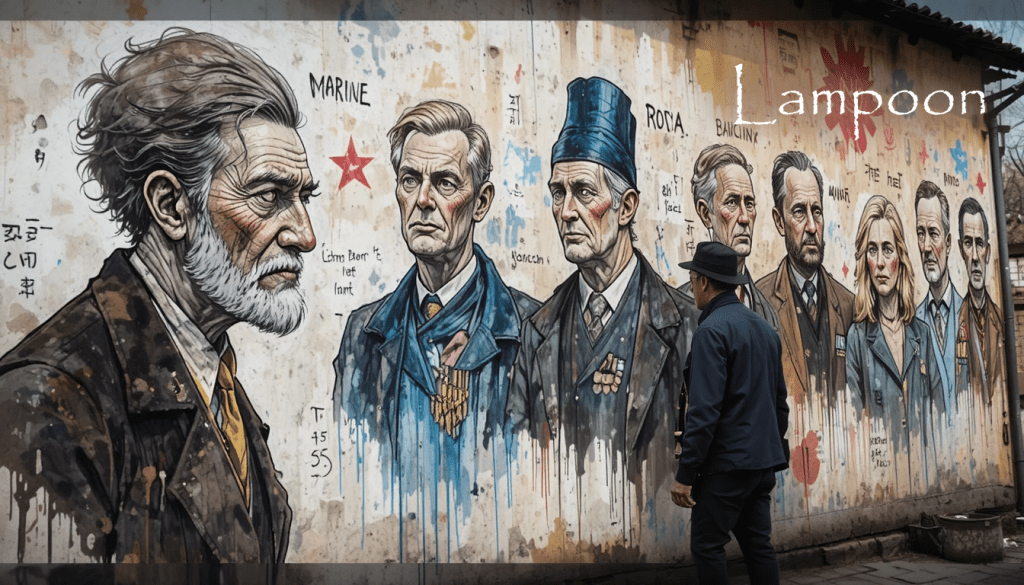
Lampoon
IPA Pronunciation: /læmˈpuːn/
Part of Speech: Noun; Verb
Origin
First attested in English in the mid-17th century, from French lampon, a term connected to a drinking refrain or satirical song.
Possibly derived from French lamper — “to gulp down drink,” implying boisterousness and rowdy mockery.
The early lampoon was a public, often sung satire, a merrily vicious ritual of ridicule.
Over time, the word came to describe any sharply humorous attack on a person, practice, or institution.
Etymology
- French: lampon — a mocking or ribald refrain.
- Verb: lamper — “to drink greedily,” suggesting raucous, unrestrained expression.
- English adoption: a move from sung satire to written or spoken mockery.
The term carries the spirit of raucous festivity blended with pointed derision.
Core Definitions
Noun
- A Sharp, Humorous Satire
A piece of writing, speech, or performance that ridicules someone or something.
“The play was a lampoon of aristocratic vanity.” - A Public Mockery or Caricature
Exaggerated criticism intended to entertain as much as to expose.
“The pamphlet—half truth, half lampoon—spread quickly through the city.”
Verb
- To Ridicule Through Satire
To attack with humorous exaggeration or biting wit.
“He lampooned the council’s grand promises in a single scathing paragraph.”
Explanation & Nuance
Lampoon belongs to the world of mockery with intent—not merely humor, but humor sharpened into a blade.
Its tone is:
- Public rather than private
- Exaggerated rather than factual
- Playful, yet often cruel
- Comic, yet pointed toward truth-telling
Where satire critiques through structure and irony, lampoon delights in the directness of derision, the gleeful exposure of folly.
Historically, lampooning was a communal act—songs sung in taverns, lines whispered in court, pamphlets pasted on walls—giving the word a hint of boisterous theatricality.
Examples in Context
Literary:
“The novel opens with a lampoon of fashionable society, each character a lightly veiled caricature of someone real.”
Political:
“His speech lampooned the administration’s contradictions, drawing both laughter and discomfort.”
Social / Humorous:
“They lampooned each other with affection, trading jests as easily as breaths.”
Cultural:
“Street artists filled the walls with lampoons of corrupt officials, their ink as fierce as their indignation.”
Media / Journalism:
“The column, equal parts truth and lampoon, became a weekly ritual of civic amusement.”
Symbolic Dimensions
- Mask — mockery that reveals by disguising.
- Mirror — distortion used to expose genuine faults.
- Carnival — the spirit of licensed mischief and inverted authority.
- Torch — satire as illumination, even when burning.
Synonyms & Related Terms
- Satire — broader, more structured critique.
- Parody — imitation for comedic effect.
- Caricature — exaggerated representation.
- Mockery — general derision without the crafted wit.
- Burlesque — humorous exaggeration, often theatrical.
Lampoon is distinct in its raucous, energetic flavor—satire with the pulse of a crowd.
Cultural & Intellectual Resonance
18th-Century Literature:
A golden age of lampoons—political pamphlets, epigrams, caricatures—used as weapons in public discourse.
Modern Comedy and Media:
Late-night shows, cartoons, memes—all descend from the lampooning tradition.
Art and Caricature:
Visual lampoons have shaped political perception for centuries, turning complex issues into instantly recognizable absurdities.
Takeaway
Lampoon is satire at its most exuberant and merciless: a dance of laughter and accusation, exposing folly through joyful exaggeration.
Lampoon
A spirited act of ridicule—half jest, half judgment—where humor becomes a mirror that distorts only to reveal what lies beneath.
Curious about what happened today in history? Want to learn a new word every day?
You’ll find it all—first and in one place—at The-English-Nook.com!
If you love languages, this is your space.
Enjoy bilingual short stories, fun readings, useful vocabulary, and so much more in both English and Spanish.
Come explore!
 Word of the Day - The English Nook
Leave a comment