
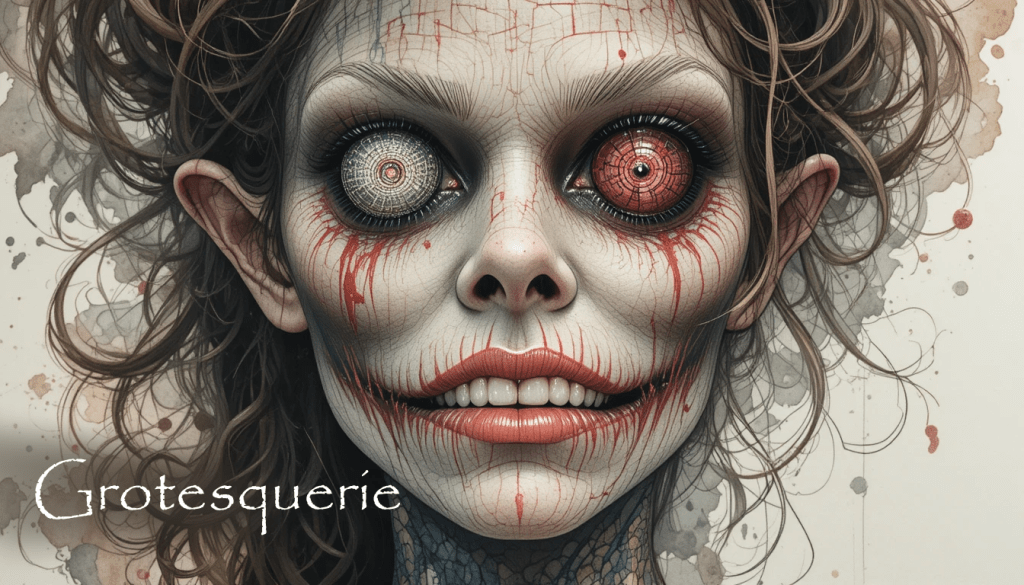
Grotesquerie
IPA Pronunciation: /ɡroʊˌtɛsˈkɛri/
Part of Speech: Noun
Origin
First recorded in English in the mid-17th century, from French grotesquerie — “something fantastically distorted,” itself derived from grotesque.
Grotesque originates from the Italian grottesca (“of a cave or grotto”), first applied to the strange hybrid figures discovered in ancient Roman subterranean ruins (thought to be grotte). These decorations mingled human, animal, and vegetal forms in surreal, dreamlike arrangements.
Thus, grotesquerie inherits a history of artistic strangeness, monstrous whimsy, and the delightful disturbance of the familiar.
Etymology
- Italian: grottesca — “cave painting; fanciful decorative motif.”
- French: grotesque → “odd, distorted, fantastical.”
- French derivative: grotesquerie → “grotesque thing; grotesque style.”
- A term evolving from specific art-historical context to broad metaphor for distortion, exaggeration, or the uncanny blending of forms.
Core Definitions
- A Grotesque Thing or Display
Something bizarrely distorted, exaggerated, or monstrous.
“The carnival revelers wore masks of such grotesquerie that children shrank from them.” - The Grotesque Style in Art or Decoration
A mode marked by fantastical, hybrid forms; the mingling of beauty and absurdity.
“The fresco was alive with grotesquerie—winged men, serpent-limbed maidens, flowers sprouting faces.” - Behavior or Situations Marked by Absurd or Macabre Exaggeration
Actions rendered ridiculous, darkly comic, or disturbingly distorted.
“The trial descended into grotesquerie—a parody of justice.” - Collective Term for Grotesque Elements
A gathering of oddities or monstrosities.
“The novel’s gallery of characters formed a parade of grotesquerie.”
Explanation & Nuance
Grotesquerie occupies a rich emotional spectrum:
- Comic distortion — the absurd made charming.
- Macabre exaggeration — the familiar made unsettling.
- Artistic hybridity — humans fused with beasts, nature with architecture.
- Moral or social critique — exposing hypocrisy through deliberate distortion.
It is the vocabulary of the in-between, the liminal space where beauty becomes strange and strangeness becomes strangely compelling.
Where the human form bends, blends, or breaks into surreal shapes.
Where reality slips, exaggerates, or mutates.
In literature, it may describe characters whose features or behaviors are heightened to reveal hidden truths.
In politics or society, it names the moment when earnest proceedings tip into absurdity.
Examples in Context
Artistic / Visual:
“The ceiling was a riot of grotesquerie—birds with human faces, vines that curled into grinning mouths.”
Literary:
“The author’s grotesquerie served as critique; through caricature, he revealed the vices of the age.”
Atmospheric / Descriptive:
“A grotesquerie of shadows danced across the alley, twisting into shapes that defied sense.”
Social / Satirical:
“The campaign season unfolded in wild grotesquerie, each speech stranger than the last.”
Humorous:
“She decorated for Halloween with delightful grotesquerie—monsters so ridiculous they inspired laughter.”
Symbolic Dimensions
- Mask — the concealment that reveals through distortion.
- Hybrid Creature — mixing categories to unsettle or amuse.
- Grotto / Cave — origins in darkness, mystery, and rediscovery.
- Caricature — exaggeration as truth-telling.
- Labyrinth — twisting forms that resist orderly meaning.
Synonyms & Related Terms
- Grotesque — the root concept; more general.
- Caricature — exaggerated features for comic or critical effect.
- Monstrosity — suggests horror rather than whimsy.
- Macabre — darker, death-related grotesquerie.
- Bizarre — strange but not necessarily distorted or hybridized.
- Freakishness — physical abnormality; less artistic.
Grotesquerie uniquely blends the comic, the uncanny, and the artistic—distortion with imagination.
Cultural & Intellectual Resonance
Renaissance Art:
The grotesque motif flourished in frescoes, scrollwork, and decorative borders—celebrations of the fantastical.
Gothic and Baroque Literature:
Used to evoke the uncanny, the distorted mirror of human vice or vulnerability.
Romanticism & Victorian Gothic:
Grotesquerie becomes psychological—manifesting fear, repression, or moral corruption.
Modernism & Surrealism:
A tool of rebellion against realism, logic, and conventional beauty.
Contemporary Culture:
Seen in graphic novels, dark comedy, political satire, and speculative fiction.
Takeaway
Grotesquerie is the art of imaginative distortion—the marvelous mingling of the comic and the horrific, the beautiful and the bizarre.
It names the space where forms twist, meanings blur, and creativity disrupts the comfortable order of the world.
Grotesquerie
A dance of the strange and the sublime—where reality bends into oddity, and beauty emerges from the fantastic distortions of the human imagination.
Curious about what happened today in history? Want to learn a new word every day?
You’ll find it all—first and in one place—at The-English-Nook.com!
If you love languages, this is your space.
Enjoy bilingual short stories, fun readings, useful vocabulary, and so much more in both English and Spanish.
Come explore!
 Word of the Day - The English Nook
Leave a comment