
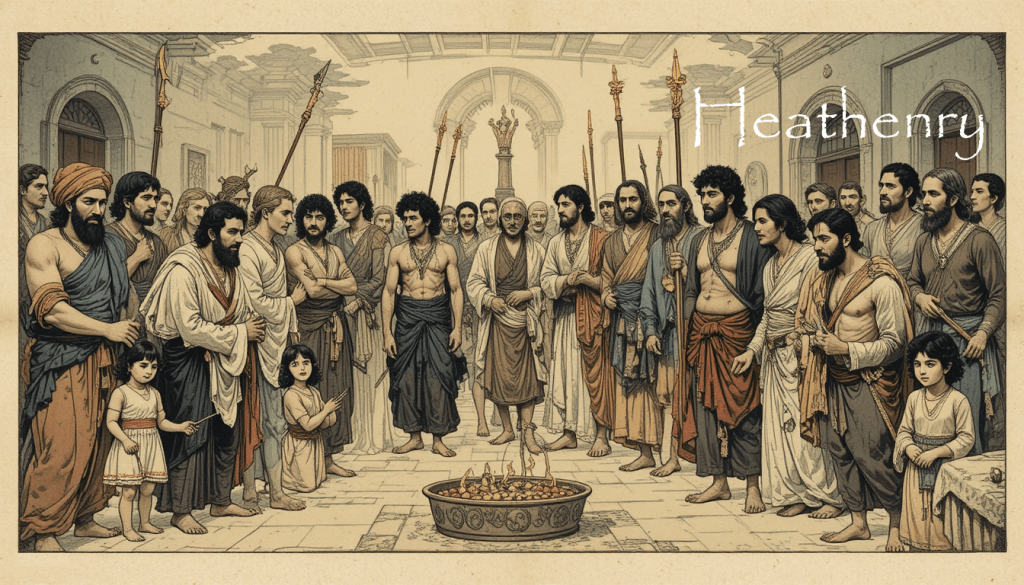
Heathenry
IPA Pronunciation: /ˈhiːðənri/
Part of Speech: Noun
Origin
First attested in English in the 12th century, from Old English hǣðenra and hǣðenrīce — “the state or practice of being heathen,” derived from hǣðen (“pagan, non-Christian”), itself related to hǣþ (“heath, uncultivated land”).
Originally denoting those who lived “on the heath” or outside settled Christian communities, the term evolved to refer broadly to pre-Christian or non-Christian belief systems, particularly in northern Europe.
Rooted ultimately in the Proto-Germanic base haiþinaz — “dweller on the heath,” which may reflect both geography and cultural separation.
Etymology
- Old English: hǣðen → “pagan, non-Christian.”
- Old Norse: heiðinn → “heathen; belonging to the old gods.”
- Proto-Germanic: haiþinaz → “heath-dweller.”
- Suffix: -ry → forming collective nouns indicating a state, practice, or system.
The word carries both historical and religious implications: a spiritual world outside, beyond, or before Christian boundaries.
Core Definitions
- The Practice or Belief System of a Heathen Religion
Often referring to pre-Christian or polytheistic traditions, especially those of Germanic or Norse heritage.
“Modern practitioners of Heathenry honor the old gods once revered in northern Europe.” - Collective Term for Pagan Customs or Ways of Life
Describing cultural practices rooted in ancient or non-Christian traditions.
“The festival preserved the remnants of local Heathenry, long woven into rural ritual.” - Historically: The Condition of Being Outside the Christian Faith
A term once used broadly and sometimes pejoratively to classify non-Christian peoples.
“Medieval chronicles describe distant lands as regions steeped in Heathenry.”
Explanation & Nuance
Heathenry blends geography, culture, and religion.
Its earliest meaning reflects a world divided by belief: those within the church and those who lived “out on the heath,” beyond the circle of conversion.
Over centuries, the word gathered multiple shades:
- Neutral or historical — describing pre-Christian traditions.
- Cultural — naming the folkways, rituals, and cosmologies of northern European peoples.
- Revived and reclaimed — in modern contexts, identifying contemporary practitioners of Germanic paganism (e.g., Ásatrú, Forn Sed).
- Pejorative (historically) — used by Christian writers to denote “outsiders.”
In its modern usage, the term has regained dignity: a deliberate, thoughtful revival of ancestral practice.
Examples in Context
Historical:
“Archaeologists uncovered artifacts linked to Heathenry in the burial mounds along the river.”
Modern Religious:
“Heathenry today encompasses diverse paths, from god-honoring rites to nature-based spirituality.”
Cultural:
“Seasonal festivals preserved in remote villages still echo the rhythms of ancient Heathenry.”
Literary / Descriptive:
“The saga’s world is steeped in Heathenry — a cosmos alive with spirits, gods, and fateful bonds.”
Critical / Sociological:
“The term ‘Heathenry’ reveals as much about medieval Christian perspective as it does about the practices it sought to describe.”
Symbolic Dimensions
- Heath / Moorland – wild land, boundary, the world beyond settlement.
- Fire – ritual, offering, continuity.
- Tree / Wood – sacred groves, cosmological pillars.
- Ancestry – lineage, memory, and sacred obligation.
- Gods and Wights – beings of earth, sky, and fate.
Synonyms & Related Terms
- Paganism – broad term for polytheistic or non-Abrahamic traditions.
- Polytheism – belief in multiple deities.
- Folk Religion – community-rooted, pre-institutional belief.
- Ásatrú / Heathen Practice – modern revivals of Germanic pagan traditions.
- Old Ways – poetic term for ancestral spiritual paths.
(Heathenry is more specific than paganism — grounded in Germanic cultural and spiritual heritage.)
Cultural & Intellectual Resonance
Medieval Europe:
The word shaped the boundary between Christian and non-Christian realms, becoming both theological classification and cultural marker.
Folklore & Anthropology:
Heathenry embodies the continuity of belief long after official conversion — in charms, seasonal rites, and rural myth.
Modern Pagan Revival:
Reclaimed as a living spiritual identity, emphasizing connection to ancestors, land, and traditional cosmology.
Literature & Myth:
Epic narratives and sagas draw heavily on Heathen imagery: fate, honor, gods woven into daily life.
Takeaway
Heathenry evokes a world rooted in ancestral memory — a tapestry of gods, land, ritual, and story that predates or stands apart from Christian tradition.
It is both a historical inheritance and, for many, a living path: the spiritual language of the wild places, the hearth of ancient belief.
Heathenry
The practice, heritage, or worldview rooted in pre-Christian traditions—born of the wild heath, shaped by ancestral rites, and sustained in myth, ritual, and renewed devotion.
Curious about what happened today in history? Want to learn a new word every day?
You’ll find it all—first and in one place—at The-English-Nook.com!
If you love languages, this is your space.
Enjoy bilingual short stories, fun readings, useful vocabulary, and so much more in both English and Spanish.
Come explore!
 Word of the Day - The English Nook
Leave a comment