
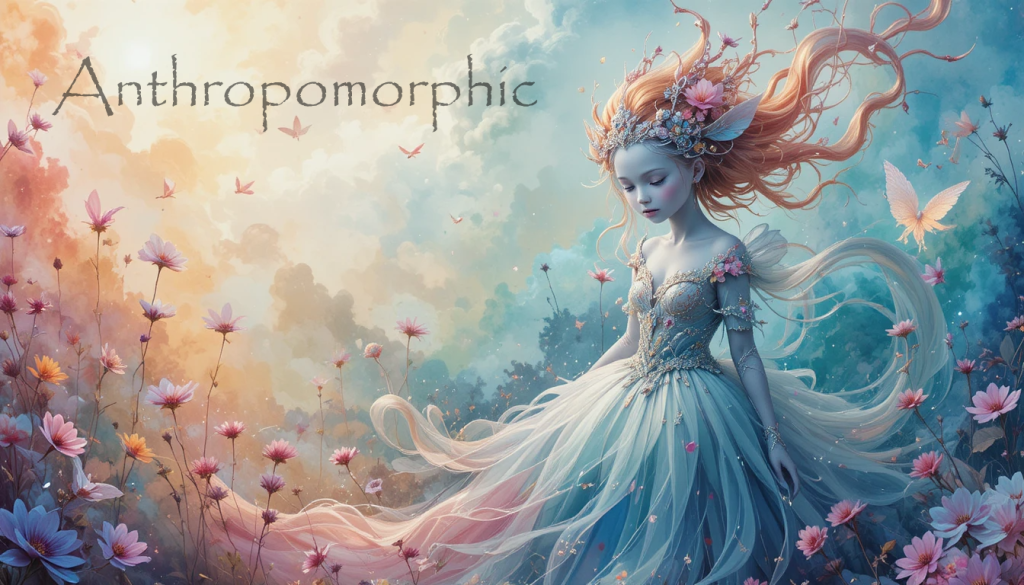
Anthropomorphic
IPA Pronunciation: /ˌænθrəpəˈmɔːrfɪk/
Part of Speech: Adjective
Origin
First attested in English in the early 18th century, from Greek anthrōpomorphos — “in the form of a human,” from anthrōpos (“human being”) + morphē (“shape, form”).
The term arose within philosophical, artistic, and theological discourse, naming humanity’s deep habit of imagining the world in its own likeness.
Rooted ultimately in the Proto-Indo-European base manu- (“human, person”) and mer- (“to form, to shape”).
Etymology
- Greek: anthrōpos → “human, person.”
- Greek: morphē → “shape, form, appearance.”
- Greek: anthrōpomorphos → “having human form.”
- Modern Latin / French: anthropomorphique → adopted into English philosophical vocabulary.
The word signifies the projection of human qualities onto nonhuman beings or forces, uniting imagination with interpretation.
Core Definitions
- Ascribing Human Traits or Emotions to Nonhuman Entities
Giving objects, animals, or abstract forces human feelings, desires, or intentions.
“The storm seemed almost angry — an anthropomorphic reading of the clouds.” - Representing Nonhuman Beings in Human Form
Artistic or symbolic depiction of gods, animals, or spirits as humanlike.
“Ancient statues often portray deities in anthropomorphic shapes.” - Interpreting the World Through Human-Centered Assumptions
Understanding nature or technology through the lens of human experience.
“Our anthropomorphic descriptions of artificial intelligence reveal more about us than about machines.”
Explanation & Nuance
To describe something as anthropomorphic is to acknowledge an ancient human instinct:
to see ourselves in everything.
This mental habit can be:
- Artistic, shaping mythological and religious imagery.
- Psychological, revealing our tendency to empathize with the nonhuman.
- Philosophical, raising questions about how we interpret the world.
- Scientific, warning against reading human motives into animal behavior.
Anthropomorphism bridges the divide between self and other — granting familiarity to the unfamiliar, meaning to the mute, and personality to the impersonal.
But it can also mislead, giving intention where there is none, or narrowing the world to our own likeness.
Examples in Context
Mythological:
“In many cultures, the sun is an anthropomorphic figure — a god with a face, a journey, and a will.”
Literary:
“The forest whispers and sighs, its trees bending like mourners — an anthropomorphic voice woven into the narrative.”
Scientific Observation:
“To call the fox ‘cunning’ is an anthropomorphic projection of human strategy onto instinctual behavior.”
Technological:
“Robots with expressive ‘faces’ invite anthropomorphic responses, making users trust them more.”
Philosophical / Critical:
“Our anthropomorphic metaphors shape how we conceive nature — often turning ecosystems into moral tales.”
Symbolic Dimensions
- Mirror – reflecting ourselves in the nonhuman world.
- Mask – giving human features to forces beyond comprehension.
- Gesture – the human body as a template for meaning.
- Story – narrative as a bridge between the living and the inanimate.
- Soul – the attribution of inner life to what may have none.
Synonyms & Related Terms
- Personified – represented as a person or given personal traits.
- Anthropocentric – centered on human perspective, though not necessarily granting human form.
- Humanized – made to seem human in character or feeling.
- Zoomorphism (contrast) – giving human traits an animal form, or vice versa.
(Among these, Anthropomorphic is the most technical and comprehensive — encompassing both representation and interpretation.)
Cultural & Intellectual Resonance
Ancient Religion: Gods shaped in human likeness to make the divine comprehensible.
Fables and Folklore: Animals endowed with human voices to teach moral lessons.
Art and Sculpture: Human form as the universal language of expression.
Psychology and Cognitive Science: Anthropomorphism as a survival instinct — empathy extended outward.
Modern Technology: Voice assistants, robots, and algorithms provoke humanlike expectations and emotions.
Wherever human imagination meets the unknown, the anthropomorphic impulse follows.
Takeaway
Anthropomorphic names the human tendency to cast the world in our own image — to give voice to silence, intention to nature, and form to the formless.
It is both a creative gesture and a caution: a bridge between understanding and illusion.
Curious about what happened today in history? Want to learn a new word every day?
You’ll find it all—first and in one place—at The-English-Nook.com!
If you love languages, this is your space.
Enjoy bilingual short stories, fun readings, useful vocabulary, and so much more in both English and Spanish.
Come explore!
 Word of the Day - The English Nook
Leave a comment