
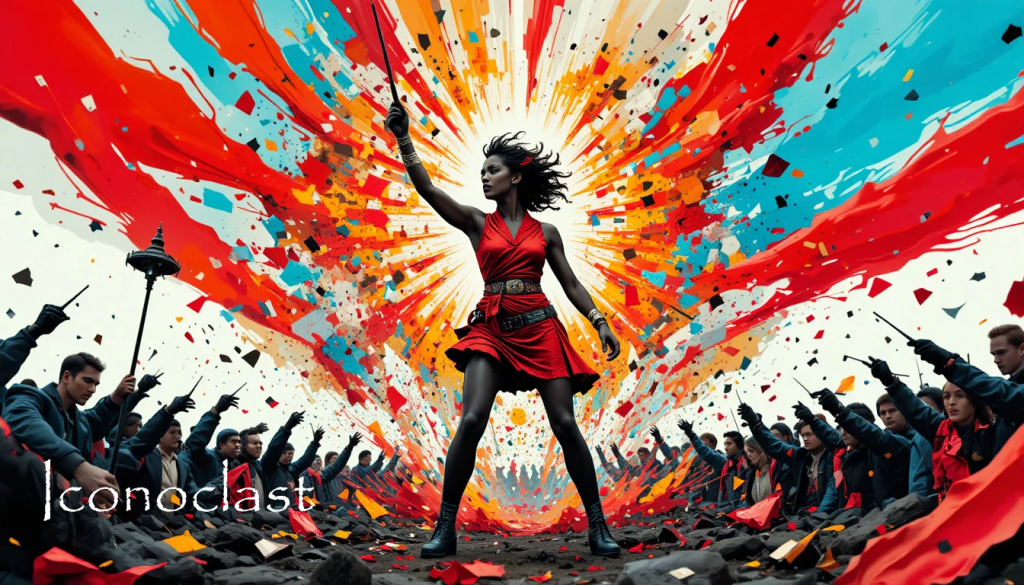
Iconoclast
IPA Pronunciation: /aɪˈkɒnəˌklæst/
Part of Speech: Noun
Origin
First attested in English in the mid-17th century, from Middle Greek eikonoklastēs — “image-breaker,” from eikōn (“image, likeness”) + klan (“to break”).
The term originally referred to those who destroyed religious images during the Byzantine Iconoclasm (8th–9th centuries), a theological revolt against the veneration of icons.
Over time, iconoclast moved beyond its literal meaning to describe anyone who challenges cherished beliefs, institutions, or symbols — one who shatters the sacred idols of convention.
Etymology
- Greek: eikōn → “image, likeness, representation.”
- Greek: klan (κλάω) → “to break, to shatter.”
- Byzantine Greek: eikonoklastēs → “destroyer of images.”
- Latin / French: iconoclaste → entered English through theological discourse.
Thus, the word carries both physical and metaphorical weight: the breaking of images, and the breaking of ideas.
Core Definitions
- Destroyer of Religious Images
Historically, one who opposed or defaced icons or sacred representations.
“The iconoclasts stormed the cathedral, tearing down the painted saints.” - One Who Attacks Established Beliefs or Institutions
A critic of social, political, or cultural orthodoxy.
“Every generation breeds its iconoclasts — those unwilling to bow before inherited certainties.” - A Challenger of Tradition or Reverence
A person who delights in questioning what others hold sacred, not out of cynicism but conviction.
“The iconoclast does not merely mock the temple; he demands to know why it was built.”
Explanation & Nuance
The iconoclast stands at the crossroads of faith and doubt, creation and destruction.
To break an idol is not only to destroy, but to clear space for truth.
In religion, the term once signified heresy — the denial of divine mediation through art.
In modern thought, it has become a mark of intellectual courage, even rebellion — the refusal to accept inherited dogma.
Yet the iconoclast’s energy is double-edged:
- At best, a reformer, breaking false images to reveal what is real.
- At worst, a nihilist, tearing down meaning itself.
Thus, every iconoclast must wrestle with what to build in the place of what was broken.
Examples in Context
Historical / Religious:
“During the Byzantine Iconoclasm, iconoclasts believed that holy images corrupted the purity of faith.”
Philosophical:
“Nietzsche was an iconoclast of morality, shattering the inherited idols of good and evil.”
Cultural:
“Modern art was born from iconoclasts who refused to paint by the rules of beauty.”
Political:
“The reformer’s zeal often verges on the iconoclastic — a vision too radical for the age that conceives it.”
Personal / Psychological:
“She was an iconoclast of her own history, unlearning the myths she had once lived by.”
Symbolic Dimensions
- Hammer – destruction as revelation; force that unmasks illusion.
- Fire – purification through annihilation.
- Mirror – the shattering of reflection, breaking the false image of self or world.
- Temple – the locus of reverence, the stage for revolt.
- Light – illumination that follows the act of breaking.
Synonyms & Related Terms
- Heretic – one who opposes religious orthodoxy.
- Rebel – one who resists authority or control.
- Maverick – independent thinker refusing convention.
- Skeptic – one who questions accepted truth.
- Revisionist – one who reinterprets established narratives.
(Among these, Iconoclast bears the most vivid imagery — not just of dissent, but of striking through the very symbols of belief.)
Cultural & Intellectual Resonance
Theology: Once a term of condemnation, denoting blasphemy and desecration.
Enlightenment Thought: Became a badge of rational critique — the thinker as destroyer of superstition.
Romanticism & Modernism: Adopted as a figure of artistic rebellion; the poet or painter as breaker of inherited forms.
Contemporary Culture: Now applied broadly — to innovators, critics, and disruptors who question authority in science, politics, or art.
In every era, the iconoclast reappears — not merely to break, but to demand the renewal of vision.
Takeaway
Iconoclast names both a spirit and a gesture: the courage to confront the untouchable, to strike at the image that has grown too sacred to question.
It is a word of violence and of vision — the breaking of illusion in the name of a deeper truth.
Curious about what happened today in history? Want to learn a new word every day?
You’ll find it all—first and in one place—at The-English-Nook.com!
If you love languages, this is your space.
Enjoy bilingual short stories, fun readings, useful vocabulary, and so much more in both English and Spanish.
Come explore!
 Word of the Day - The English Nook
Leave a comment