
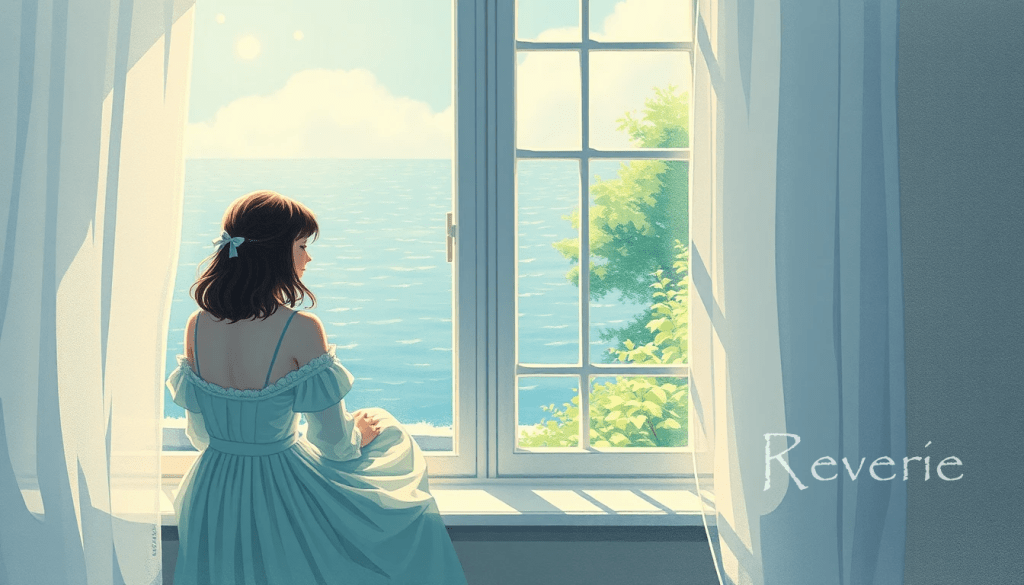
Reverie
IPA Pronunciation: /ˈrɛvəri/
Part of Speech: Noun
Origin
First attested in English in the 14th century, from Middle French resverie — “wild speech, delirium, daydream,” derived from resver (later rêver), meaning “to dream, to wander in thought,” itself of uncertain origin, possibly from Old French resver — “to roam, stray, rave.”
Originally denoting delirium or wandering of the mind, reverie evolved into a gentler meaning: the free drift of thought, the soul’s quiet meandering through inner landscapes.
Etymology
- Old French: resver → “to wander, rave, drift in mind.”
- Middle French: resverie / rêverie → “daydream, fanciful musing.”
- Modern French: rêver → “to dream.”
The word thus carries both ancient wildness and later calm — a journey from madness to imagination, from rapture to reflection.
Core Definitions
- A State of Being Lost in Thought or Daydream
A quiet drift of the mind, often accompanied by pleasure, nostalgia, or creative vision.
“She sat by the window in reverie, her mind adrift among half-remembered summers.” - An Abstracted or Dreamlike Meditation
A mood of inward absorption, where the boundary between thought and dream dissolves.
“His music unfolds like a reverie — no clear beginning or end, only motion within stillness.” - A Dream or Vision of Fancy (poetic)
A delicate construction of imagination; a waking dream of beauty, desire, or memory.
“The painting is a reverie in blue, a vision too soft for waking.”
Explanation & Nuance
- Reverie is the mind unmoored, floating freely through imagination or memory.
- It is not distraction but deliberate surrender — a form of attentive drifting, where the self dissolves into image and sensation.
- The tone of the word is gentle, luminous, and introspective — far removed from its earlier sense of wild or frenzied thought.
- A reverie may arise from solitude, music, twilight, or silence — moments when consciousness loosens its grip, and the world becomes interior.
- In art and philosophy, it represents the contemplative imagination — thought that dreams, and dreaming that thinks.
Examples in Context
Poetic / Reflective:
“She walked along the river in reverie, her mind painting worlds upon the water’s slow glass.”
Artistic / Musical:
“The composer’s nocturne unfolds as a reverie — a drifting dialogue between silence and sound.”
Psychological:
“In reverie, the boundaries of the self dissolve, and memory becomes landscape.”
Romantic / Emotional:
“The letter drew him into a reverie of what might have been, tender as moonlight on closed eyes.”
Philosophical:
“Reverie is thought released from purpose — the mind dreaming itself.”
Symbolic Dimensions
- Water – flowing thought, fluid imagination.
- Wind – movement without direction; the spirit wandering.
- Mirror – reflection and illusion intertwined.
- Twilight – border between wakefulness and dream.
- Silence – the soft space where imagination stirs.
Synonyms & Related Terms
- Daydream – lighter, often whimsical wandering of the mind.
- Recollection – memory in focus, rather than drift.
- Meditation – disciplined reflection, purposeful and calm.
- Fantasy – imaginative creation, more vivid and elaborate.
- Contemplation – still, thoughtful observation.
(Among these, Reverie alone unites softness and mystery — it is the dream one knows and does not know one is dreaming.)
Cultural & Intellectual Resonance
- Romanticism: Reverie became central to Romantic art and poetry — the inward turn toward imagination as truth, the dream as revelation.
- Rousseau’s “Rêveries du promeneur solitaire” (Reveries of the Solitary Walker): The archetype of philosophical reverie — meditation through wandering, thought dissolving into nature.
- Music & Painting: Used to title works that evoke tranquility and dreamlike emotion — Debussy’s Rêverie, Monet’s twilight scenes.
- Psychoanalysis: Reverie describes the mind’s spontaneous imagery — the raw material of unconscious life.
- Modern Usage: Suggests calm introspection, artistic absorption, or quiet detachment from the rush of time.
Takeaway
Reverie is the mind’s gentle drift, the soul’s way of remembering what the waking world forgets.
It is neither dream nor thought, but the twilight between them — where imagination becomes a form of breathing, and memory turns luminous.
To enter reverie is to move inward toward stillness, where the self, for a moment, becomes infinite.
Reverie
A tranquil drifting of the mind into imagination or memory; the tender dream of wakefulness — thought set free to wander the luminous landscapes within.
Curious about what happened today in history? Want to learn a new word every day?
You’ll find it all—first and in one place—at The-English-Nook.com!
If you love languages, this is your space.
Enjoy bilingual short stories, fun readings, useful vocabulary, and so much more in both English and Spanish.
Come explore!
 Word of the Day - The English Nook
Leave a comment